After failing a JLPT mock test, do not retake another test immediately. Review within 48 hours, classify every wrong answer by root cause, rebuild the weak skill for 7 days, then retest only that section. The fastest score gains come from fixing repeated mistake types, not from collecting more mock scores.
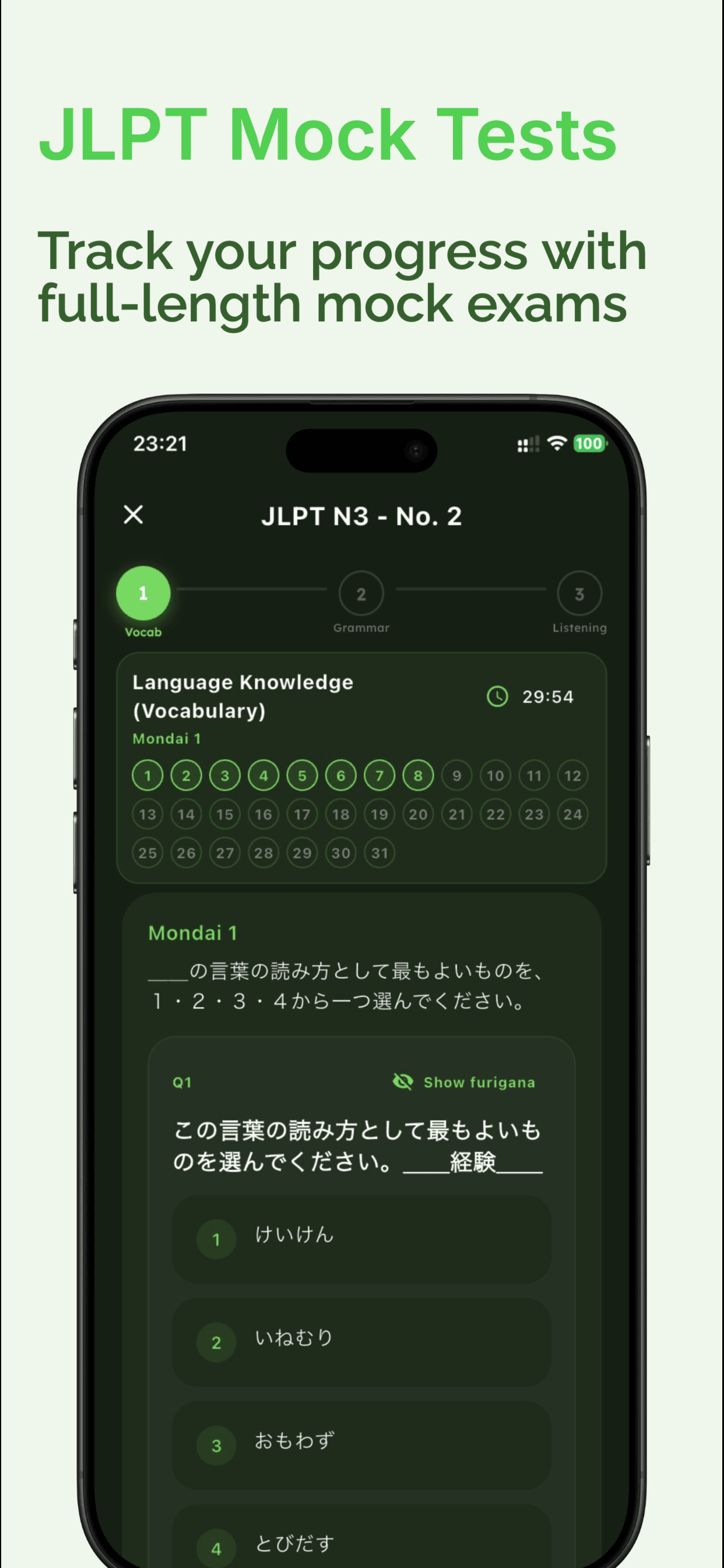
Mock tests hurt because they remove excuses. You either finish on time or you do not. You either recognize the grammar or you guess. You either understand the listening cue or it disappears. But the score itself is not the important part. The mistake pattern is.
The Biggest Mock-Test Mistake
The most common mistake is taking another mock test too soon. This feels productive, but it usually trains panic. A mock test is a diagnostic tool. If you do not repair the diagnosis, the next mock only confirms the same weakness.
The 7 Mistake Categories
After the test, put every wrong answer into one of these buckets:
| Category | Symptom | Fix |
|---|---|---|
| Vocabulary gap | You did not know the word | Add to SRS with example sentence |
| Kanji reading | You knew the meaning but missed the reading | Review onyomi/kunyomi in compounds |
| Grammar pattern | You recognized words but missed the structure | Study pattern + cloze drills |
| Sentence parsing | You lost the main verb or subject | Mark particles and final predicate |
| Time pressure | You understood but too slowly | Timed short passages |
| Listening cue | You missed correction, contrast, or final answer | Transcript replay + shadow key lines |
| Distractor logic | You chose a true-but-wrong option | Underline exact evidence |
Example: Grammar Mistake Log
Suppose the answer depended on this sentence:
雨が降ったにもかかわらず、試合は行われました。
あめがふったにもかかわらず、しあいはおこなわれました。
Despite the rain, the match was held.
If you chose an answer meaning because it rained, the match was canceled, the issue was not vocabulary. The key grammar was にもかかわらず (despite / even though). Your log should say: N2 concession grammar, contrast relation, not cause-effect.
Example: Listening Mistake Log
JLPT listening loves correction. A speaker often says one thing, then changes it:
三時にしましょう。あ、すみません、三時半のほうがいいです。
さんじにしましょう。あ、すみません、さんじはんのほうがいいです。
Let’s make it three. Ah, sorry, three-thirty would be better.
The answer is not the first time you hear. It is the corrected time. Your log should say: missed self-correction cue: あ、すみません / のほうがいい.
The 48-Hour Review Schedule
- Hour 0: Finish the mock. Record score, time left, and emotional state.
- Hour 1: Mark all wrong and guessed questions. Guessed-correct counts as weak.
- Hour 2: Classify mistake categories. Do not study yet.
- Hour 24: Review your top two categories only.
- Hour 48: Redo wrong questions without looking at answers.
One Week Before Retesting
For the next seven days, do targeted repair:
- Vocabulary: 20 new weak words, SRS review daily.
- Grammar: 5 patterns, 10 cloze sentences each.
- Reading: 3 short passages under time.
- Listening: replay transcript lines until you can predict the answer cue.
- Mock JLPT: retest only the weak section, not the whole exam.
How Kanjijo Fits the Review Loop
Kanjijo is useful after a mock because it does not isolate the test from study. A wrong reading question can send you back to reading practice. A missed grammar pattern can be reviewed in grammar lessons. Unknown vocabulary goes into SRS with mnemonics. Listening mistakes can be repaired with native audio and transcripts. OCR scanning lets you keep training from real Japanese signs, books, menus and manga outside the test.
Frequently Asked Questions
No. A low mock score early enough is useful. It gives you a map of what to fix before the real test.
Review guessed-correct answers and slow answers. Fully confident correct answers can be skipped unless you are close to test day.
Three to five full mocks are enough for many learners if each one is reviewed deeply. Section drills can be more frequent.