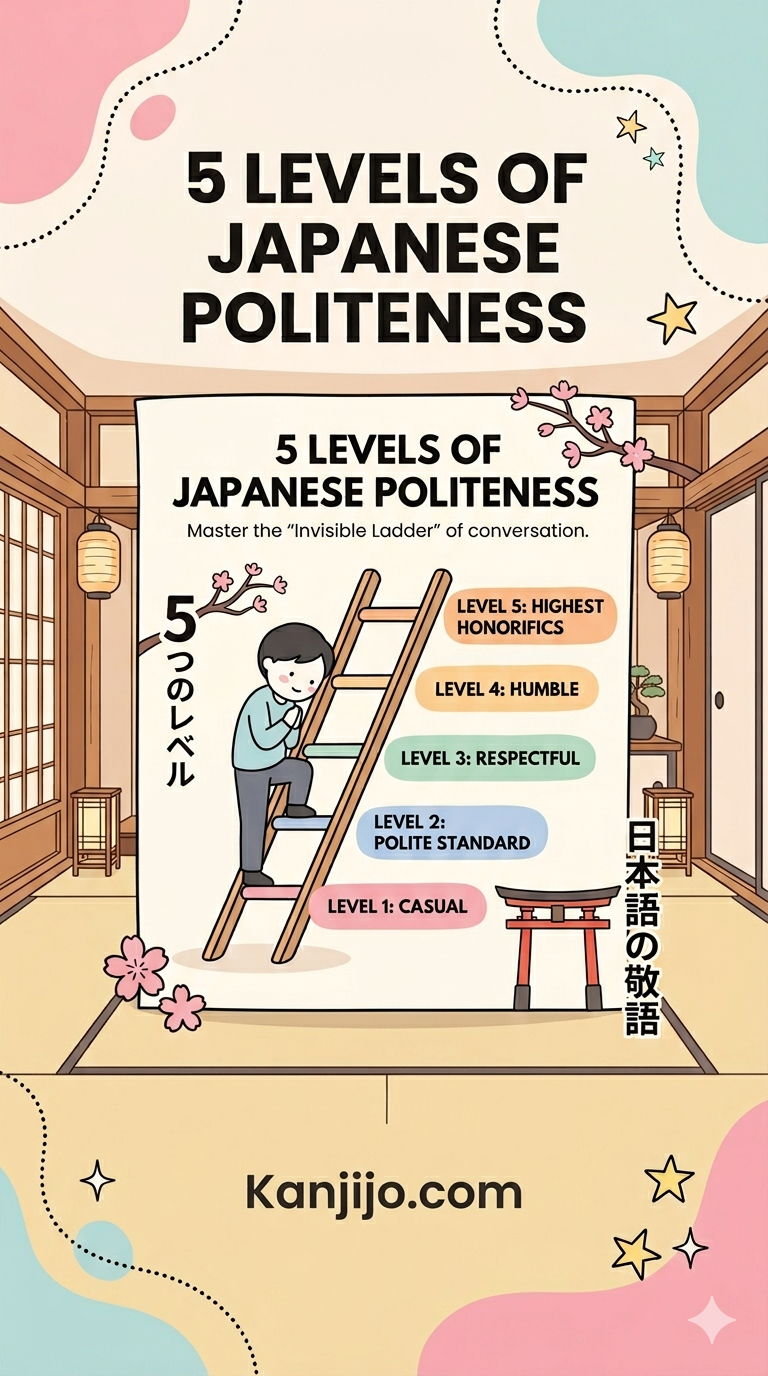
Japanese doesn’t just have “formal” and “informal.” It has a full spectrum of politeness levels, and choosing the wrong one sends a stronger signal than choosing the wrong word. Understanding these five levels transforms your Japanese from textbook-correct to socially aware.
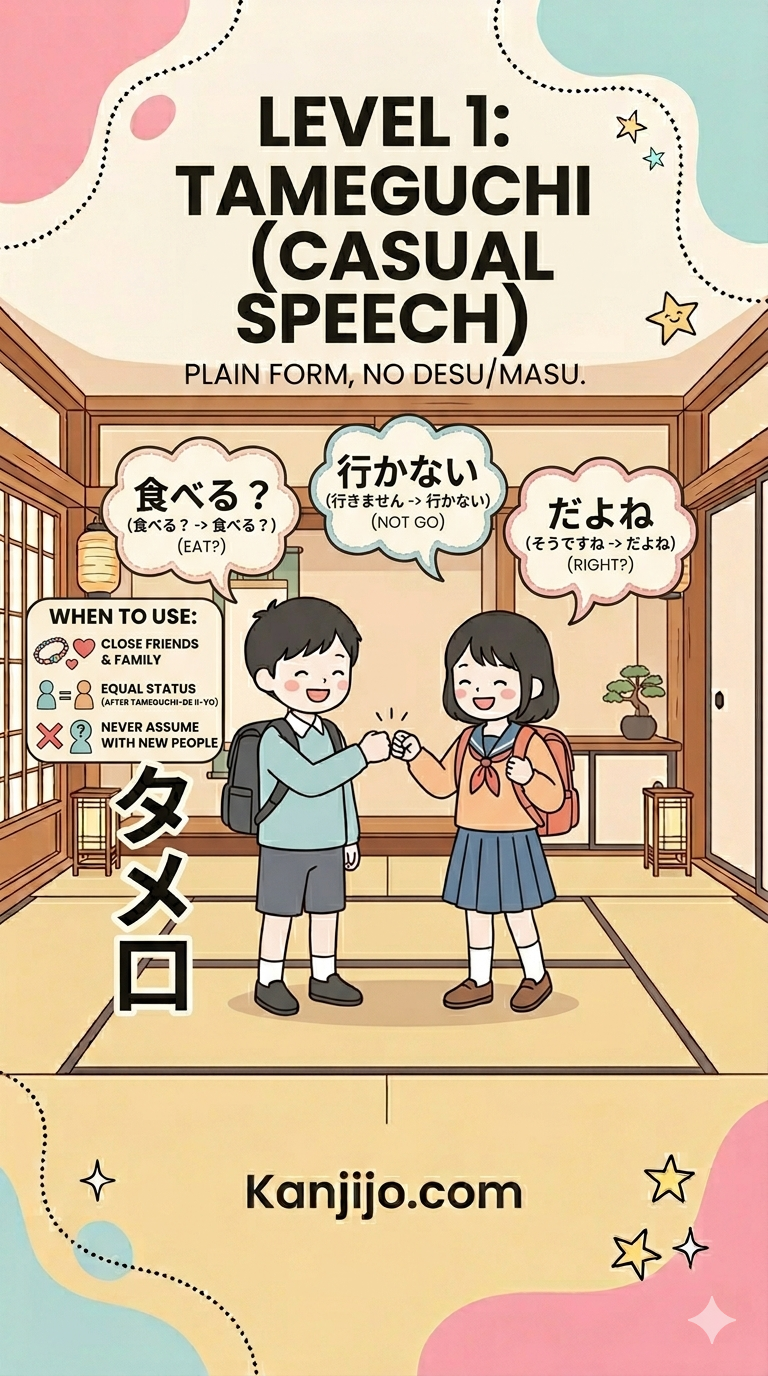
Level 1: タメ口 (Tameguchi) - Casual Speech
Plain form, no です/ます. Used between close friends, family, and people of equal status who have an established relationship.
| Standard | タメ口 | Notes |
|---|---|---|
| 食べますか? | 食べる? | Dropping ます and か |
| 行きません | 行かない | Plain negative |
| そうですね | だよね | Casual agreement |
| 知りません | 知らない | Plain form |
| すみません | ごめん | Casual apology |
When to use: Only with people who have explicitly or implicitly signaled that casual speech is okay. In Japan, this usually happens gradually - a friend might say “タメ口でいいよ” (casual speech is fine) or simply start using it themselves. Never assume you can use タメ口 with someone you just met.
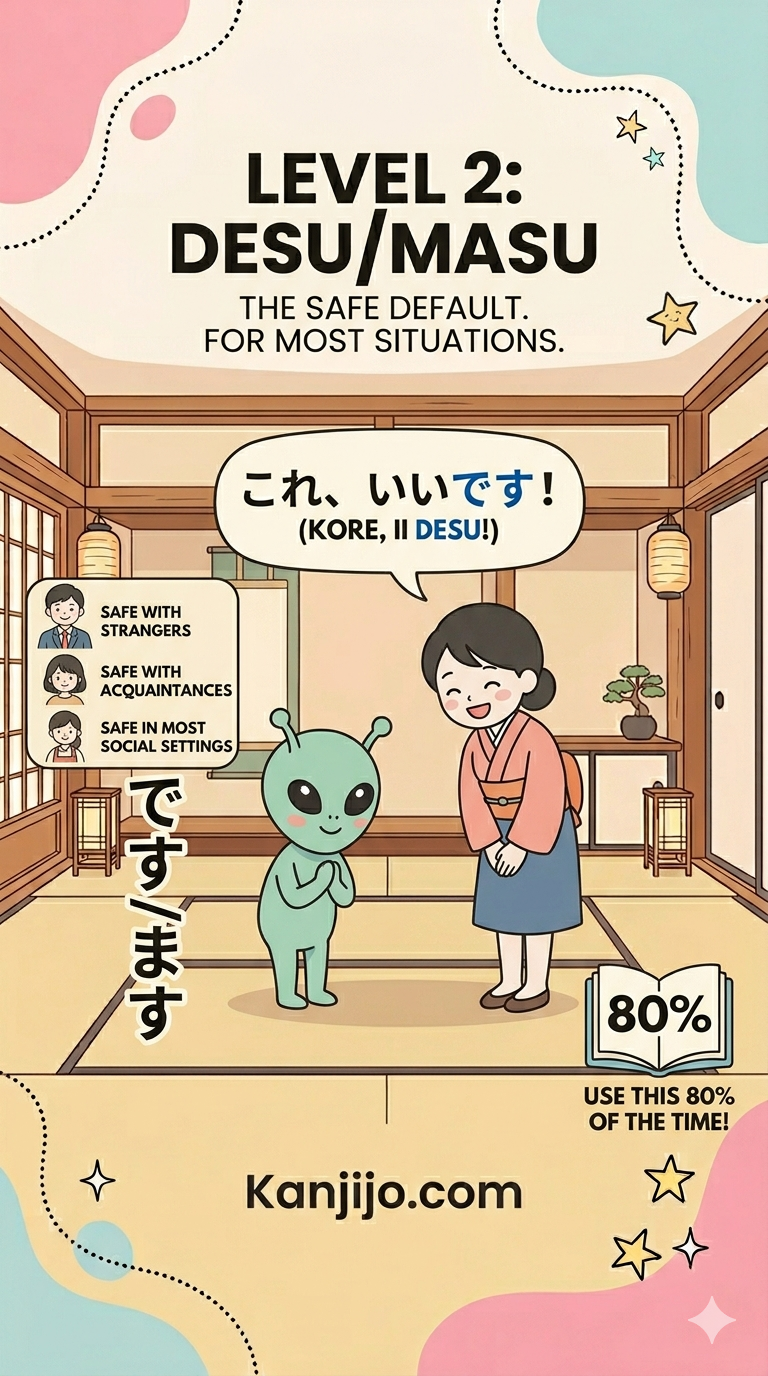
Level 2: です/ます (Desu/Masu) - Polite Standard
The “default” level for daily life. Safe with strangers, coworkers, acquaintances, and most social situations.
| Casual | です/ます Form | Situation |
|---|---|---|
| これ、いい | これ、いいです | Shopping, light conversation |
| わかった | わかりました | Acknowledging instructions |
| ちょっと待って | 少々お待ちください | Asking someone to wait |
| 何? | 何ですか? | Asking a question |
The safe default: When in doubt, use です/ます. It is never offensive, never too casual, and shows basic social awareness. Textbooks teach this level first because it works in 80% of real-life situations.
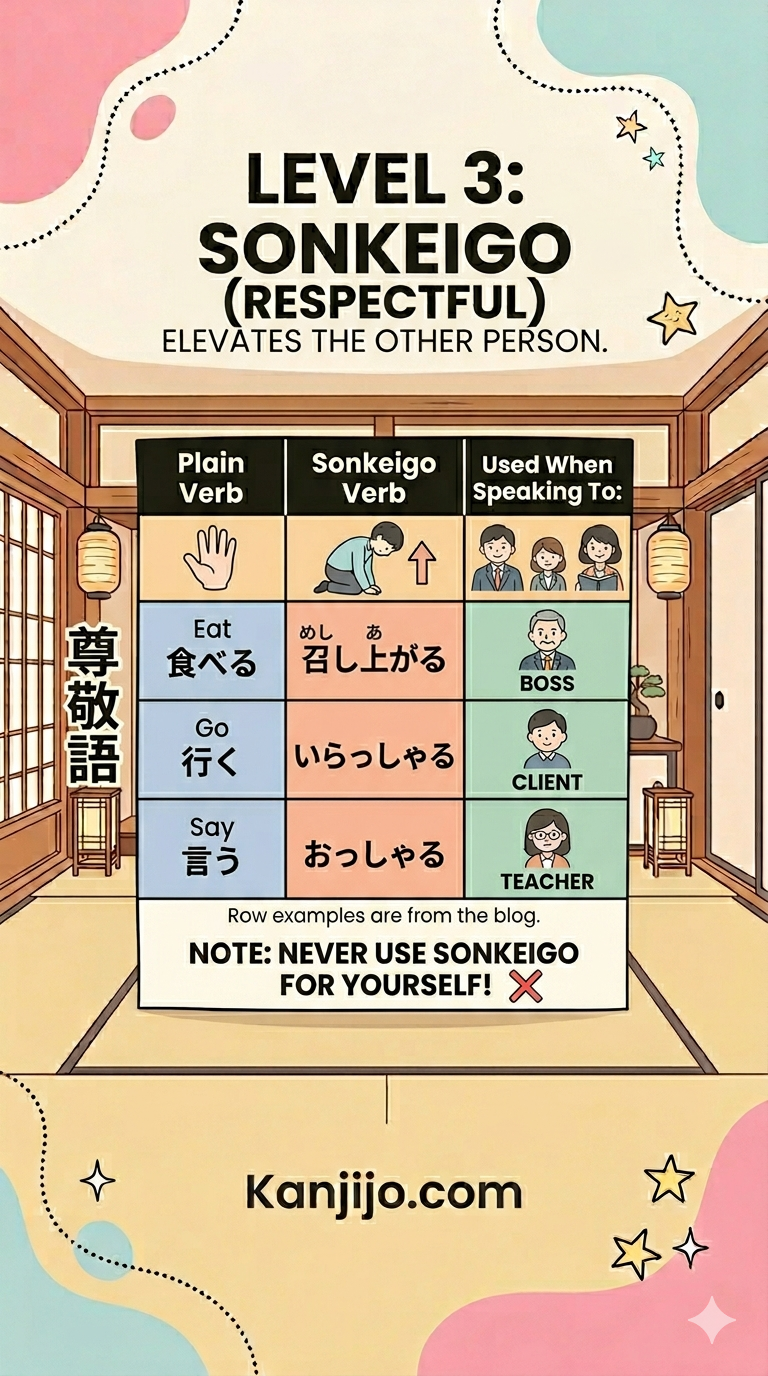
Level 3: 尊敬語 (Sonkeigo) - Respectful Language
Elevates the other person’s actions. Used when speaking about or to superiors, clients, and customers.
| Plain | 尊敬語 | Who Does It |
|---|---|---|
| 食べる (eat) | 召し上がる | The other person eats |
| 行く (go) | いらっしゃる | The other person goes |
| 言う (say) | おっしゃる | The other person says |
| 見る (see) | ご覧になる | The other person sees |
| する (do) | なさる | The other person does |
| 知っている (know) | ご存じ | The other person knows |
The key principle: 尊敬語 is NEVER used for yourself. It raises others. Saying 私が召し上がります (I will humbly eat - using respectful form for yourself) is a classic mistake that instantly marks a non-native speaker.
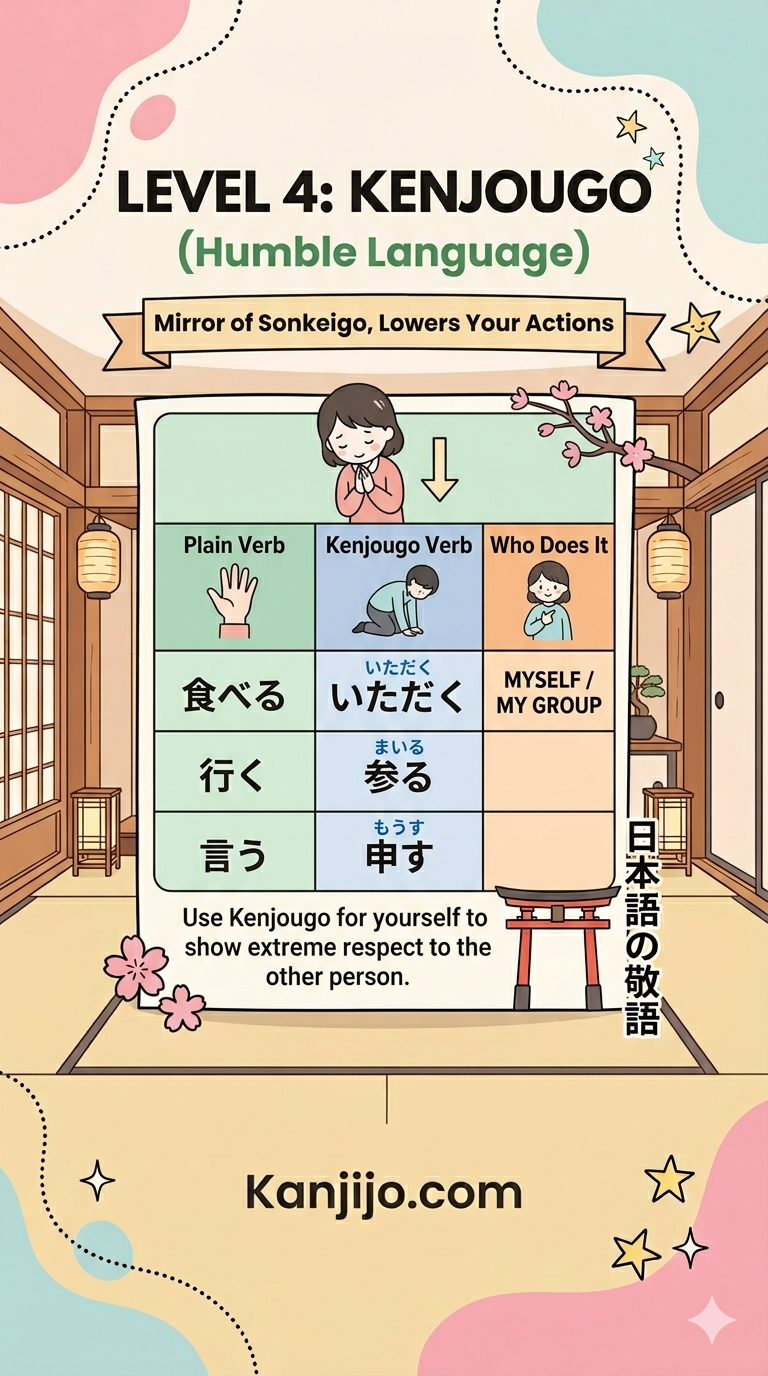
Level 4: 謙譲語 (Kenjougo) - Humble Language
Lowers your own actions to show respect to the listener. The mirror of 尊敬語.
| Plain | 謙譲語 | Who Does It |
|---|---|---|
| 食べる (eat) | いただく | I eat (humbly) |
| 行く (go) | 参る | I go (humbly) |
| 言う (say) | 申す | I say (humbly) |
| 見る (see) | 拝見する | I see (humbly) |
| する (do) | いたす | I do (humbly) |
| 知っている (know) | 存じております | I know (humbly) |
尊敬語 + 謙譲語 together: In business, you often use both in the same sentence. “部長がおっしゃった資料を拝見いたしました” - “I (humbly) looked at the documents that the director (respectfully) mentioned.” The director’s actions are raised; yours are lowered.
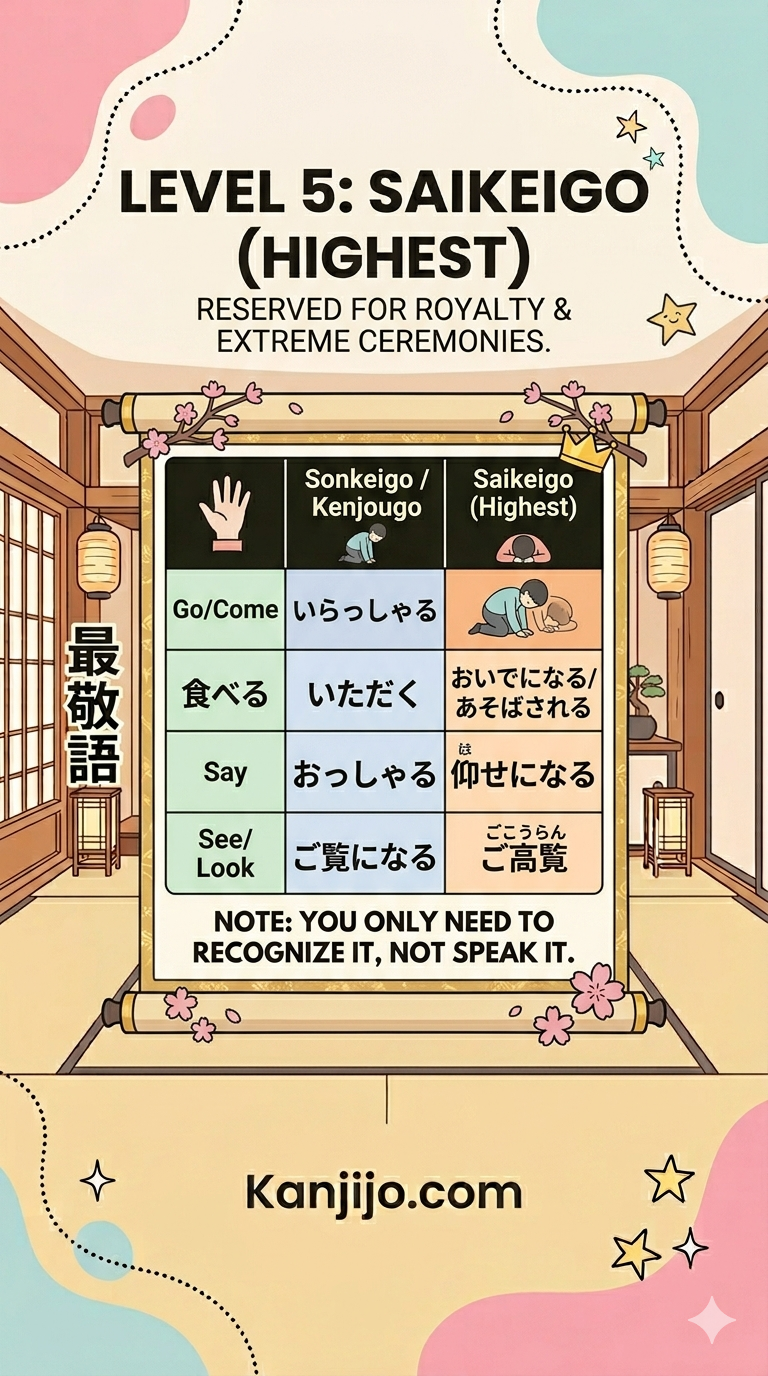
Level 5: 最敬語 (Saikeigo) - Highest Honorifics
Reserved for royalty, extremely formal ceremonies, and traditional institutions. Most Japanese people rarely use this level in daily life.
| Standard Keigo | 最敬語 | Context |
|---|---|---|
| いらっしゃる | おいでになる / あそばされる | Imperial/royal speech |
| おっしゃる | 仰せになる | Addressing royalty |
| ご覧になる | ご高覧 | Formal written documents |
Where you’ll encounter this: News reports about the imperial family, extremely formal business letters, traditional Japanese theater (Noh, Kabuki), and historical dramas. You don’t need to produce 最敬語, but recognizing it helps with media comprehension.
How to Know Which Level to Use
Each politeness layer drilled inside Kanjijo - from タメ口 phrasing to full 尊敬語 / 謙譲語 pairs - with mnemonics and SRS scheduling so the register sticks, not just the word.
Japanese speakers evaluate multiple factors simultaneously to choose their politeness level:
- Age gap: Older person gets higher politeness from younger person
- Social hierarchy: Boss, teacher, client = higher; colleague, classmate = equal; junior = lower
- Uchi/Soto (inside/outside): Your group members = closer; outsiders = more polite
- Familiarity: New acquaintance = polite; long-time friend = casual
- Setting: Office meeting = formal; izakaya = relaxed
- Topic seriousness: Requesting a favor = more polite; chatting about weather = relaxed
Common Level-Switching Mistakes
- Using タメ口 with a new Japanese friend too soon - wait for them to signal it’s okay
- Mixing 尊敬語 for yourself - never elevate your own actions
- Using keigo with close friends - creates emotional distance and feels cold
- Dropping to casual mid-sentence in business - jarring and unprofessional
- Over-using 最敬語 in emails - sounds sarcastic or archaic to modern readers
Related Guides
Frequently Asked Questions
Default to です/ます (Level 2) in almost every situation. It is polite without being overly formal and is always safe. Only drop to casual when a Japanese friend explicitly invites you to, and use keigo in business settings.
Too casual with a superior comes across as rude. Too formal with friends creates awkward emotional distance. For foreigners, being too polite is almost always forgiven. Being too casual is not.
They evaluate age difference, social hierarchy, familiarity, the setting, and whether the person is uchi (inside their group) or soto (outside). They calibrate these factors subconsciously and sometimes switch levels mid-conversation as the mood shifts.
Master the kanji behind every politeness level. Free on iOS.