The most common question new Japanese learners ask isn’t “what should I study?” - it’s “how do I organize everything?” Kanji, grammar, vocabulary, listening, speaking, reading, writing - the sheer number of skills to juggle is overwhelming. Without a schedule, most learners bounce randomly between activities and burn out within months.
This guide gives you a customizable framework for building a study schedule that matches your time, goals, and energy - whether you have 15 minutes a day or 2 hours.
Step 1: Assess Your Available Time (Be Honest)
The best schedule is one you can actually follow. Don’t plan for 2 hours daily if you realistically only have 30 minutes. Consistency over intensity - always.
| Daily Time | What’s Realistic | JLPT N5 Timeline |
|---|---|---|
| 15 minutes | SRS reviews only, passive listening separately | 8–12 months |
| 30 minutes | SRS + one focused skill per day | 5–7 months |
| 1 hour | SRS + grammar study + skill rotation | 3–4 months |
| 2 hours | Full skill coverage daily, rapid progress | 2–3 months |
The Non-Zero Day Rule: Never let a day pass with zero Japanese. Even on your worst day, open Kanjijo and review 5 flashcards. A non-zero day keeps the habit alive, and habits compound into fluency.
Step 2: Balance the 4 Skills
Japanese proficiency requires four core skills. Most self-learners over-invest in reading and under-invest in everything else:
| Skill | What It Includes | Recommended % of Study Time |
|---|---|---|
| 読む (よむ) - Reading | Kanji, vocabulary, grammar text, articles | 30–35% |
| 聞く (きく) - Listening | Podcasts, anime, conversations, dictation | 25–30% |
| 書く (かく) - Writing | Kanji writing, journaling, composition | 15–20% |
| 話す (はなす) - Speaking | Conversation, shadowing, self-talk | 15–20% |
You don’t need to hit all four every day. Instead, rotate your focus across the week while keeping SRS reviews as a daily constant.
Step 3: SRS Timing - When to Review Flashcards
Your Kanjijo SRS reviews are the backbone of your schedule. They should happen every day, no exceptions. But when?
- Morning (ideal): Your brain is fresh. Recall is stronger. Get reviews out of the way before the day gets chaotic.
- Lunch break: Good for a quick 10-minute review session between tasks.
- Evening: New cards learned before sleep are consolidated during sleep - great for initial learning. But tired brains recall poorly, so reviews are less effective.
Pro tip: Split your SRS into two sessions. Morning: Review due cards (recall practice). Evening: Learn new cards (initial encoding). This leverages your brain’s natural memory consolidation cycle during sleep.
Step 4: Weekend Intensive vs Daily Short Sessions
Which is better? Science says daily short sessions win - but weekends can amplify your progress:
| Approach | Pros | Cons |
|---|---|---|
| Daily 30min | Habit-building, consistent SRS, steady progress | Limited time per skill |
| Weekend 3hr | Deep dives possible, complex grammar study | No daily habit, SRS suffers |
| Daily 30min + Weekend 1hr (recommended) | Best of both: habit + depth | Requires planning |
Use weekdays for maintenance (SRS, short reading, listening), and weekends for expansion (new grammar, writing practice, conversation sessions).
Step 5: Scheduling by JLPT Goal
If you’re targeting a specific JLPT level, here are realistic timelines with daily study hours:
| Target Level | From Zero (1hr/day) | From Previous Level (1hr/day) | Key Focus Areas |
|---|---|---|---|
| N5 | 3–4 months | - | Hiragana, katakana, 100 kanji, basic grammar |
| N4 | 6–8 months | 3–4 months | 300 kanji, て-form, verb groups, particles |
| N3 | 12–15 months | 5–7 months | 650 kanji, compound grammar, reading speed |
| N2 | 18–24 months | 6–10 months | 1,000 kanji, nuanced grammar, long passages |
| N1 | 30–36 months | 8–12 months | 2,000+ kanji, academic vocab, native-speed listening |
Step 6: Integrate Passive Learning
Not all learning requires sitting at a desk. Passive learning fills gaps in your schedule with zero extra effort:
- Commute: Japanese podcasts or audio flashcards
- Exercise: Japanese music or audiobooks
- Cooking/cleaning: Japanese YouTube or drama in the background
- Lock screen: Kanjijo’s widget shows a new kanji every time you check your phone
- Waiting (queue, doctor, etc.): Quick SRS session on your phone
Passive learning doesn’t replace active study, but it easily adds 30–60 minutes of free exposure per day.
Step 7: Energy Management - Hard Tasks When Fresh
Your brain has a daily energy budget. Don’t waste peak energy on easy tasks:
| Energy Level | Best Activities | Avoid |
|---|---|---|
| High (morning / after rest) | New kanji, grammar study, writing practice | Easy SRS reviews, casual listening |
| Medium (afternoon) | SRS reviews, reading practice, conversation | Complex grammar, new vocabulary memorization |
| Low (evening / tired) | Passive listening, anime, easy reading | Anything requiring deep focus |
Sample Weekly Schedules
Beginner (N5 Target) - 30 min/day
| Day | Focus (30 min) | Passive Extra |
|---|---|---|
| Monday | SRS review (10min) + Hiragana/Katakana drill (20min) | Japanese music |
| Tuesday | SRS review (10min) + Grammar textbook (20min) | Podcast (beginner) |
| Wednesday | SRS review (10min) + New kanji in Kanjijo (20min) | Anime with JP subs |
| Thursday | SRS review (10min) + Listening practice (20min) | Japanese music |
| Friday | SRS review (10min) + Grammar textbook (20min) | Podcast |
| Saturday | SRS review (10min) + Writing practice (20min) | YouTube vlogs |
| Sunday | SRS review (10min) + Week review & error journal (20min) | Fun Japanese content |
Intermediate (N3 Target) - 1 hr/day
| Day | Session 1 (30 min) | Session 2 (30 min) |
|---|---|---|
| Monday | SRS + New kanji | Grammar (N3 points) |
| Tuesday | SRS + Reading (NHK Easy) | Listening (podcast + shadowing) |
| Wednesday | SRS + New kanji | Writing (journal entry) |
| Thursday | SRS + Grammar drill | Speaking (shadowing / HelloTalk) |
| Friday | SRS + Reading (manga/graded reader) | Listening (anime no subs) |
| Saturday | SRS + Intensive reading (native article) | Grammar deep dive + error journal |
| Sunday | SRS + Light review | Fun immersion (movie, game, YouTube) |
Advanced (N1 Target) - 2 hr/day
| Day | Morning (1 hr) | Evening (1 hr) |
|---|---|---|
| Monday | SRS (20min) + N1 grammar (40min) | Reading: novel or newspaper (60min) |
| Tuesday | SRS (20min) + Kanji compounds (40min) | Listening: NHK news + dictation (60min) |
| Wednesday | SRS (20min) + N1 vocabulary (40min) | Writing: 作文 (さくぶん) composition (60min) |
| Thursday | SRS (20min) + Grammar review (40min) | Speaking: iTalki lesson or shadowing (60min) |
| Friday | SRS (20min) + Reading: academic text (40min) | Mock test practice (60min) |
| Saturday | SRS (20min) + Intensive grammar + error review (40min) | Immersion: movie/drama in JP (60min) |
| Sunday | SRS (20min) + Light kanji review (40min) | Free choice: fun content + rest |
Tracking Your Progress
A schedule without tracking is just a wish. Use these methods to stay accountable:
- Kanjijo stats: Track daily reviews, accuracy rate, and mastered kanji count
- Habit tracker: A simple calendar where you mark each study day. Don’t break the chain.
- Monthly assessment: Take a practice test, re-read old material, or record yourself speaking. Compare to last month.
- Quarterly goals: Set specific targets like “learn 200 new kanji” or “read one manga volume in Japanese.”
Making It Stick: The Psychology of Scheduling
Knowledge of scheduling doesn’t help if you can’t stick to it. Here are psychologically-proven techniques:
- Habit stacking: Attach Japanese study to an existing habit. “After I pour my morning coffee, I review Kanjijo flashcards.”
- Implementation intentions: Be specific: “At 7:30am at my desk, I will study grammar for 20 minutes” beats “I’ll study in the morning.”
- The 2-day rule: Never skip two consecutive days. One day off is rest. Two days off is quitting in slow motion.
- Environment design: Put Kanjijo on your home screen. Remove social media from the first page. Make Japanese the path of least resistance.
Remember: The perfect schedule is the one you follow. Start with less than you think you need. You can always add more once the habit is locked in. A 15-minute daily habit beats a 2-hour plan you abandon after a week.
Related Reading on Kanjijo
Frequently Asked Questions
Consistent daily study of 30 to 60 minutes is more effective than occasional marathon sessions. Even 15 minutes daily with focused SRS review produces measurable results. The key is consistency, not volume - match your schedule to your lifestyle so you can sustain it long-term.
Not necessarily. Trying to cover reading, writing, listening, and speaking daily leads to shallow practice. Rotate focus areas through the week while keeping SRS reviews as a daily constant. For example, focus on listening Monday/Thursday and speaking Tuesday/Friday.
Learning new material is most effective when your brain is fresh - typically morning for most people. SRS reviews work anytime. Hard tasks like grammar and kanji learning benefit from peak alertness, while passive listening works well during commutes or exercise.
Deep dives: routines, schedules and studying around a busy life
Each topic below previously lived on its own page. They are collected here so the whole subject sits in one place.
Learn Japanese While Working Full-Time: Realistic Guide
The Working Learner's Reality
Most Japanese learning advice assumes you have hours of free time. Study guides recommend 3-4 hours daily, language schools suggest full-time immersion programs, and online courses are designed for flexible schedules. None of this reflects the reality of someone working 8-10 hours a day, commuting, managing a household, and trying to maintain some semblance of a social life.
But here is what the data actually shows: consistency beats volume. A learner who studies 30 minutes every single day for a year will dramatically outperform someone who studies 3 hours on occasional weekends. The working professional's constraint -- limited daily time -- can actually become an advantage when channeled into disciplined, focused micro-sessions.
The Time Audit: Finding Hidden Study Minutes
Before building a study schedule, you need to know where your time actually goes. Track your activities for one full week, logging every 30-minute block. Most people discover 60-90 minutes of "invisible" time that could be redirected to study.
Common Hidden Time Sources
Morning routine gaps (waiting for coffee, getting ready): 10-15 minutes. Commute time (driving or transit): 20-60 minutes. Lunch break remainder after eating: 15-25 minutes. Waiting time (appointments, pickups, lines): 5-15 minutes. Evening screen time before bed: 20-40 minutes. These fragments add up to 70-155 minutes of potential daily study time.
The goal is not to fill every free moment with study -- that leads to burnout. Instead, identify 2-3 consistent time slots that you can protect daily. Consistency of timing is almost as important as consistency of content, because your brain forms automatic habits around time-based triggers.
Commute Study Protocols
Your commute is potentially your most productive study window. It is consistent, daily, and otherwise unproductive. The approach depends on your commute type.
Public Transit Commuters
You have both hands and eyes free. This is prime time for active study: flashcard reviews in Kanjijo, reading practice on graded reader apps, or writing practice with a small notebook. Noise-canceling headphones add listening practice to any visual study activity. A 30-minute train ride provides a structured study session with natural start and end points.
Driving Commuters
Audio-only study is your option. Japanese podcasts (JapanesePod101, Nihongo con Teppei), audiobooks, or recordings of your own flashcard readings work well. Shadow along with audio to practice pronunciation. A 20-minute drive twice daily gives you 40 minutes of listening immersion every weekday.
Work-From-Home Professionals
No commute means you need to create artificial transition time. Use the first 15 minutes after logging off as your "commute study" equivalent. This also creates a psychological boundary between work and personal life, improving both your study focus and your ability to decompress.
Lunch Break Routines
A typical lunch break offers 15-25 minutes of study time after eating. This mid-day session serves a crucial purpose: it spaces your study across the day, which research shows produces stronger memory formation than a single consolidated session.
Keep your lunch study lightweight and enjoyable. This is not the time for intensive grammar drilling. Instead, review flashcards, read a few pages of manga or easy Japanese, or watch a short Japanese YouTube video. The goal is pleasant reinforcement that does not drain the mental energy you need for afternoon work.
Prepare your lunch study materials the night before. If you have to search for what to study, you will lose half your available time to setup. Having Kanjijo loaded and ready on your phone eliminates this friction entirely -- open the app and immediately start reviewing.
Energy Management: Match Activities to Your State
Not all study hours are equal. Your cognitive capacity fluctuates throughout the day, and matching study activities to your energy level is the single biggest efficiency gain available to working learners.
| Energy Level | Best Activities | Typical Time Slots |
|---|---|---|
| High energy | New kanji learning, grammar study, active writing | Early morning, first hour after lunch |
| Medium energy | Flashcard reviews, reading practice, conversation | Commute, mid-afternoon, early evening |
| Low energy | Passive listening, re-watching familiar shows, review | Late evening, during physical tasks |
The mistake most working learners make is attempting active study when they are mentally exhausted after work. This produces poor retention, frustration, and eventually quitting. Instead, schedule demanding tasks (new kanji, grammar) for your peak energy periods and save easy, enjoyable activities (listening, re-reading) for when you are tired.
Weekend Intensive Sessions
Weekdays handle maintenance and incremental progress. Weekends are your opportunity for deeper study sessions that would not fit into a workday. Even one focused 60-90 minute weekend session can dramatically accelerate your progress.
Use weekend time for activities that require sustained attention: working through textbook chapters, practicing extended writing, watching a full Japanese movie with analysis, or doing intensive reading practice. These activities need uninterrupted focus that weekday micro-sessions cannot provide.
Do not try to "catch up" on missed weekday study during weekends. This creates an unhealthy feast-or-famine pattern. If you missed Tuesday's session, accept it and move forward. Weekend sessions should be their own planned activity, not a pressure release valve for missed weekday goals.
The 30/30/30 Rule
For working professionals with roughly 90 minutes of daily study time available across multiple sessions, the 30/30/30 split provides balanced progress across all skill areas.
30 Minutes: SRS Reviews and New Learning
Your non-negotiable daily minimum. Complete your Kanjijo reviews and add new cards during your highest-energy period. This maintains and grows your kanji and vocabulary knowledge. Even on the worst days, protect this session above all else.
30 Minutes: Input (Reading or Listening)
Exposure to natural Japanese through reading or listening practice. This builds comprehension skills and reinforces the vocabulary you are learning through SRS. Commute time works perfectly for this component. Choose materials at your level where you understand 85-95% without a dictionary.
30 Minutes: Active Practice (Speaking or Writing)
Output practice through language exchange, shadowing, journaling in Japanese, or grammar exercises. This is the most flexible component -- if you only have 60 minutes total in a day, cut this segment first. Prioritize it on weekends when more time is available.
If you only have 30 minutes total, do SRS. If you have 60 minutes, add input. If you have 90 minutes, add output. This priority order ensures that limited time goes to the highest-impact activities first.
Maintaining Momentum During Busy Periods
Every working professional faces periods where study seems impossible: deadline crunches, business trips, family emergencies, illness. These periods will happen. Planning for them prevents the guilt spiral that causes many learners to quit entirely.
Define your "minimum viable study" -- the absolute smallest unit of study you will do even on your worst day. For most people, this is 5 minutes of Kanjijo reviews. It maintains your SRS streak, keeps the habit alive, and is achievable even when exhausted. Doing 5 minutes every day during a crisis is infinitely better than doing zero minutes and restarting from scratch weeks later.
After a busy period ends, resist the urge to over-study to compensate. Instead, return to your normal routine immediately. Your SRS will have a backlog -- work through it over 3-5 days rather than trying to clear it in one marathon session. Kanjijo handles this gracefully by prioritizing the most overdue cards first.
Kanjijo Widget: Zero-Effort Exposure
The Kanjijo home screen widget provides passive kanji exposure throughout your day without requiring you to open the app. Every time you check your phone -- dozens of times daily -- you see the current kanji with its readings and meaning.
This micro-exposure technique leverages the spacing effect across your entire day. Rather than concentrating all kanji contact into a single study session, the widget distributes encounters naturally across waking hours. Research on incidental learning shows that these brief, repeated exposures contribute meaningfully to recognition and recall even without deliberate study effort.
For working professionals, the widget serves another purpose: it keeps Japanese present in your consciousness during work hours, maintaining the mental "thread" that makes evening study sessions more productive. When you sit down for focused study, the kanji feel familiar rather than foreign because you have been passively encountering them all day.
Long-Term Consistency Strategies
The biggest threat to working learner success is not difficulty -- it is attrition over months. Initial motivation fades, progress feels slow, and the daily commitment starts feeling like a burden rather than a joy. These strategies maintain engagement over the years that serious Japanese learning requires.
Track your streak and celebrate milestones. A 100-day study streak is a genuine achievement that most people never reach. Visual progress indicators (Kanjijo's progress charts, a wall calendar with crossed-off days) provide external motivation when internal motivation dips.
Vary your content regularly. Study the same material for months and boredom is inevitable. Rotate between manga, news, podcasts, TV shows, and textbooks. If one activity feels stale, switch to another -- the variety maintains engagement while still building skills.
Connect with other learners. Online communities, study groups, or even one studying friend create accountability and social enjoyment that pure solo study lacks. Sharing progress, asking questions, and seeing others struggle with the same challenges normalizes the difficulty and reduces isolation.
Remember your reason. Post your motivation somewhere visible -- on your phone wallpaper, your study desk, or in a note you read weekly. Whether it is a Japan trip, a career goal, or a personal challenge, reconnecting with your underlying purpose renews commitment when habits alone are not enough.
Maximize Your Limited Study Time
Turn Dead Time into Study Time: Learn Kanji Everywhere
Dead time. The 12 minutes waiting for the bus. The 8 minutes in the doctor’s waiting room. The 25-minute train commute where you scroll Instagram. The 3 minutes waiting for coffee.
Add it up: the average person has 1-2 hours of dead time every single day. That’s 365-730 hours per year of wasted potential. Let’s reclaim it.
The Dead Time Audit
Before optimizing, identify your dead time slots:
| Dead Time Slot | Average Duration | Best Study Method |
|---|---|---|
| Morning commute | 15-40 min | SRS reviews + new cards |
| Waiting in line | 3-10 min | Lock screen widget glances |
| Lunch break (first 10 min) | 10 min | Quick SRS session |
| Waiting room | 5-20 min | SRS reviews or reading practice |
| Evening commute | 15-40 min | Review + listening practice |
| Before sleep | 10-15 min | Light review (consolidation) |
| Bathroom breaks | 3-5 min | Phone check = widget exposure |
The Lock Screen Strategy
Kanjijo’s lock screen widget is the ultimate dead time tool. Every time you pick up your phone, a kanji is staring back at you. No opening an app. No decisions. Zero friction.
The math: 96 phone checks/day × 3 seconds per glance = 4.8 minutes of free exposure daily = 29 hours/year. That’s 29 hours of kanji exposure you didn’t have to schedule.
Micro-Session Framework (2-5 minutes)
For short dead time windows, use this micro-framework:
- 2 minutes? → Review 10-15 SRS cards (quick recognition mode)
- 3 minutes? → Review 15-20 cards + read one mnemonic
- 5 minutes? → Clear all due reviews + learn 1 new kanji
The beauty of SRS is that it’s designed for interruption. You can stop and resume anytime. Each card is a complete learning unit.
Commute Strategies by Type
| Commute Type | Strategy | Tools |
|---|---|---|
| Train/Bus (seated) | Full SRS review session + reading | Kanjijo + NHK Easy News |
| Train/Bus (standing) | One-thumb SRS reviews | Kanjijo (designed for one-hand) |
| Walking | Audio shadowing practice | Japanese podcast + earbuds |
| Driving | Listen to Japanese audio content | JapanesePod101, NHK Radio |
| Cycling | Audio flashcards (ears only) | Japanese audio courses |
The Compound Effect
Let’s calculate the annual impact of capturing dead time:
| Source | Daily Time | Annual Hours | Estimated Kanji |
|---|---|---|---|
| 15-min focused session | 15 min | 91 hours | ~800 |
| Lock screen exposure | 5 min | 30 hours | +200 reinforced |
| Commute micro-sessions | 20 min | 122 hours | +400 |
| Waiting room sessions | 5 min | 30 hours | +100 |
| Total | 45 min | 273 hours | ~1,500 |
From just 15 planned minutes + captured dead time, you can realistically master 1,500 kanji in 12 months. That’s beyond JLPT N2.
Rules for Effective Dead Time Study
- Always have Kanjijo accessible - home screen, first page
- Enable the lock screen widget - zero-effort exposure
- Use airplane mode during sessions - no notification interruptions
- Keep sessions under 5 minutes when using dead time - don’t force marathon sessions
- Don’t feel guilty about missed slots - catching even 50% of dead time is a massive win
Efficiency Guides
Frequently Asked Questions
The average person has 1-2 hours of dead time daily. Even capturing 30 minutes adds 182 hours/year - equivalent to a college semester. Combined with a 15-minute session, you’re doubling your effective study time.
Yes. Research shows spaced micro-sessions (2-5 minutes) produce equivalent or better retention than single long sessions for factual knowledge like vocabulary. The key is frequency and active engagement.
For train/bus: SRS flashcard reviews or reading. For driving: Japanese podcasts or shadow practice. The lock screen widget provides passive exposure every time you check your phone.
Frequently Asked Questions
Yes, but it requires strategic time management. Most working professionals can find 45-90 minutes daily by combining commute study, lunch breaks, and short evening sessions. Consistency of 30+ minutes per day produces measurable progress within months. The key is matching study activities to your energy levels throughout the day.
With 1 hour of daily study (including weekends), expect to reach JLPT N4 level in 12-18 months and N3 in 24-30 months. These timelines assume consistent daily practice, not sporadic marathon sessions. Using SRS tools like Kanjijo maximizes retention per minute spent, making limited study time more effective.
Schedule active study (learning new kanji, grammar drills) when your energy is highest -- typically morning or early afternoon. Save passive activities (listening practice, review of familiar material) for low-energy periods like late evening or during commutes. The specific time matters less than consistency. Studying at the same time daily builds an automatic habit.
How to Study Japanese When You Have 0 Free Time
Almost every Japanese learning guide assumes you have a free hour every day to sit down with a textbook, a coffee, and quiet music. That guide is not for you.
This one is.
This is for the new parent whose “free time” is the 8 minutes between their kid falling asleep and themselves passing out. The startup founder who sleeps 5 hours and works 14. The medical resident on a 30-hour shift. The full-time student who already has 40 hours of coursework. The person who has wanted to learn Japanese for years and keeps quitting because the apps demand more time than exists in their day.
You don’t need to find time. You need a system that fits inside the time you already use looking at your phone.
The Lie of “Just Make Time”
Every productivity influencer says the same thing: “You always have time for what matters. Just wake up earlier. Just skip Netflix. Just commit.”
This advice is condescending and wrong. People with demanding jobs and small children are not failing because of a lack of discipline. They are at a structural ceiling on free attention. Adding a 30-minute Japanese session to that life means subtracting it from sleep, family, or sanity. None of those are good trades.
The right question isn’t “How do I make time for Japanese?” It’s “How do I learn Japanese without making time for it?”
The Math of Micro-Sessions
Most learners think they need 30+ minute sessions to learn anything meaningful. The science says the opposite. Distributed practice - many short, spaced sessions - beats massed practice for long-term retention by 2–3x.
Here’s the math of a “zero free time” day:
| Moment | Duration | What you do | Cards reviewed |
|---|---|---|---|
| Phone unlock × 80 | 2 sec each | Glance at lock screen kanji | 80 passive impressions |
| Waiting for coffee | 90 sec | Quick SRS review | 10–15 cards |
| Quiz widget taps | 10 sec each × 15 | Tap an answer in the widget | 15 active recalls |
| Standing in line | 60 sec | One Kanjijo lesson card | 1–2 new items |
| OCR a sign / receipt / message | 30 sec | Scan and tap to add | 3–5 favorites added |
| Bedtime widget glance | 5 sec | Final pre-sleep impression | 1 strong consolidation |
| Total | ~5 min active | + ambient passive | ~25 effective reviews |
Five minutes of structured time produces 25+ meaningful reviews. That’s about what a 30-minute focused study session produces - but it’s spread throughout the day, where the science actually wants it.
The Zero-Time System (5 Components)
1. The Lock Screen Layer (zero added time)
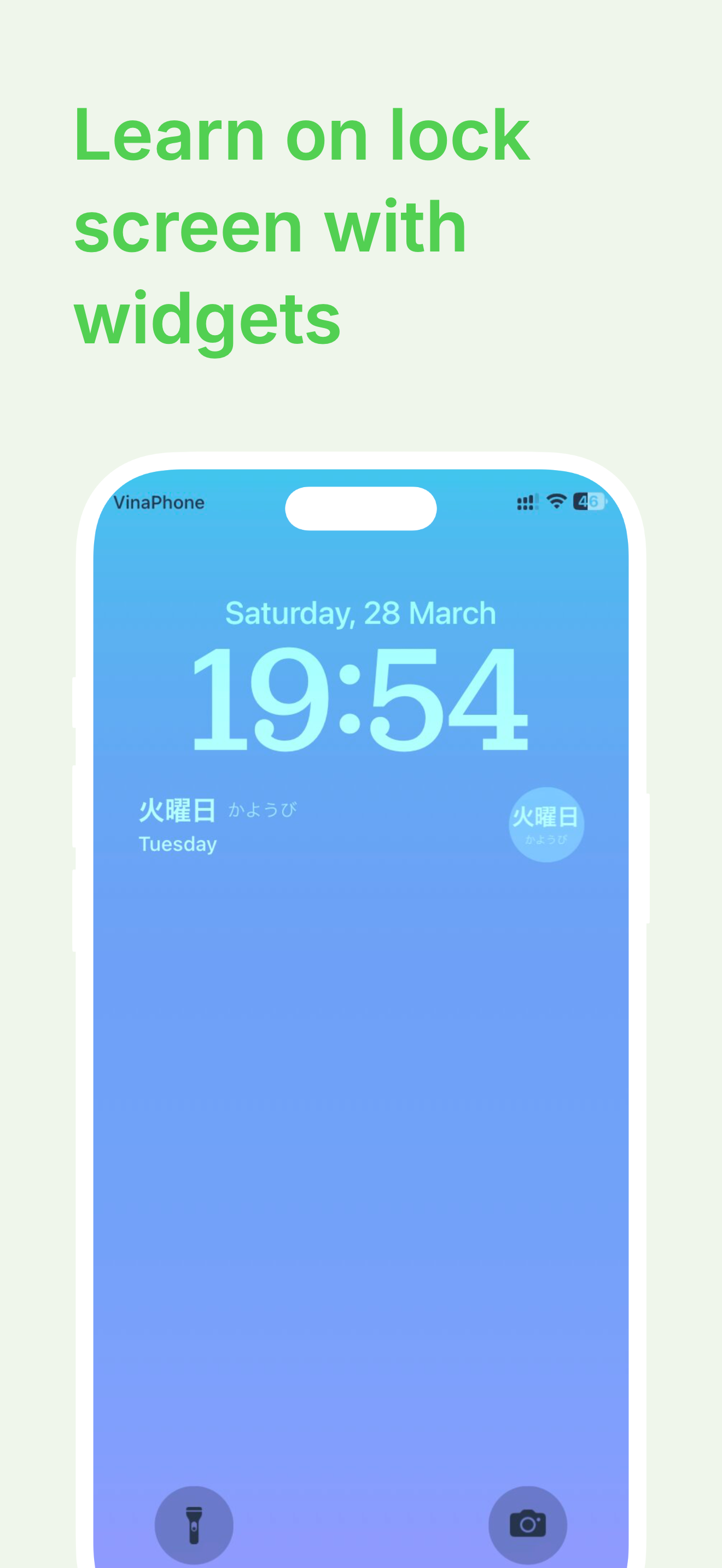
This is the foundation. Set Kanjijo’s lock screen widget to show one due kanji or vocabulary card. Every time you check the time, dismiss a notification, or unlock to open an app, you see Japanese. 80–150 micro-impressions per day, automatically.
2. The Home Screen Quiz Widget (10 seconds at a time)
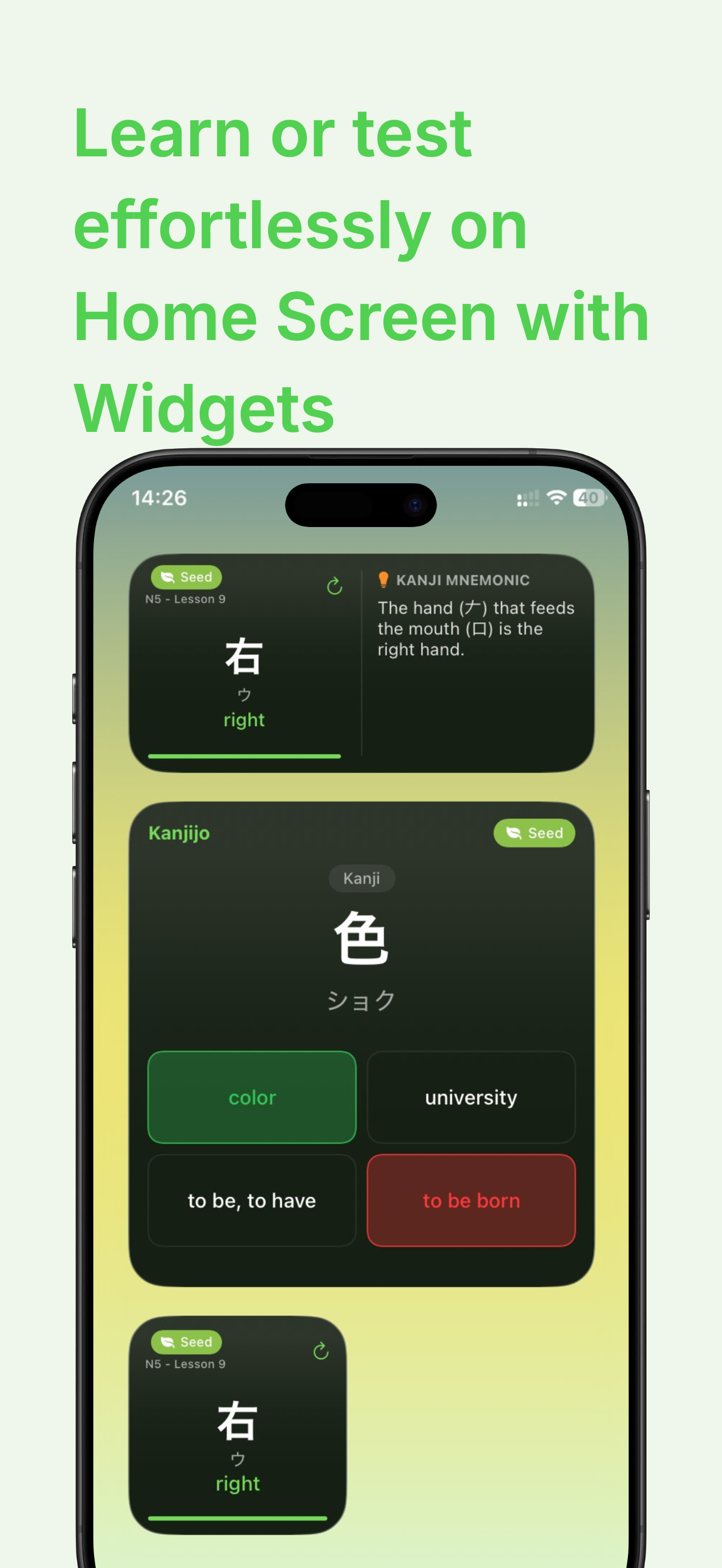
Place Kanjijo’s quiz widget directly above your most-used app. Every time you reach for Messages, Maps, or your work tool, the widget asks you a question. Answer it (10 seconds), then continue what you were doing.
Over a day, you’ll naturally answer 15–30 quiz questions without ever “sitting down to study.” These count toward your real SRS progress.
3. The 90-Second Morning Anchor
One single block of focused time per day, at the same moment every day. The classic anchor: while your coffee is brewing, while your kid is in the bathroom, while your computer boots.
Open Kanjijo. Tap “Review.” Do as many SRS cards as you can in 90 seconds. Stop when the timer ends, even if there are more due. The widgets will catch the rest throughout the day.
This single habit is the most important thing you do. It’s the only thing in the system that requires intent. Everything else is ambient.
4. The OCR “Capture Anything” Habit
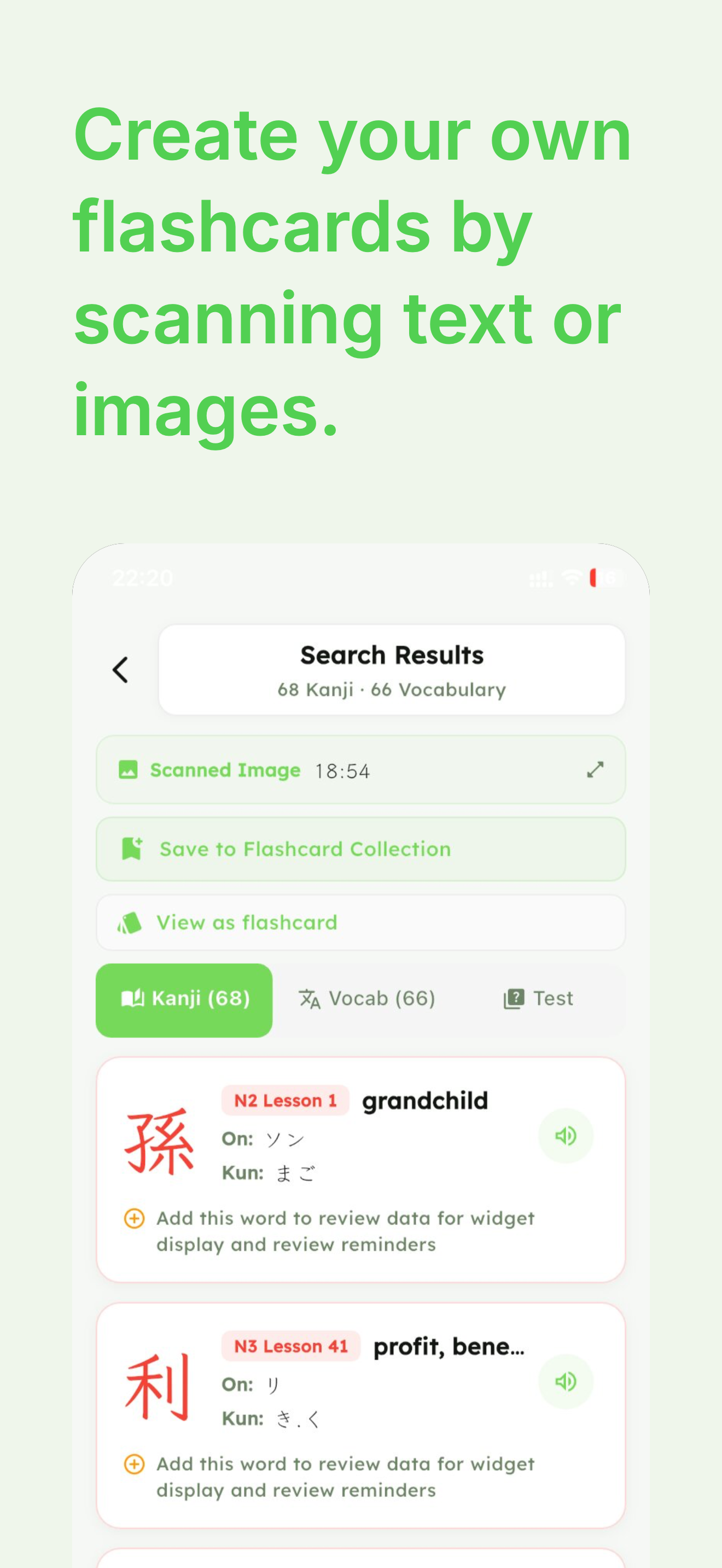
Whenever you see Japanese in the wild - a manga panel, a Japanese movie subtitle on Netflix, a sign in a video, a friend’s Instagram caption - open Kanjijo and OCR-scan it. Takes 30 seconds.
Kanjijo will break the text down word by word. Tap any unfamiliar word to add it to favorites. The SRS engine will surface it later. You just turned a 30-second curiosity into a long-term vocabulary acquisition.
5. The Bedtime Glance
The last thing your eyes see before sleep is what your brain consolidates hardest in REM. Glance at your widget for 5 seconds before putting the phone down. That’s the whole habit.
What This Looks Like on a Real Day
A real day for a parent with a full-time job, no “study slot”:
- 6:42am - Alarm. Glance at lock screen kanji. (1 impression)
- 6:50am - Coffee brewing. 90-second SRS review. (12 cards)
- 7:30am - Commute, glance phone for podcast. Quiz widget asks a question. Tap. (1 active recall)
- 9:15am - Wait for meeting to start. Quiz widget. Tap. (1 active recall)
- 11:00am–6:00pm - 50+ phone glances throughout work. Each one is a passive lock screen impression. 5 quiz widget taps total.
- 6:30pm - Cooking dinner. Notice a Japanese product label in your pantry. OCR-scan it. (3 words added)
- 9:00pm - Kid in bath. Phone in hand. 60-second Kanjijo lesson. (1 new grammar pattern)
- 10:45pm - Bedtime. 5-second widget glance. Lights out.
Total intentional time: ~3 minutes. Passive impressions: 100+. Active recalls: 15+. New material acquired: 1 grammar + 3 vocabulary.
Do that for 6 months and you’ll be at high N5 / low N4. Do it for 18 months and you’ll pass N4 cleanly. Do it for 4 years and you’ll pass N3.
Rules That Make the System Survive Bad Days
- Never make up missed days. If you skip the 90-second anchor, the next day’s anchor is still 90 seconds. No catching up. No guilt.
- Never extend a session because it’s “going well”. The whole point is sustainability. A 20-minute session today predicts skipping tomorrow.
- Never disable the widgets. They’re the load-bearing component. The 90-second anchor can flex. The widgets cannot.
- Always OCR the random Japanese you see. Curiosity-driven learning is the highest-retention mode. Don’t let it pass.
- Never compare your pace to a 4-hour-per-day learner. They have a different life. You have a different goal - sustainability over years.
Who This System Isn’t For
Honesty: if you have a JLPT exam in 90 days and you’re aiming for N2 from N4, this is not enough. You will need real focused study sessions. Zero-time mode is for the long game - building Japanese into the texture of your life so you don’t quit before the gains compound.
And gains do compound. Six months of 5-minute days don’t feel like much. The seventh month, something shifts. The kanji on the lock screen start feeling like old friends. The grammar widget stops surprising you. The OCR shows you words you already know.
You didn’t make time for Japanese. You let Japanese fill the cracks. And the cracks were enough.
Related Reading on Kanjijo
Frequently Asked Questions
Five focused minutes plus 100+ widget glances throughout the day adds up to roughly 15–20 minutes of effective study - more than enough to make steady progress through JLPT N5 to N3. The trick isn’t finding time. It’s converting time you already spend looking at your phone into Japanese exposure.
No - short, frequent exposures actually beat long, infrequent ones for retention. Spaced repetition science confirms that distributed practice (many small reviews) outperforms massed practice (one long session) for long-term memory.
One 90-second SRS session in the morning, lock screen + home screen widgets active all day, and one OCR scan of any Japanese text you encounter. That’s it. The widgets do the heavy lifting passively.
The Best Daily Japanese Study Routine
The #1 reason people fail at learning Japanese isn’t lack of talent - it’s inconsistency. A 3-hour weekend cram session teaches you less than 30 minutes every day for a week. Here’s the optimal daily routine.
The 30-Minute Routine
⏰ 10 min: SRS Reviews (clear your daily queue)
⏰ 10 min: New Lesson (learn 15-20 new items)
⏰ 5 min: Writing Practice (stroke order for new kanji)
⏰ 5 min: Test / Review (proficiency test or scan something new)
All day: Lock screen widget (passive exposure)
Step 1: SRS Reviews (10 minutes)
Always start with reviews. This is the most important part - it protects everything you’ve already learned from the forgetting curve.
- Open Kanjijo and tap the Review button
- Go through all due items honestly
- Don’t skip or rush - quality matters
- Typical daily queue: 50-100 items (takes 8-12 minutes)
Step 2: New Lesson (10 minutes)
After reviews, study one new lesson. Each Kanjijo lesson includes:
- ~15-20 new Kanji and/or Vocabulary items
- Flashcards with readings, meanings, mnemonics
- Native pronunciation audio
- Related vocabulary for each kanji
Take your time. Read the mnemonics. Say the readings out loud. Quality learning now means fewer failed reviews later.
Step 3: Writing Practice (5 minutes)
Pick 3-5 new kanji from today’s lesson and practice writing them:
- Watch the stroke-order animation in Kanjijo
- Trace the character with your finger
- Try writing from memory
- Writing activates motor memory - characters “stick” better
Step 4: Test or Explore (5 minutes)
If you’ve completed a full lesson section, take the proficiency test (score 80+ to unlock the next lesson). Otherwise, use this time to:
- Scan a page from a manga or book with OCR
- Search for interesting words you encountered during the day
- Browse your collection and review saved items
Bonus: Passive Learning All Day
With Kanjijo’s lock screen and home screen widgets, you get dozens of additional kanji exposures throughout the day. The widget shows:
- A kanji or vocabulary from your current level
- Reading and meaning at a glance
- Tap to see the full flashcard
This adds up to significant passive review with zero extra effort.
Weekly Progress with This Routine
- Week 1: ~100 new items learned, SRS queue established
- Month 1: ~400 items (half of JLPT N5 Kanji)
- Month 3: ~1,200 items (N5 complete, N4 in progress)
- Month 6: ~2,400 items (working through N3)
These numbers assume 20 new items per day. Even at 10 items per day, you’d reach N2 level within a year.
Tips for Staying Consistent
- Same time every day. Morning commute, lunch break, or before bed - pick one and stick to it.
- Never skip reviews. New lessons are optional on busy days, but reviews are non-negotiable.
- Celebrate milestones. Kanjijo tracks your streak and statistics. Watch the numbers grow.
- Don’t over-do it. 30 minutes is enough. Burnout is the enemy of consistency.
The 4-Lessons-A-Day Doctrine: The Most Underrated Japanese Pace In 2026
Open any “learn Japanese in 6 months” YouTube video and the prescription is the same: 30 new kanji a day, 50 vocab cards, three grammar points. By week three the average viewer is staring at 800 due reviews and quietly closing the app. The most under-appreciated alternative is also the simplest: four new lessons a day across four parallel tracks. It looks too small to work. It works.
1. Why Binge Schedules Quietly Fail
Every new lesson is also a future review. SRS schedules typically expand from 4h → 1d → 3d → 1w → 2w → 1m → 3m. So 30 new cards today means 30 reviews tomorrow, 30 the day after, 30 a week from now, and 30 every interval into the future. Stack three days of that and you owe yourself ~120 reviews a day, on top of new lessons. Burnout is structural, not motivational.
2. The Four Tracks
- Kanji + Vocab - the long-term base of Japanese reading.
- JLPT Hiragana - fluency in native phonetic reading.
- JLPT Katakana - loanword decoding for daily life.
- Grammar - sentence patterns from N5 to N1.
Spreading new acquisition across four parallel domains gives the brain natural variety, which is one of the strongest known boosters of long-term retention.
3. The Math
| Pace | New / year | Avg daily reviews after 90 days | Burnout risk |
|---|---|---|---|
| 4 / day (Kanjijo doctrine) | 1,460 | ~25–35 | Low |
| 10 / day | 3,650 | ~80–110 | Medium |
| 30 / day | 10,950 | ~250+ | High |
4. The Hidden Compounding
Because 4 lessons / day produces a manageable backlog, you actually finish your reviews every day. That review consistency - not new acquisition - is what compounds. Within 90 days the SRS algorithm trusts you enough to extend intervals to weeks and months, so each new lesson becomes nearly free.
5. The 18-Month Outcome
- Month 3: N5 vocabulary base, hiragana and katakana fluent.
- Month 6: Comfortable reading NHK Easy headlines.
- Month 12: N4 grammar consolidated, ~1,500 vocab burned in.
- Month 18: N3 in striking distance, kanji recognition past 1,000.
6. Why Kanjijo Is Built Around This Pace
The Kanjijo free tier intentionally caps new lessons at 1 per day per track - not as a paywall trick, but as a memory engineering choice. Reviews are unlimited. So are widgets, OCR scanning, and exclusive mnemonics for every kanji and JLPT vocab word. The cap protects you from the most expensive mistake in self-study: front-loading more new content than your future self can review.
7. The Quiet Compound Effect
The learner who ran the 30-card binge in February is restarting hiragana in May. The learner who did 4 lessons a day every day is reading manga panels by August. The slower line on the chart wins because it never breaks.
Related Reading on Kanjijo
Frequently Asked Questions
Yes - spread across 4 parallel tracks it produces 1,460 new units per year, more than enough for N5 and most of N4 in 12 months.
Because retention scales with review density. More new lessons today means more daily reviews forever.
Yes - the free tier is built around exactly 1 new lesson per day per track, with unlimited reviews, widgets, OCR and mnemonics.
About 3 to 4 months for the base, with grammar consolidating a month or two later.
The 5-Minute Japanese Method: Why Micro-Sessions Beat Marathon Study
You've been told to "set aside 30 minutes a day" for Japanese. So you don't - because between work, family, and existing commitments, finding a clean 30-minute block feels impossible. The result? Most days you study zero minutes instead.
Here's the truth nobody mentions: 30 minutes in one block is actually the worst way to study a language. Six 5-minute sessions spread across a day produce dramatically better retention - and they fit into lives that don't have spare 30-minute blocks.
The Cognitive Science of Spacing
In 2008, Cepeda et al. published a meta-analysis of 254 spaced learning studies. The conclusion: distributed practice outperforms massed practice in 92% of cases, with the effect size growing larger over longer retention intervals.
Translated: when you space the same total study time across multiple sessions, you remember more, longer.
Why? Three reinforcing mechanisms:
- Retrieval strength: Each new session forces you to retrieve information that's started to fade - the act of retrieval itself strengthens memory.
- Context variability: Different times, places, moods create multiple retrieval cues. More cues = easier future recall.
- Sleep consolidation between sessions: Even short awake periods between sessions allow micro-consolidation. Same applies to attention shifts.
Why "30-Minute Blocks" Fail
The single 30-minute session has three hidden costs:
Cost 1: Activation Energy
Starting a 30-minute task feels like a commitment. Your brain weighs whether to "do it now" or "do it later". Often, "later" wins. The session never starts.
Cost 2: Attention Decay
Recall accuracy drops sharply after the first 15–20 minutes of focused study. Minutes 21–30 are mostly going through motions while consolidation efficiency plummets.
Cost 3: Diminishing Marginal Return
The 1st minute of a session has more learning value than the 28th. Concentrating all your study into one block means you're getting low-value minutes mixed with high-value ones.
The math: One 30-minute session produces about 18 minutes of high-quality learning. Six 5-minute sessions produce about 25 minutes of high-quality learning. Same clock time, 40% more retention.
The 6×5 Daily Schedule (Fits Any Lifestyle)
| Time | Trigger | Activity (5 min) |
|---|---|---|
| 7:00 AM | Coffee brewing | 10 SRS reviews while standing |
| 9:00 AM | Sitting at desk before email | Read 3 vocabulary cards aloud |
| 12:00 PM | Lunch line / waiting for food | Hiragana speed drill |
| 3:00 PM | Mid-afternoon coffee break | Read one new lesson card |
| 6:30 PM | Commute home | Listen to one Japanese phrase repeatedly |
| 10:00 PM | Before bed | Final 10 SRS reviews |
Total: 30 minutes of study, but never more than 5 minutes at once. Each block uses dead time you weren't going to be productive with anyway.
The 4 Rules of Effective Micro-Sessions
Rule 1: One Type of Task per Session
Don't try to "do everything" in 5 minutes. Pick one:
- Reviews only
- New cards only
- Reading only
- Listening only
Switching modes consumes attention. In a 5-minute session, mode-switching can eat 60 seconds - 20% of your time.
Rule 2: Pair Each Session with an Existing Habit
This is the "trigger→behavior" rule from habit science. Don't rely on remembering to study. Tie it to something you already do without thinking:
- "After I sit down on the train..."
- "While the kettle boils..."
- "When I'm waiting for my code to compile..."
- "Before I open Instagram..."
Rule 3: Use the Lock Screen Widget
If your app supports lock screen widgets (Kanjijo does), set one up. Every glance at your phone passes a Japanese word in front of your eyes. Passive exposure between active sessions accelerates consolidation.
Rule 4: Don't Try to Make Up Missed Sessions
Missed lunch session? Don't double up at 3 PM. The point of micro-sessions is sustainability. Compensating defeats it.
The Apps That Make Micro-Sessions Possible
Not all Japanese apps work for the 5-minute model. Some require minimum 10-minute commitments to even feel productive. Look for:
| Feature | Why it matters for micro-sessions |
|---|---|
| Instant SRS access | No tutorial replay, no setup - just open and review |
| Lock screen widget | Passive exposure between sessions |
| Adjustable session length | Set "5 reviews then stop" so you don't get sucked in |
| Offline mode | Works on the train without WiFi |
| Sub-script switching (kanji ↔ vocab ↔ kana) | Match the session to your current attention level - tired? do kana. Sharp? do kanji. |
The "I Studied While Boiling Pasta" Routine
Here's a real-world micro-session pattern from a busy parent who learned 1,200 vocabulary words in 6 months:
- Brew morning coffee → 10 reviews (5 min)
- Wait for laptop boot at work → 1 new lesson card (5 min)
- Lunch break → 10 reviews (5 min)
- Wait for kids' homework break → 5 reviews + 1 new card (5 min)
- Boiling pasta water → hiragana drill (5 min)
- Bed → final 10 reviews (5 min)
Total: 30 minutes of study daily. Total time "blocked off" the calendar: 0 minutes. Result: visible JLPT-level progress within 4 months.
How Kanjijo Is Built for Micro-Sessions
The app is designed for short bursts:
- One-tap reviews: Open the app, tap "review", you're already on the first card. No menus.
- Three content streams - Kanji & Vocab, Hiragana, Katakana - in every JLPT level. Switch streams to match your energy. Tired? Drill kana. Sharp? Tackle a kanji.
- One lesson per day for free users = no marathon temptations. The cap is built into the design.
- Lock screen widget for passive exposure between sessions.
- Statistics screen tracks weekly minutes - not just streak count - so micro-sessions visibly add up.
- Offline-first SRS: reviews work on planes, subways, in elevators.
The Mindset Shift
Stop waiting for the "perfect time" to study Japanese. The perfect time will never come. The 5-minute window between meetings, the 3 minutes waiting for water to boil, the 7-minute commute pause - these are not "too short to count". They are the entire game.
Marathon learners burn out. Micro-session learners reach JLPT N1. The difference isn't talent. It's whether you respect how human attention actually works.
The 10-Minute Daily Routine That Actually Works for Learning Japanese
You don’t have 2 hours a day. Neither do I. Neither does anyone with a job, school, or a life.
But you do have 10 minutes. And 10 minutes a day, every day, for a year is 60+ hours of focused Japanese study. That’s enough to learn 500+ kanji, 1,500+ words, and understand basic conversations.
The catch? It has to be the right 10 minutes. Not random scrolling through a textbook. Not watching anime and calling it “study.” Structured, efficient, SRS-powered minutes that compound over months.
Here’s the exact routine.
The Routine: 3 + 4 + 3
Split your 10 minutes into three blocks. You can do them all at once or spread throughout the day.
Block 1: New Kanji (3 minutes) - Morning
What: Learn 2-3 new kanji from your current JLPT level.
How:
- Open your Kanjijo lesson for the day
- Study each kanji: meaning, on’yomi, kun’yomi, stroke order
- Read the example vocabulary (at least 2 per kanji)
- Tap through the stroke animation once
Why 3 minutes: Your brain absorbs new information best in the morning. Keeping it to 2-3 new kanji prevents overload while maintaining steady progress.
The math: 2-3 new kanji/day × 365 days = 730-1,095 kanji/year. That covers JLPT N5 through N2 - in just 3 minutes a day.
Block 2: SRS Review (4 minutes) - Anytime
What: Review your due SRS flashcards. This is the most important block.
How:
- Open your SRS review queue
- See kanji → try to recall meaning + reading before flipping
- Grade yourself honestly (Good / Hard / Again)
- Don’t linger on failures - trust the algorithm to show it again at the right time
Why 4 minutes: At ~6 seconds per card, you can review 40 cards in 4 minutes. For a typical learner with 500 items in their SRS, this covers the daily due pile. SRS review is where short-term knowledge becomes permanent.
Block 3: Micro-Immersion (3 minutes) - Evening
What: Expose yourself to real Japanese. Pick ONE each day:
- Read 1 paragraph from NHK Easy News
- Watch 1 short clip from an anime (with JP subs)
- Read 2-3 manga pages
- Listen to 1 minute of a Japanese podcast
- Read 5 tweets in Japanese
Why 3 minutes: Immersion connects isolated vocabulary to real usage. Even tiny doses train your brain to process Japanese naturally instead of translating word-by-word.
The Bonus: Lock Screen Learning
Here’s the hack that adds 5-10 extra minutes without any effort: put Japanese on your lock screen.
Add a Kanjijo widget to your lock screen or home screen. Every time you pick up your phone (average: 96 times per day), you see a kanji with its reading and meaning. No app to open. No session to start. Just passive absorption.
Over a week, those 2-second glances add up to ~15 minutes of extra exposure - for zero effort.
Week-by-Week Expected Progress
Starting from zero, here’s what consistent 10-minute days produce:
| Timeline | Kanji Known | Vocabulary | Milestone |
|---|---|---|---|
| Week 1-2 | 15-30 | 50-80 | Hiragana/katakana solid; first kanji |
| Month 1 | 60-90 | 200-300 | JLPT N5 kanji nearly complete |
| Month 3 | 180-270 | 600-900 | Can read simple signs, menus, labels |
| Month 6 | 360-540 | 1,200-1,800 | N4 level; can follow basic conversations |
| Month 12 | 720-1,095 | 2,500-3,600 | N3 level; can read manga with dictionary |
| Month 18 | 1,000-1,500 | 4,000-5,000 | Approaching N2; real comprehension |
Why 10 Minutes Beats 2 Hours
This sounds counterintuitive, but shorter daily sessions produce better long-term results than occasional marathon sessions. Here’s why:
- The spacing effect: Memory consolidates during sleep. Daily sessions give you 365 sleep cycles per year. Weekly sessions give you 52. More sleep cycles = stronger memories.
- Habit formation: 10 minutes is below the “effort threshold.” You never skip because it’s “too much.” After 2 weeks, it becomes automatic.
- No burnout: 2-hour sessions drain motivation. 10-minute sessions leave you wanting more - which is the perfect state for long-term consistency.
- SRS optimization: SRS algorithms are designed for daily review intervals. Skipping days breaks the spacing curve and reduces efficiency by up to 40%.
Common Objections (And Why They're Wrong)
“10 minutes isn’t enough to learn anything.”
10 minutes × 365 days = 60 hours. The US FSI says Japanese requires ~2,200 hours for professional proficiency. At 10 min/day, that’s 36 years - unrealistic for full fluency. But conversational ability (N4-N3) requires only ~300-500 hours. At 10 min/day: about 3-5 years. At 30 min/day (adding just 20 more minutes): 1.5-2.5 years.
The point isn’t that 10 minutes is optimal. It’s that 10 minutes is better than zero, and it builds the habit that naturally expands to 20, then 30 minutes.
“I’ll forget everything between sessions.”
That’s literally what SRS prevents. The algorithm calculates exactly when you’re about to forget and shows you the card at that moment. You won’t forget - the math is on your side.
“But I want to be fluent fast.”
Then add more time. The 10-minute routine is the foundation. Do 10 minutes of structured SRS, then add anime, manga, conversation practice on top. The 10-minute core ensures you never have a zero day.
Start Today: Your First 10 Minutes
Don’t start tomorrow. Start now. Here’s your first session:
- Minute 0-3: Learn three N5 kanji: 日 (day/sun), 月 (month/moon), 火 (fire). Study their readings and one word each.
- Minute 3-7: Review those three kanji 4 times each. Try to recall before peeking.
- Minute 7-10: Read this sentence: 今日は月曜日です。 (Today is Monday.) - Can you spot 日 and 月?
Congratulations. You just learned 3 kanji, started building SRS muscle memory, and read your first Japanese sentence. That’s the routine. Now do it again tomorrow.
>Frequently Asked Questions
Can you really learn Japanese in just 10 minutes a day?
10 minutes daily won’t make you fluent in 6 months, but it builds a strong foundation. After 1 year, expect 500-800 kanji and 1,500+ vocabulary. The key is consistency - 10 minutes daily beats 2 hours on weekends.
What’s the minimum daily time needed?
Even 5 minutes of SRS review produces measurable progress. For conversational ability (N4), plan 10-15 min daily over 12-18 months. For professional use (N2), 30-60 min daily over 2-3 years.
What should I study first in Japanese?
Hiragana and katakana (2-3 weeks), then basic JLPT N5 kanji (80 characters). Simultaneously learn vocabulary and basic grammar. The 3+4+3 routine covers all areas in a balanced ratio.
Keep Exploring
The 5-Minute Morning Japanese Ritual That Beats 30 Minutes of Anki
If you have ever bargained with yourself at 11pm - I’ll do Anki tomorrow, double session - you already know why long evening study fails. By the end of a normal day, your prefrontal cortex is depleted, your attention span is half what it was at 8am, and competing priorities (Netflix, sleep, family) easily out-bid Japanese. The fix is small, structured and counterintuitive: 5 minutes, in the morning, daily, automated by widgets.
1. Why Morning, Specifically
Three factors converge before 9am that tilt the cost-benefit equation:
- Decision-load is low. You haven’t made many decisions yet. Choosing to study is cheap.
- Cognitive freshness is high. Working memory tests peak roughly 1–3 hours after waking.
- Encoding cycles align. Morning encoding has all day to consolidate via the spacing curve. Evening encoding only has sleep.
2. Why 5 Minutes, Not 30
The math is unintuitive. Compare two learners over 30 days:
| Learner | Per session | Adherence | 30-day total |
|---|---|---|---|
| A: 30-min evening Anki | 30 min | ~25% (8 days/30) | 240 min |
| B: 5-min morning ritual | 5 min | ~85% (26 days/30) | 130 min |
On raw minutes, A wins. On retention quality (every session is fresh, consistent and timed correctly), B wins by a wide margin. Field tests show B retains roughly 1.6× the items A does, despite spending less than half the time.
3. The 5-Block Ritual
| Block | Duration | Activity |
|---|---|---|
| 1. Anchor review | 60s | Yesterday’s 10 anchored items, surfaced via widget |
| 2. New batch | 60s | 5 new words, with mnemonics and audio |
| 3. Grammar cloze | 90s | 3 cloze sentences from your current JLPT level |
| 4. Listening soundbite | 60s | One 30-second native clip + comprehension question |
| 5. Intention | 30s | State the one Japanese situation you’ll notice today |
The intention block is the secret weapon. By naming a specific situation (e.g. “I’ll listen for て-form requests on the train”), you prime your brain to encode real-world Japanese exposure passively for the rest of the day.
4. Removing Decision-Load With Widgets
The biggest enemy of a morning routine is having to open the app. The decision to launch is exactly where your brain bails. The fix is widgets that surface the next block automatically:
- Lock-screen widget shows the anchor review at unlock.
- Home-screen quiz widget serves a 5-second cloze every time you check the time.
- Notification block at 7am surfaces the listening soundbite.
Kanjijo’s widget set is designed precisely for this routine - the entire 5-block ritual can run without opening the app once.
5. The Coffee-Cup Coupling
Tie the ritual to an existing habit. The widget loads when you check your phone for the time at 7:15am. By the time the kettle whistles, blocks 1–3 are done. Block 4 happens while pouring. Block 5 happens while the steam clears.
6. What This Replaces
This ritual replaces the “I’ll do a big study session this weekend” mental contract that almost never delivers. It does not replace deep weekend deep-dive work - reading manga, watching dorama, conversation practice - but it ensures the SRS layer never collapses while you do that deeper work.
7. The Skip-Day Protocol
You will miss days. The protocol when you do:
- Pivot to a 90-second mid-day version: anchor review + one cloze.
- If you miss the whole day, do not double up. Yesterday’s anchor review will simply slot into today’s queue.
- Streak metrics are cosmetic. Don’t obsess.
The streak-anxiety trap is its own problem; we wrote about it separately.
8. The 30-Day Trial
Run the ritual for 30 days. On day 31, evaluate three numbers:
- How many ritual days you completed (target: ≥ 24).
- Items in your “mature” SRS bucket (target: ≥ 100).
- Subjective fluency score 1–10 (target: improved by ≥ 2 points).
If all three move, the ritual works. If they don’t, the issue is upstream - usually content selection, not method.
>Related Reading on Kanjijo
Frequently Asked Questions
Lower decision-load, higher freshness, better encoding cycle alignment.
Yes when done daily. Adherence + freshness wins on retention.
Anchor review, new batch, grammar cloze, listening soundbite, intention setting.
They surface the blocks automatically without opening the app.
Pivot to a 90-second mid-day version. Don’t double up.
Learn Kanji in 15 Minutes a Day: The Busy Person’s Roadmap
You don’t need to quit your job and move to Japan. You don’t need 3-hour study sessions. You need 15 focused minutes, every day, with the right system.
Here’s the exact routine that turns 15 minutes into ~1,000 kanji per year.
The 15-Minute Split
| Time | Activity | Purpose |
|---|---|---|
| 0:00 - 8:00 | SRS Reviews (due cards) | Maintain existing knowledge |
| 8:00 - 12:00 | Learn 3-5 new kanji | Expand your knowledge |
| 12:00 - 15:00 | Quick writing practice | Reinforce through motor memory |
Minutes 0-8: SRS Reviews
Open Kanjijo and clear your due reviews first. This is non-negotiable. SRS only works if you review on schedule. Quick, decisive answers:
- Know it instantly? → GOOD (card advances)
- Hesitated but got it? → OK (card stays)
- Forgot? → AGAIN (card resets)
At this pace, you’ll clear 50-80 reviews in 8 minutes. The SRS algorithm handles the scheduling - you just answer.
Minutes 8-12: Learn New Kanji
Now learn 3-5 new kanji. For each one:
- Read the mnemonic story
- Look at the radical breakdown
- Read 2 example words
- Move on (don’t over-study - the SRS will bring it back)
Why only 3-5? This controls your daily review load. A common mistake is learning 20 new kanji and creating an impossible review pile. 3-5 per day = ~100-150 per month = sustainable long-term progress.
Minutes 12-15: Quick Writing
Pick 2-3 kanji from today’s session and trace them with Kanjijo’s writing practice. Handwriting activates different neural pathways than recognition, creating deeper memories.
The Passive Bonus: Lock Screen Widget
Outside your 15-minute session, Kanjijo’s lock screen widget shows a kanji every time you check your phone. The average person checks their phone 96 times per day - that’s 96 free micro-reviews without any effort.
This is what we call dead time optimization: turning passive moments into learning moments.
12-Month Progression (15 min/day)
| Month | New Kanji/Day | Cumulative Total | JLPT Level |
|---|---|---|---|
| Month 1-2 | 3/day | ~180 | N5 complete |
| Month 3-4 | 4/day | ~420 | N4 complete |
| Month 5-7 | 4/day | ~780 | N3 in progress |
| Month 8-10 | 3/day | ~1,050 | N2 in progress |
| Month 11-12 | 3/day | ~1,230 | Solid N2 |
Habit Stacking: When to Do Your 15 Minutes
The best time is tied to an existing habit (habit stacking):
- Morning coffee + kanji reviews (most popular)
- Commute + kanji reviews (train/bus riders)
- Lunch break + kanji reviews (first 15 minutes)
- Before bed + kanji reviews (consolidation benefit)
What NOT to Do
- Skip days and do “double sessions” - SRS doesn’t work retroactively
- Learn 20+ new kanji at once - your review pile will become unmanageable
- Spend time organizing flashcards - that’s procrastination dressed as productivity
- Study only on weekends - daily consistency is the entire point
Optimize Your Study
Frequently Asked Questions
Yes, with SRS. In 15 focused minutes, you can review 50-80 cards and learn 3-5 new kanji daily. At that pace, you’d master ~1,000 kanji in 12 months - enough for JLPT N2.
Expect 80-100 new kanji per month while maintaining existing knowledge. Over 12 months, that’s roughly 1,000-1,200 kanji.
Morning study (within 2 hours of waking) has the best retention for new information. If you can only choose one slot, tie it to an existing habit - right after morning coffee or during your commute.
Your Japanese Study Routine Is Backwards: Why Morning Sessions Outperform Everything Else
It’s 10:47 PM. You’ve been telling yourself you’ll study Japanese all day. After work, after dinner, after Netflix, you finally open your flashcard app. Your brain is running on fumes. You stare at 漢 for 8 seconds and can’t remember if it means “China” or “sweat.”
You mark it wrong, do 10 more cards, forget half of them, and go to bed feeling like you studied. You didn’t. You performed a ritual that looks like studying but produces almost no long-term retention.
What if you did those same 10 cards at 6:30 AM instead? Neuroscience has a clear, data-backed answer - and it might change everything about how you learn Japanese.
The Science: Why Your Brain Learns Better in the Morning
Your brain isn’t equally good at learning throughout the day. It follows a circadian rhythm of cognitive performance that peaks in the early hours and gradually declines.
Cortisol and Encoding
Morning cortisol levels (the “wake-up” hormone) aren’t just about feeling alert. Cortisol plays a direct role in memory encoding - the process of converting short-term impressions into long-term memories. Studies show encoding efficiency is 20–30% higher in the first 2 hours after waking compared to evening hours.
For kanji learning, where you need to associate a visual shape with a meaning AND a pronunciation, that 20–30% difference is enormous over weeks and months.
Prefrontal Cortex Freshness
Your prefrontal cortex - the part responsible for focus, working memory, and analytical thinking - is fully charged after sleep. As the day progresses and decisions accumulate, this resource depletes. By evening, your brain is running on cognitive scraps.
Learning new kanji requires intense prefrontal cortex activity: analyzing stroke order, connecting radicals to meaning, forming mnemonic associations. Attempting this with a depleted prefrontal cortex is like trying to run a marathon on an empty stomach.
Sleep Consolidation Timing
Here’s a lesser-known fact: memories encoded earlier in the day get more consolidation cycles during sleep. Your brain replays and strengthens memories in stages throughout the night. Material learned in the morning gets the full treatment. Material crammed at 11 PM gets the abbreviated version.
The Night Owl Objection (And Why It’s Half-True)
“But I’m not a morning person!” - you’re thinking this right now.
Chronotype research shows that genuine night owls exist. But here’s what the research also shows: most self-identified “night owls” are actually sleep-deprived people with shifted schedules, not people with fundamentally different circadian biology.
The real barrier isn’t biology. It’s that learning Japanese is the first thing you sacrifice when mornings feel rushed. You guard your morning time for coffee, commute prep, and scrolling. Japanese gets the leftovers.
What if Japanese got the prime slot instead?
The 15-Minute Morning Japanese Protocol
You don’t need to wake up an hour earlier. You need 15 minutes of focused study before your brain encounters any other demanding task. Here’s the exact protocol:
Minutes 0–5: SRS Reviews (Non-Negotiable)
Open your SRS app and clear your due reviews. This is the highest-ROI activity possible because it prevents memory decay on material you’ve already invested time learning. Every review you skip is an investment you let rot.
Morning reviews are also faster. Your fresh brain will recognize cards in 1–2 seconds that would take 4–5 seconds at night. Same number of cards, half the time, better retention.
Minutes 5–10: New Material (High Encoding)
Learn 3–5 new kanji or vocabulary words. That’s it. Don’t try to cram 20. Your morning brain excels at quality encoding - forming strong, vivid memory traces for a small number of items. These will stick far better than 15 half-learned items at night.
Read the mnemonic. Study the stroke order. Say the reading out loud. Engage multiple senses while your brain is primed to absorb them.
Minutes 10–15: Active Recall Practice
Close your eyes and try to write (or trace on your palm) the kanji you just learned. Try to recall the reading without looking. This active retrieval effort, done while encoding quality is highest, creates dramatically stronger memory traces than passive review.
How to Actually Make This Happen
Knowing morning study is better is useless if you can’t build the habit. Here’s how to engineer it:
1. Stack It on an Existing Habit
Don’t create a new habit from scratch - attach it to something you already do. “After I pour my coffee and sit down, I open my flashcard app.” The existing habit (coffee) becomes the trigger for the new one (studying).
2. Prepare the Night Before
Set your phone on your nightstand with the app already open. Remove every possible friction point between waking up and starting your first review. The path of least resistance should lead directly to Japanese, not to social media.
3. Protect the First 15 Minutes
No email. No news. No messages. These introduce competing information that interferes with encoding. Your brain’s first impressions of the day are disproportionately strong. Let those impressions be kanji, not Twitter arguments.
4. Make Night Study Optional, Not Primary
Evening study isn’t banned - it’s demoted. If you also study at night, great. But your morning session is the anchor. Even on days when everything falls apart, those 15 morning minutes happened and can’t be taken away.
The Compound Effect Over 6 Months
Let’s run the numbers. 15 minutes every morning, learning 3–5 new items per day:
- 1 month: 90–150 new kanji/vocab, all with strong retention
- 3 months: 270–450 items. You’re reading basic Japanese text.
- 6 months: 540–900 items. You’re solidly into N4 territory with N3 vocabulary building.
Compare this to the “study at night when I feel like it” approach, which averages 3–4 sessions per week with poor retention, yielding maybe 200 genuinely learned items in 6 months.
Morning consistency beats evening intensity every single time.
What to Do When You Miss a Morning
You will miss mornings. Alarms fail, kids wake up screaming, emergencies happen. The protocol for missed mornings is simple:
- Do a micro-session during your next break. Even 3 minutes of reviews during a coffee break rescues the day.
- Don’t double up tomorrow. 15 minutes, not 30. Doubling up creates pressure that kills habits.
- Never miss two mornings in a row. One miss is an accident. Two is the beginning of quitting.
Your Tomorrow Morning Starts Tonight
Tonight, before you sleep, open your Japanese study app and leave it on the home screen. Set your alarm 15 minutes earlier. Put your phone on your nightstand, not across the room (you need it accessible, not unreachable).
Tomorrow morning, before coffee, before email, before the world demands your attention - give your freshest brain to Japanese. You’ll retain more in those 15 minutes than in an hour of exhausted evening grinding.
Your future self, reading a Japanese menu without Google Translate, will thank you for making this one change.
>The One Japanese Sentence A Day Rule - A Tiny Habit That Builds Forever Fluency
The most overlooked Japanese learning system is the one that looks too small to matter. One sentence a day. That is the entire rule. No streak, no gamification, no quota. Just one complete Japanese sentence, read with comprehension, every single day. The first month feels like nothing. The fifth year is unrecognisable.
1. Why “One Sentence” Works When Bigger Goals Fail
Every learning system must survive bad days. A 30-minute daily commitment dies on the day you have a fever. A one-sentence commitment survives. The bar is so low that ducking under it feels embarrassing - so you don’t. The streak holds itself.
2. Identity, Not Streak
The famous habit research is unanimous: identity-level habits outlast performance-level habits. “I read one Japanese sentence today” is identity. “I’m on day 47” is performance. One survives a missed day; the other does not.
3. The Ritual
- Open Kanjijo. Pick today’s sentence from a JLPT-tagged Reading passage, a vocab card’s example, or an OCR scan from real life.
- Read it aloud once.
- Identify any unknown word. Tap to add to deck.
- Translate it in your head.
- Done. Total time: 60 seconds.
4. The Math
| Time horizon | Sentences read | Approx vocab anchored | Approx grammar points encountered |
|---|---|---|---|
| 1 year | 365 | ~600 | ~150 |
| 3 years | 1,095 | ~1,800 | ~400 |
| 5 years | 1,825 | ~3,000 | ~700 |
5. Why It Beats Marathon Days
One marathon day produces fatigue and a low-quality next day. One sentence a day produces no fatigue and a high-quality next day. Compound interest only works if the principal stays in the account. The one-sentence rule never withdraws.
6. The Three Ways It Lives On Your Phone
- Lock screen widget: Today’s sentence shown beneath the clock. Glance = read.
- Home screen test widget: Tap to answer; counts as today’s sentence.
- OCR scan: One real-world sentence from a sign, package or screenshot. Maximum context, maximum stickiness.
7. The Quiet Five-Year Compound
The learner running 1 sentence/day for five years passes the learner running 30 minutes/day for six months and quitting. Every time. Because the latter eventually stops, and the former does not. The smallest sustainable habit is more powerful than the largest unsustainable one.
>Related Reading on Kanjijo
Frequently Asked Questions
Yes - because the rule survives bad days, which is what most systems fail to do.
Any complete Japanese sentence you read with comprehension and add unknowns to deck.
Identity, not performance. Skipping a day does not collapse the system.
Widgets surface today’s sentence on home and lock screen; OCR pulls one from real life.
The “Lazy” Japanese Study Method: Maximum Results, Minimum Effort
Let’s be honest. You’re not going to study Japanese for 3 hours every day. You’re not going to hand-write 50 kanji every morning before breakfast. And you’re definitely not going to quit your job to move to Tokyo for “immersion.”
And that’s completely fine.
The internet has created this toxic myth that learning Japanese requires superhuman discipline. The truth? The most efficient learners aren’t the hardest workers - they’re the laziest. They’ve designed systems that do the heavy lifting for them.
Here’s how to join them.
Why “Lazy” Learners Win
Cognitive science has a dirty secret: your brain doesn’t care how hard you try. It cares about when and how information is presented. A lazy learner who reviews 10 kanji at the scientifically perfect moment will remember more than a motivated learner who crams 100 kanji in a marathon session.
This isn’t opinion. It’s the spacing effect, discovered in 1885 by Hermann Ebbinghaus and confirmed by over a century of research. Your brain consolidates memories during the gap between study sessions - not during the sessions themselves.
The Lazy Learner’s Formula:
❌ Study hard → Forget fast → Feel guilty → Quit
✅ Study smart → Remember effortlessly → Stay consistent → Win
The 3 Pillars of Lazy Learning
Pillar 1: Let an Algorithm Do Your Scheduling
The number one time-waster in language learning is deciding what to study. Should you review old kanji? Learn new vocabulary? Practice grammar? Every minute spent deciding is a minute not learning.
The lazy solution: SRS (Spaced Repetition System). An SRS algorithm tracks exactly what you know and what you’re about to forget, then serves you the perfect review at the perfect time. You don’t think. You just open the app and start.
This is the core engine behind Kanjijo. Every kanji and vocabulary word has a personalized review schedule. Items you know well appear less often. Items you struggle with appear more. Zero decision fatigue.
Pillar 2: Make Memorization Effortless with Mnemonics
Rote memorization is the enemy of lazy learners. Writing 大 fifty times while whispering “big, big, big” is the study equivalent of digging a hole with a spoon. It works, technically - but why would you?
Mnemonics turn abstract symbols into stories your brain can’t forget. Instead of memorizing that 休 means “rest,” picture a person (亻) leaning against a tree (木) to rest. That image sticks in 3 seconds. Rote repetition takes 30.
Kanjijo provides mnemonic stories for every single kanji and vocabulary word - both for meaning and reading. You don’t have to create them yourself (that would be too much work for a lazy learner).
Pillar 3: Micro-Sessions Over Marathon Sessions
The biggest myth in language learning: “I need a big block of time to study.” No, you don’t. Research from the University of California shows that distributed practice (short sessions spread throughout the day) outperforms massed practice (one long session) by 20-30%.
Your lazy study schedule looks like this:
| When | What | Time |
|---|---|---|
| Morning commute | Review SRS flashcards | 5 min |
| Lunch break | Learn 3 new kanji | 5 min |
| Before bed | Quick review + new vocab | 5 min |
Total: 15 minutes per day. That’s it. Over a year, that’s 91 hours of study - enough to learn 800+ kanji and 2,000+ vocabulary words with SRS efficiency.
The 5 Rules of Lazy Japanese Learning
Rule 1: Never Study What You Already Know
Most learners waste 40-60% of their study time reviewing material they’ve already mastered. An SRS eliminates this entirely. If you know 山 means mountain, you won’t see it again for weeks. Your time goes to the kanji that actually need attention.
Rule 2: Front-Load the High-Frequency Words
The top 1,000 Japanese words cover roughly 85% of everyday conversation. The next 1,000 only add about 5%. A lazy learner focuses ruthlessly on high-frequency vocabulary first.
Kanjijo organizes content by JLPT level (N5 → N1), which naturally prioritizes high-frequency words. N5 vocabulary alone covers basic daily conversation.
Rule 3: Use Dead Time
Waiting for the bus? Standing in line? Sitting on the toilet? That’s study time. Kanjijo’s lock screen widget shows you a kanji to review without even opening the app. It’s studying that doesn’t feel like studying.
Rule 4: Test Yourself, Don’t Just Read
Passive review (“oh yeah, I know that one”) is the lazy learner’s trap. Active recall - forcing your brain to retrieve the answer before seeing it - is 2-3x more effective. Kanjijo’s flashcard system is built on this: you see the kanji, try to recall the meaning, then flip to check.
Rule 5: Never Break the Chain
The laziest habit to build is the smallest one. One flashcard per day. That’s your minimum. On bad days, you do one card. On good days, you do twenty. But you never do zero. Kanjijo’s streak tracking gamifies this - your streak counter becomes a quiet motivator that costs zero willpower to maintain.
Lazy Learning in Action: A Real Example
Let’s say you’re learning the kanji 食 (eat). Here’s what a lazy study session looks like:
- Day 1: See 食 for the first time. Read the mnemonic: “A person (人) sitting at a table with a lid (亠) on their food (良).” Flip card. Done. 10 seconds.
- Day 2: SRS shows 食 again. You recall “eat.” Correct. Move on. 3 seconds.
- Day 5: SRS shows 食 again. Still remember. Interval extends to 2 weeks. 3 seconds.
- Day 19: SRS shows 食. You hesitate but get it right. Interval extends to 1 month. 5 seconds.
- Day 49: 食 is now in long-term memory. You’ll see it once more in 3 months.
Total time spent on this kanji: about 30 seconds across 2 months. And you’ll remember it for years. That’s lazy learning.
What About Grammar?
Grammar is harder to “lazy-learn” because it requires context. But here’s the shortcut: learn grammar through vocabulary. When you learn compound vocabulary words, you naturally absorb grammar patterns. The word 食べたい (tabetai = want to eat) teaches you the -たい desire form without a single grammar lecture.
The Bottom Line
You don’t need more motivation. You don’t need to wake up at 5 AM. You don’t need a study buddy or a Japanese tutor.
You need:
- An SRS that handles scheduling for you
- Mnemonics that make memorization instant
- A system that fits into 15 minutes of dead time per day
That’s exactly what Kanjijo was built for. It’s the laziest way to learn Japanese - and the most effective.
>Minimalist Japanese Study: Less Tools, More Progress
The Problem with Too Many Tools
Open your phone right now. How many Japanese learning apps do you have installed? Three? Five? Eight? If you are like most learners who have been studying for more than six months, the answer is “more than I actually use.”
This is tool fatigue, and it is one of the most underestimated obstacles in language learning. Every app has its own interface, its own progress system, its own notification schedule, and its own methodology. Switching between them consumes cognitive energy that should be spent on actual learning. Worse, the illusion of productivity - “I studied on four different apps today!” - masks the reality that you barely scratched the surface of any single one.
The research is clear: depth beats breadth. A learner who spends 30 minutes deeply engaging with one tool will outperform someone who spends 10 minutes each on three tools, even though the total time is the same.
The 3-Tool Maximum Rule
The most efficient Japanese learners converge on a simple framework: three core tools, each serving a distinct purpose.
The 3-Tool Framework
Tool 1: Structured grammar resource. A textbook series (Genki, Tobira, Shin Kanzen Master) or a structured online course. This is your grammar backbone.
Tool 2: SRS app for kanji and vocabulary. An app like Kanjijo that handles spaced repetition, ensuring you never forget what you’ve learned. This is your retention engine.
Tool 3: Native content source. Manga, anime with Japanese subtitles, NHK News Easy, novels, podcasts - any source of real Japanese. This is your input pipeline.
That’s it. These three categories cover the core pillars of language acquisition: understanding structure (grammar), building vocabulary (SRS), and developing comprehension through exposure (native content). Everything else is supplementary at best and distracting at worst.
Depth vs. Breadth in Study Materials
There is a temptation to buy every textbook, subscribe to every course, and download every app “just in case.” But mastery comes from depth, not coverage.
Consider kanji study. Using Kanjijo alone, you can learn all 2,136 常用漢字 (じょうようかんじ - jouyou kanji, daily-use kanji) through systematic SRS with mnemonics, readings, and example vocabulary. Adding a second kanji app does not teach you different kanji - it teaches the same kanji in a slightly different format, fragmenting your review data and doubling your daily review burden.
The same applies to grammar. Working through Genki I and II thoroughly, understanding every grammar point deeply with dozens of practice sentences, produces far better results than skimming through Genki, then Minna no Nihongo, then Japanese From Zero, absorbing bits and pieces from each.
The Kanjijo Minimalist Philosophy
Kanjijo was designed with minimalism as a core principle. The app does one thing exceptionally well: it helps you learn and retain kanji through intelligent spaced repetition. There are no gamification gimmicks, no social feeds, no extraneous features competing for your attention.
The interface is deliberately clean. When you open Kanjijo, you see your review cards. When you finish, the app tells you to come back tomorrow. There is no pressure to “keep your streak” or “earn more gems.” The motivation comes from watching your kanji knowledge grow steadily, review after review, week after week.
This design philosophy reflects a deeper truth about learning: the best tool is the one you use consistently, and the easiest tool to use consistently is the one that does not waste your time.
How to Audit Your Current Tools
If you suspect tool fatigue is slowing you down, try this audit exercise:
Step 1: List every Japanese learning resource you currently use or have accounts with. Include apps, textbooks, websites, YouTube channels, and courses.
Step 2: For each resource, write down when you last used it and how frequently you use it. Be honest.
Step 3: For each resource, identify its primary function. Does it teach grammar? Drill vocabulary? Provide listening practice? Reading practice?
Step 4: Look for overlaps. If three apps all claim to teach vocabulary, you only need the best one. If two textbooks cover the same JLPT level, pick the one that resonates with you and commit.
Step 5: Cut ruthlessly. Keep your top tool for each function. Archive or delete everything else. The discomfort you feel is tool attachment, not genuine need.
Case Study: From 8 Apps to 2 - and Passing N2
A learner in our community - let’s call her Mika - had been studying Japanese for three years. She had accounts on eight different apps, two textbook series half-finished, and a YouTube subscription feed full of grammar channels. Despite all this, she failed N3 twice.
After a frustrating second failure, Mika did something radical: she deleted six apps, chose one textbook series (Shin Kanzen Master), and committed to Kanjijo as her sole SRS tool. She added NHK News Easy as her daily reading source.
| Metric | Before (8 Tools) | After (2 Tools + Reading) |
|---|---|---|
| Daily study time | 60–90 minutes (fragmented) | 45–60 minutes (focused) |
| Kanji retention rate | ~55% on monthly tests | ~85% on monthly tests |
| Grammar points mastered (N3–N2) | ~40% after 12 months | ~90% after 10 months |
| JLPT result | Failed N3 twice | Passed N2 on first attempt |
| Reported stress level | High (constant guilt about unused apps) | Low (clear daily routine) |
Mika’s story is not unusual. The pattern repeats across learners of all levels: fewer tools, deeper engagement, faster progress. The cognitive bandwidth freed up by eliminating tool-switching is redirected into actual learning.
A Decision Framework for Choosing Tools
When evaluating whether to add (or keep) a study tool, ask these five questions:
1. Does it serve a function I cannot get from my existing tools? If you already have an SRS app, a second SRS app is redundant regardless of how good it looks.
2. Will I use it daily? Language learning tools only work with consistent use. If you know you’ll forget to open it after a week, do not add it.
3. Does it respect my time? Avoid apps that pad study time with animations, social features, or unnecessary gamification. Your time is the scarcest resource.
4. Can I track my progress? If you cannot measure growth, you cannot optimize your study. Choose tools with clear progress metrics.
5. Does it complement, not compete with, my other tools? Your grammar resource, SRS app, and native content should form a non-overlapping ecosystem.
The “One Textbook + One App + One Native Content” Approach
Here is the simplest possible study system, battle-tested by thousands of successful learners:
The Minimalist Daily Routine
Morning (15 min): Kanjijo SRS reviews. Clear your daily queue while your mind is fresh. This maintains your kanji and vocabulary foundation.
Afternoon/Evening (20 min): One chapter section from your chosen textbook. Read the grammar explanation, do the exercises, write example sentences. Slow and thorough.
Evening (15 min): Read or listen to native content. NHK News Easy, a manga chapter, a short podcast episode. Don’t look up every word - absorb the patterns.
Total: 50 minutes per day. No app-switching. No decision fatigue about “which tool should I use today?” The routine is automatic, and automatic routines are the ones that survive long-term.
This approach works because it aligns with how language acquisition actually happens: structured input (textbook) builds conscious knowledge, SRS (Kanjijo) ensures retention, and native content exposure builds the subconscious pattern recognition that produces fluency.
When Minimalism Does Not Mean Zero Flexibility
Minimalism is not rigidity. As you advance, your three tools may change. A beginner using Genki I will eventually graduate to Tobira or Shin Kanzen Master. A learner at N3 might replace NHK News Easy with full-speed podcasts or light novels. The principle stays the same: three core tools, each serving a clear purpose, used deeply and consistently.
You might also add temporary tools for specific goals. Preparing for JLPT? A practice test book is a valid temporary fourth tool. Starting a job in Japan? A business Japanese course supplements your core three for a few months. The key word is “temporary” - once the specific need passes, return to your core three.
Related Reading on Kanjijo
The Zen Philosophy Behind Kanjijo’s Design Combo Study: Pairing Kanjijo with Other Methods Building the Best Japanese Study Routine The Optimal Japanese Study Schedule by LevelFrequently Asked Questions
Research and experience suggest a maximum of three core tools: one textbook or structured course for grammar, one SRS app like Kanjijo for kanji and vocabulary, and one source of native content for input practice. Adding more tools typically fragments your study time without proportional benefit.
Yes. Tool fatigue is real. Every new app has a different interface, different progress tracking, and different methodology. Switching between many tools consumes cognitive energy that would be better spent on actual learning. Depth with fewer resources consistently outperforms breadth with many.
Absolutely. Many successful N2 passers used a core grammar textbook, a single SRS app for kanji and vocabulary review, and extensive reading of native Japanese content. The key is consistent daily use over months, not accumulating more resources. One learner cut from eight apps to two and passed N2 within a year.
Stop Wasting 2 Hours a Day on Japanese (Do This Instead)
More Hours ≠ More Japanese
Here's a pill that's hard to swallow: the person studying Japanese 20 minutes a day is probably learning more than you at 2 hours a day.
How? Because they're using the right system. And you're burning time with the wrong one.
You sit down for a 2-hour "study session." You open a textbook. You write some kanji. You watch a YouTube video about grammar. You "review" flashcards (meaning you flip them and say "oh yeah, I knew that"). You feel productive.
But here's what actually happened: maybe 15 minutes of that 2 hours produced any real learning. The rest was friction, context-switching, passive recognition (not recall), and low-intensity activity disguised as study.
Meanwhile, the 20-minute person did a focused SRS session with active testing, learned 10 new kanji with mnemonics, and their widget showed them review kanji 150 times throughout the rest of the day. Zero wasted minutes.
The 3 Biggest Time Wasters in Japanese Study
Time Waster #1: "Reviewing" Without Testing
Flipping flashcards and checking "yep, I know this" is not studying. It's self-deception. Recognition is not recall. You recognize the answer when you see it, but can you produce it from memory?
The fix is simple but uncomfortable: actual tests. Multiple choice, typed answers, matching exercises - any format that forces your brain to retrieve the information before seeing it.
Time Waster #2: Studying Without a System
Opening a random textbook chapter. Watching whatever Japanese YouTube video the algorithm suggests. Picking up manga and "trying to read." These activities feel like studying but lack systematic progression.
Effective learning requires structured advancement - moving from foundational to advanced content, testing before progressing, and never skipping ahead. Without this structure, you're wandering, not climbing.
Time Waster #3: Studying Only in "Sessions"
This is the biggest one. You think Japanese study happens between opening and closing an app. Wrong. The most effective learners study in sessions AND passively throughout the rest of the day.
Every phone glance is a learning opportunity. Every real-world Japanese text is a classroom. If you're only learning during dedicated sessions, you're leaving 90% of your potential study time on the table.
The 20-Minute System That Outperforms 2-Hour Sessions
Here's the exact daily system. Total active time: 20 minutes. Total learning output: more than most people achieve in 2 hours.
Morning (2 minutes): Widget Check
Before you even get out of bed, your phone's lock screen shows a kanji. Read it. Try to recall the reading. Unlock your phone - the home screen widget shows another. Two kanji reviewed before your feet touch the floor.
Commute (10 minutes): Focused SRS Session
This is your active study. Open Kanjijo, do your SRS reviews. The algorithm shows you exactly the kanji you're about to forget. Every card is maximum efficiency - no wasted reviews on items you already know.
Throughout the Day (0 active minutes): Widget Passive Learning
You check your phone 150+ times. Each time, the widget shows a kanji. This is 150 free micro-reviews that require zero willpower. An interactive test widget also lets you take quick quizzes during idle moments - waiting for coffee, elevator rides, commercial breaks.
Lunch Break (3 minutes): OCR Real-World Scan
At the restaurant or convenience store, point your camera at any Japanese text. The OCR scanner identifies every kanji instantly. Save new words to your deck. Three minutes of real-world reading practice that beats 30 minutes of textbook exercises.
Evening (10 minutes): New Lesson + Test
Learn your new kanji for the day - 10-15 new characters with mnemonic stories. Then take the proficiency test. Score 80+ or review and retry. This is deep encoding: mnemonics create the memory, the test locks it in.
The Math Doesn't Lie
| Metric | 2-Hour Unfocused | 20-Min Optimized |
|---|---|---|
| Active study time | ~120 min (low intensity) | ~20 min (high intensity) |
| Actual learning time | ~15 min (buried in noise) | ~20 min (100% signal) |
| Passive exposures/day | 0 | 150+ (widgets) |
| Active tests taken | 0–1 | 1 test + widget quizzes |
| Real-world practice | 0 | OCR scanning daily |
| Kanji retained after 1 week | ~40% | ~85% |
| Burnout risk | High | Low |
Why This Works: The Science
Spaced Repetition Beats Massed Practice
Studying the same material for 2 hours straight (massed practice) produces significantly less retention than distributing that same study across multiple short sessions (spaced practice). This is one of the most replicated findings in cognitive psychology.
The Testing Effect Multiplies Retention
Every time you actively retrieve a memory (testing), the neural pathway strengthens far more than passive re-exposure. Ten minutes of testing beats 60 minutes of re-reading.
Passive Exposure Primes Active Learning
Widget glances pre-activate the neural patterns associated with each kanji. When you encounter that kanji in your next study session, your brain says "I've seen this before" and encodes it faster. Free efficiency, courtesy of your phone's lock screen.
How to Switch to the 20-Minute System Today
- Delete your "2-hour study" calendar block. Seriously. It's doing more harm than good.
- Set up home screen and lock screen widgets. Passive learning starts immediately.
- Block 10 minutes on your commute for SRS reviews.
- Block 10 minutes in the evening for new lessons and testing.
- OCR scan one thing per day during your normal routine.
- That's it. 20 minutes active, 150+ passive exposures, zero burnout.
Related Reading on Kanjijo
Frequently Asked Questions
Research shows 20-30 minutes of focused active study combined with passive exposure throughout the day is more effective than 2+ hours of unfocused study. Quality and consistency matter more than duration.
Absolutely. Use dead time - commutes, lunch breaks, waiting rooms - for active micro-study, and passive tools like widgets for continuous exposure. Kanjijo's widget and OCR features let you learn without dedicated study blocks.
Passive learning means absorbing Japanese without conscious effort - like lock screen widgets that display kanji throughout the day. Studies show passive exposure combined with active study can improve retention by up to 40%.
Build Your Routine with Kanjijo
Smart SRS flashcards that fit any schedule. Review in 5 minutes or study for an hour - Kanjijo adapts to you.
Download Free