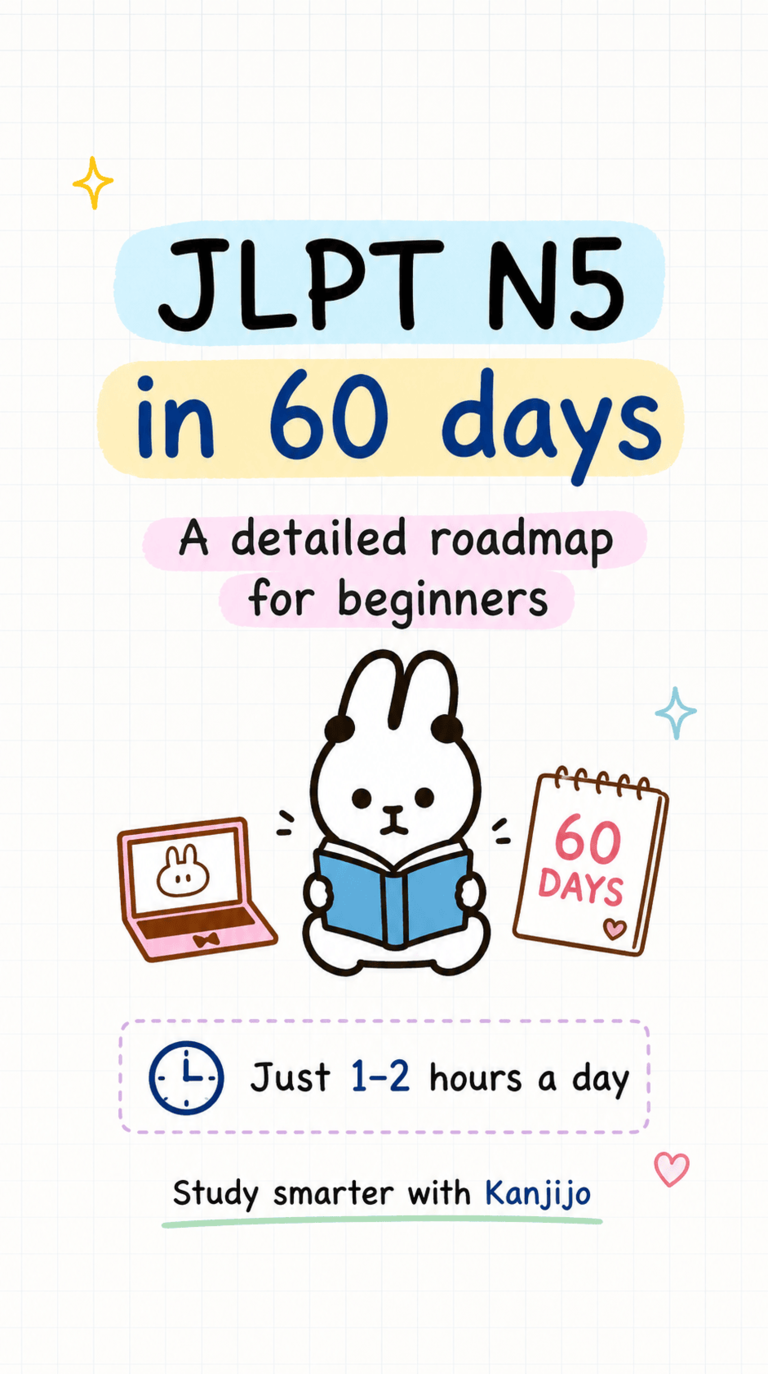
To pass JLPT N5 in 60 days, study 25–30 minutes daily across six areas: hiragana (days 1–7), katakana (days 8–14), N5 kanji + vocabulary with SRS (days 15–42), N5 grammar (days 15–42), reading practice (days 43–55), and a final review sprint (days 56–60). Use a spaced repetition app like Kanjijo to automate review scheduling.
The Problem With "Just Start Studying Japanese"
Every beginner hears the same advice: "Just start, it gets easier." It doesn't - not without a map. The first week of Japanese learning is uniquely brutal because you are simultaneously asked to master two completely foreign phonetic scripts (hiragana and katakana), learn vocabulary in a language with no Latin root connection to English, and absorb a sentence structure that is literally the mirror image of English grammar. Without a sequenced plan, most beginners either stall on hiragana for three weeks, or skip it and spend months reading romaji like a liability.
This blueprint gives you a 60-day week-by-week structure built around one principle: minimal effective dose. You do not need to study 3 hours a day. You need to study the right things in the right order with proper review spacing. Twenty-five minutes of disciplined SRS plus ambient exposure through widgets is more effective than two unfocused hours with a textbook.
The 60-Day Architecture: Six Phases
Sixty days is approximately eight and a half weeks. Each two-week block has a distinct cognitive focus. Do not skip phases - each one builds the scaffolding for the next.
| Phase | Days | Primary Focus | Daily Time |
|---|---|---|---|
| 1 | 1–10 | Hiragana + Katakana mastery | 20 min active + widgets |
| 2 | 11–20 | N5 Kanji foundations + core vocabulary | 25 min active + widgets |
| 3 | 21–30 | N5 Grammar - structure and particles | 25 min active + OCR |
| 4 | 31–40 | Vocabulary expansion + grammar deepening | 30 min active + listening |
| 5 | 41–52 | Reading passages + listening practice | 30 min active + reading |
| 6 | 53–60 | Full mock exam + weak-point targeting | 35 min active + review |
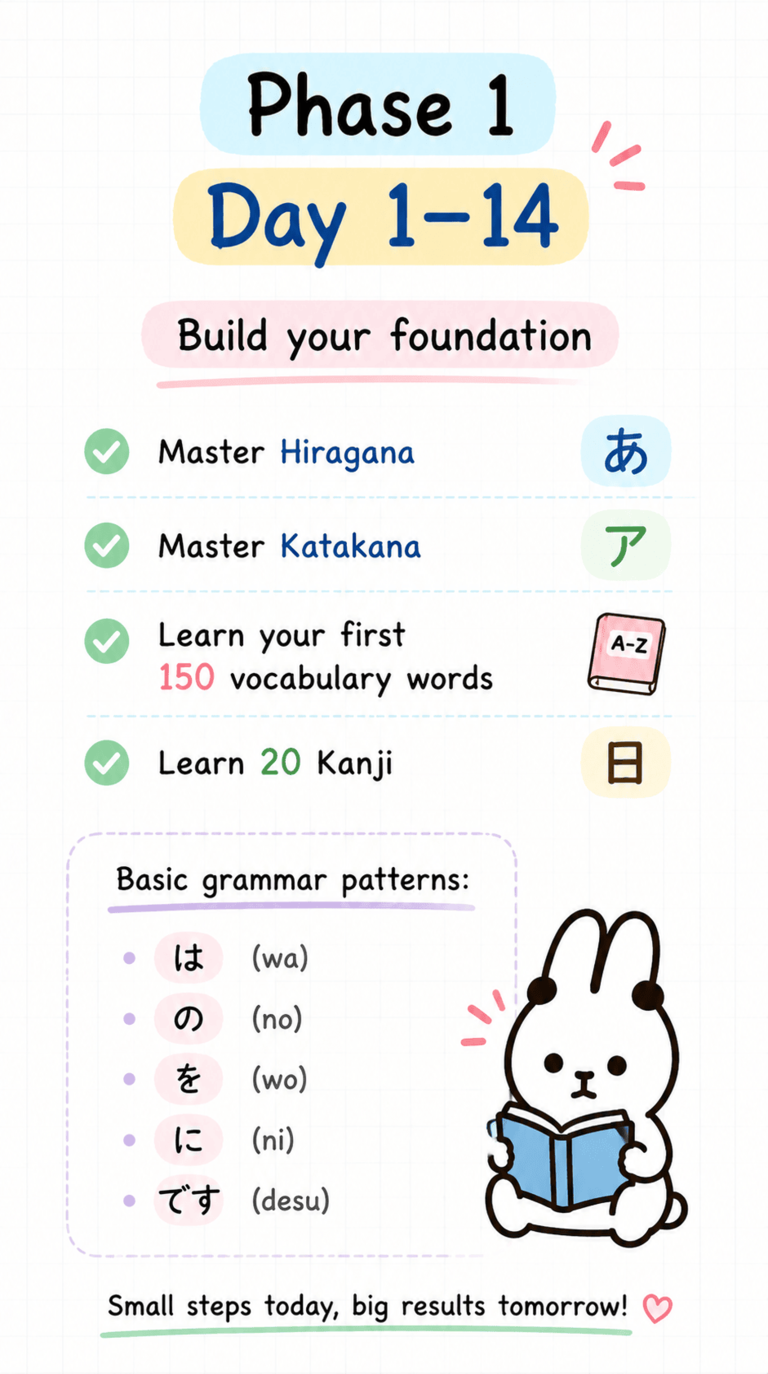
Phase 1 - Days 1–10: Hiragana and Katakana
Do not skip this. I know every YouTube video says "you can learn kana in a weekend" and technically that is true - you can recognize all 46+46 characters in 48 hours. But reading fluency - the ability to parse kana at the speed of thought without consciously translating each character - takes 10 days of consistent exposure.
The fastest method is not drilling isolated symbols in alphabetical order. It is learning kana through vocabulary words you will actually use. When you learn あ through あいさつ (greeting), the character already has a meaning context. Kanjijo's JLPT Hiragana and JLPT Katakana tracks are built exactly this way - kana learned through N5-relevant vocabulary, not abstract symbol memorization.
• Open Kanjijo → Study 1 new JLPT Hiragana lesson + 1 new JLPT Katakana lesson (15 min)
• Complete all SRS reviews that appear (5 min)
• Set lock screen widget to "Hiragana" mode - glance at it every time you check your phone
• Do not start kanji yet. Premature multitasking creates cognitive interference.
Phase 2 - Days 11–20: Kanji Foundations + Core Vocabulary
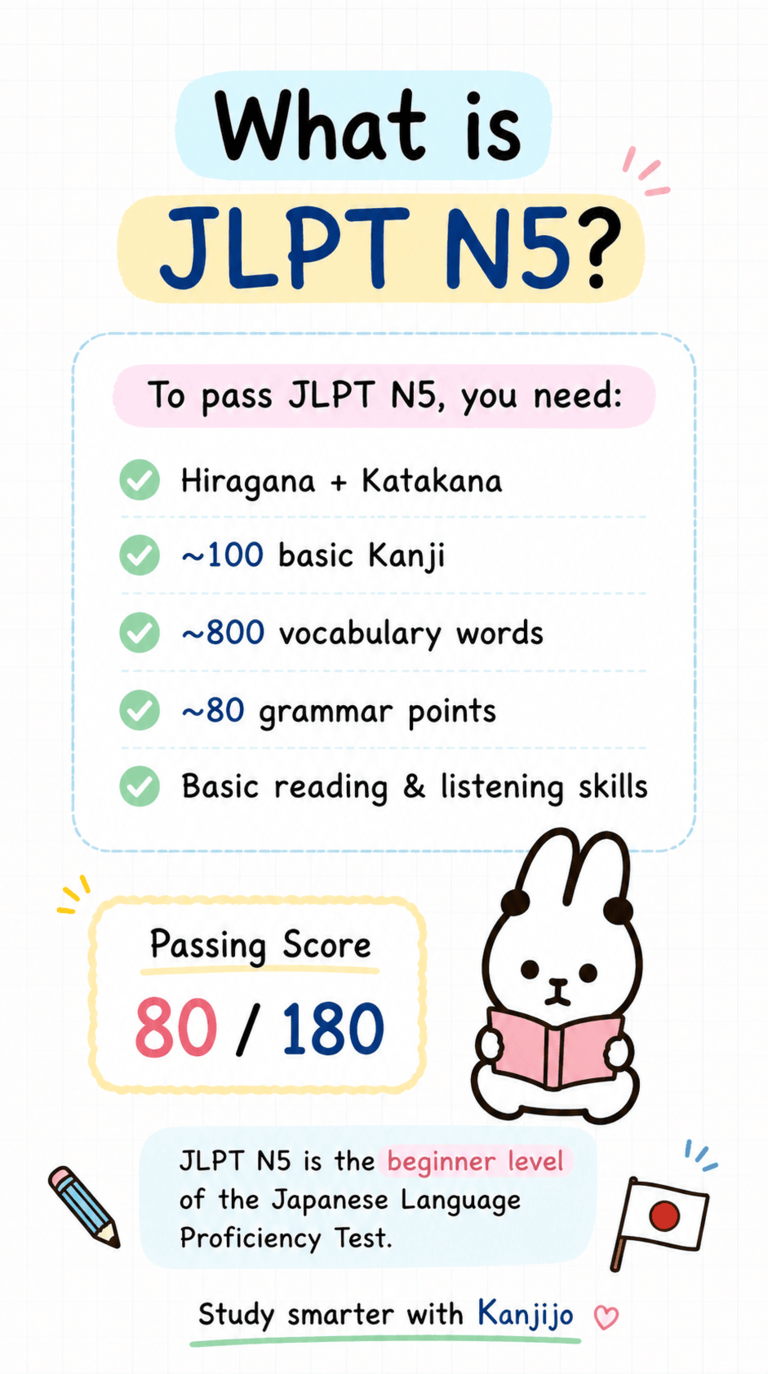
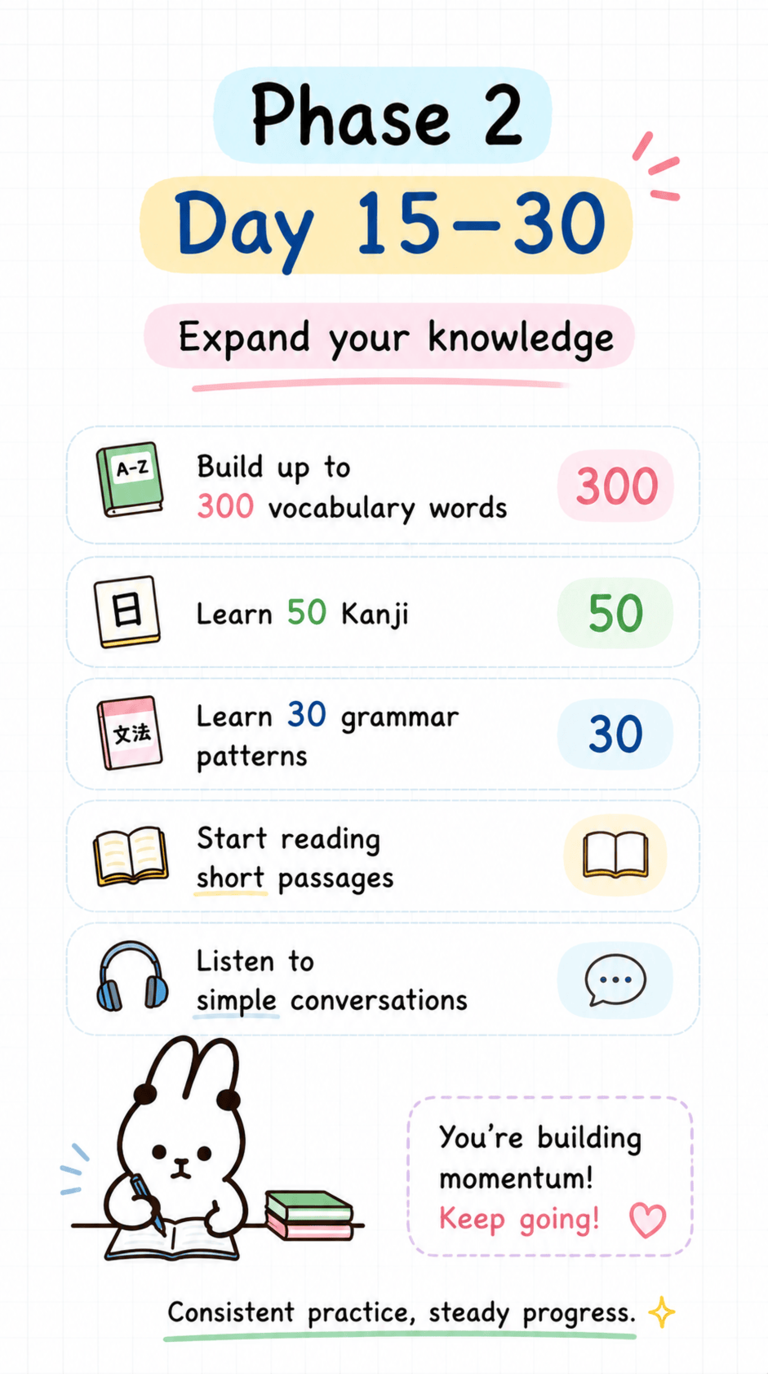
N5 kanji are the 100 most foundational characters in the language - numbers, directions, time, family, nature, body. Every one of them appears in 5–10 vocabulary words you will need for N5. This is the reason to study kanji first: each kanji is a vocabulary multiplier.
Learn 人 (person) and you immediately understand 日本人 (Japanese person), 外国人 (foreigner), 人口 (population). Each kanji is not one word - it is an entry point into a vocabulary cluster. Kanjijo's exclusive mnemonics for each kanji give you a vivid story that ties the character's shape to its meaning on the very first review. The mnemonic for 山 (mountain) connects the three peaks of the character to the shape of an actual mountain range - once you see it, you cannot un-see it.
• Kanjijo: 1 new Kanji+Vocab lesson (introduces kanji + 3–5 linked vocabulary words) - 10 min
• Complete all SRS reviews - 10 min
• Scan one real-world Japanese item with Kanjijo's OCR scanner (cereal box, product label, manga page) - 5 min
• Home screen widget: set to "Kanji of the Day" - review the mnemonic each time you glance
Phase 3 - Days 21–30: Grammar - Structure and Particles
Japanese grammar has a reputation for being impossible. It is not. At N5 level, you have approximately 100 patterns to learn, and about 30 of them are variations of the same handful of underlying rules. The cognitive load is dramatically lower than it seems - once you internalize that Japanese is SOV (Subject-Object-Verb) and that particles are the grammatical glue, the rest follows predictably.
The three grammar concepts that unlock 80% of N5 communication:
- は/が distinction - topic vs subject. は sets context; が identifies who/what. Master this and stop sounding like a grammar textbook.
- The て-form - the single most leveraged conjugation in Japanese. It connects actions (食べて飲む), makes requests (食べてください), expresses ongoing state (食べている), and forms permission patterns (食べてもいい). One form, eight patterns.
- Verb groups - Godan (Group 1), Ichidan (Group 2), and irregular. Once you know which group a verb belongs to, all conjugations follow mechanically.
Kanjijo's Grammar track covers every N5 pattern with example sentences, multiple choice drills, and fill-in-the-blank exercises - the same format used in the actual JLPT Language Knowledge section.
Phase 4 - Days 31–40: Vocabulary Expansion and Grammar Deepening
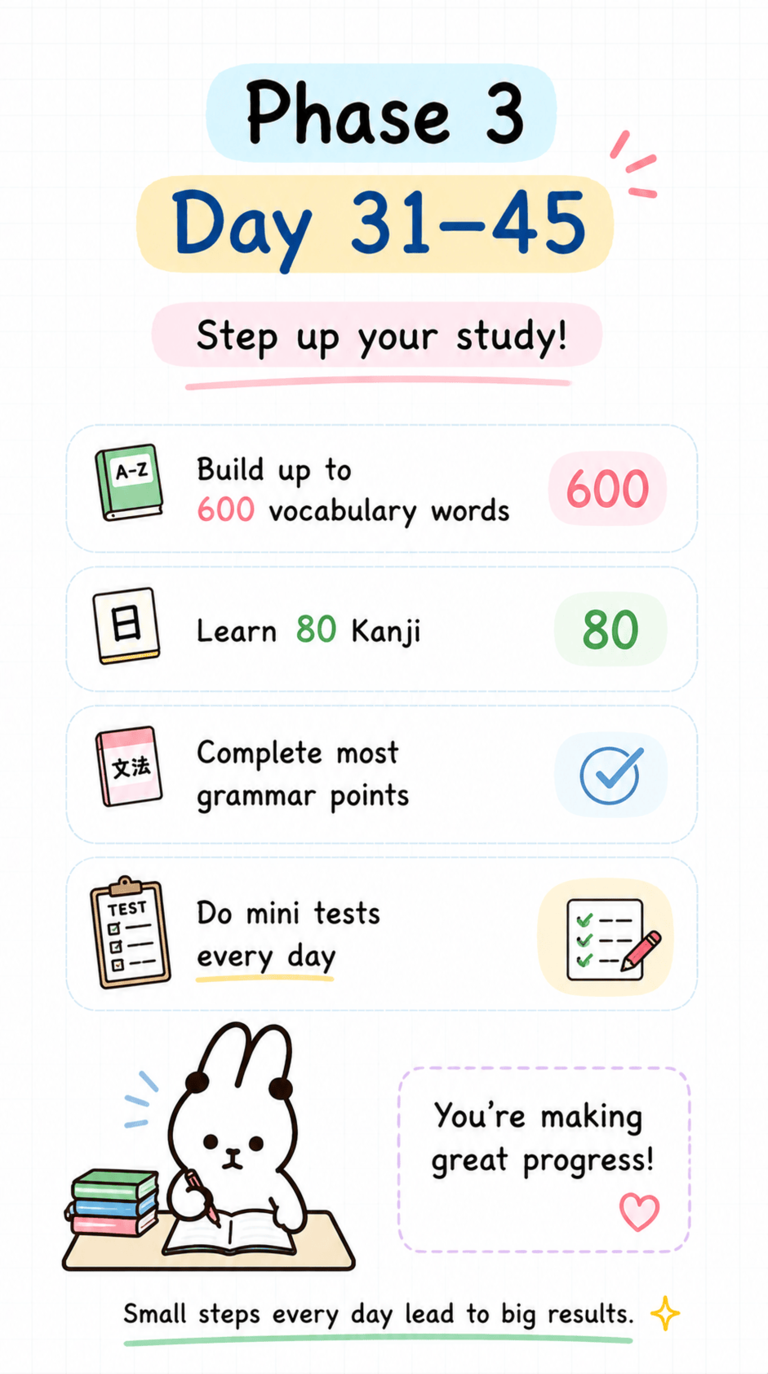
By Day 30, your SRS queue has grown significantly - you now have 200+ cards in review rotation. This is the phase where many learners panic and either start skipping reviews (fatal) or slow new items to zero (sub-optimal). The correct move is to let the algorithm guide you: complete every SRS review that appears, even on days when it feels like "all review, no progress."
Progress during Phase 4 happens inside your existing knowledge, not on top of it. The vocabulary words you half-knew in Week 2 are consolidating into durable long-term memory. The grammar patterns you drilled in Week 3 are connecting to real sentences in your SRS queue. This compounding effect is invisible but it is the mechanism that will carry you through the actual exam.
Phase 5 - Days 41–52: Reading Passages and Listening Practice
JLPT N5 has three graded question types in the Reading section: short notices (announcements, signs), medium passages (3–5 sentences with a question), and information-retrieval tasks (schedules, forms). Each type requires a different reading strategy.
For short notices: read the question first, then scan for the answer. For medium passages: identify the topic sentence, then read for supporting detail. For information-retrieval: go directly to the specific data point the question asks for. Kanjijo's JLPT Reading exercises are categorized by these exact types and include full explanations of why each answer is correct or incorrect - not just an answer key.
Listening at N5 is primarily about parsing complete sentences spoken at a slow, clear pace. The trap is vocabulary gaps: a single unknown word in a short exchange can make the whole question unintelligible. This is why SRS vocabulary acquisition earlier in the roadmap is non-negotiable - by Phase 5 you should have 500+ vocabulary words in active SRS rotation.
Phase 6 - Days 53–60: Mock Exam and Weak-Point Targeting
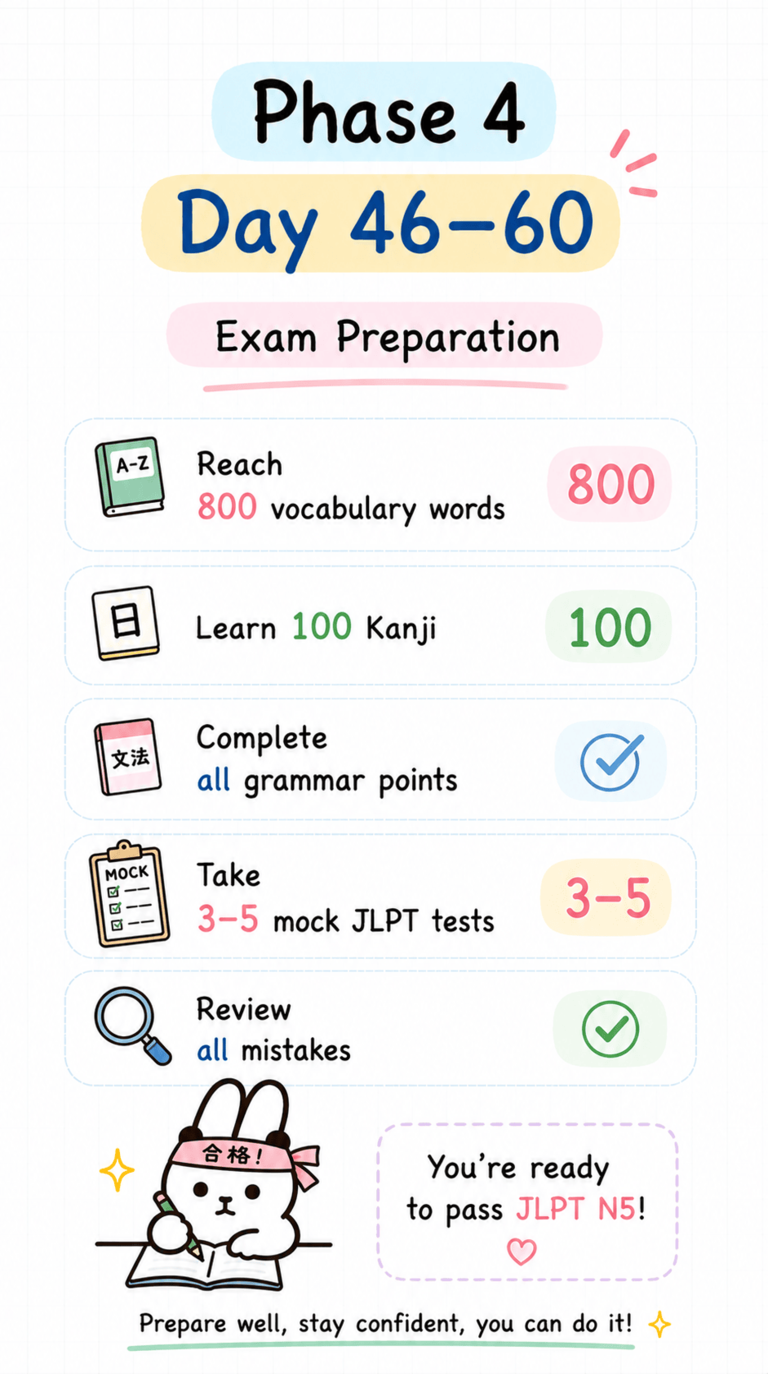
One week before the exam (or at Day 53 if self-studying), take a full timed JLPT N5 mock exam. Do not check answers mid-way. Replicate exam conditions exactly: no dictionary, no phone, 105 minutes total for Language Knowledge + Reading (25 min) + Listening (30 min).
After scoring, categorize your errors into three buckets:
- Vocabulary gap - you did not know the word at all. Return to Kanjijo SRS and prioritize cards marked "hard."
- Grammar uncertainty - you knew the words but could not parse the sentence. Re-study the specific grammar pattern in Kanjijo's Grammar track.
- Reading/Listening speed - you ran out of time or could not follow the audio. Practice with shorter timed sessions daily for the final week.
| What You Will Know at Day 60 | N5 Requirement | Coverage |
|---|---|---|
| Kanji recognized | ~100 | ~110 (Kanjijo includes surrounding N5+ context) |
| Vocabulary in SRS | ~800 | ~900+ (with reading context) |
| Grammar patterns drilled | ~100 | ~120 (Kanjijo N5 Grammar track) |
| Listening hours | Sufficient for slow, clear speech | ~12 hours (5 min/day + practice sessions) |
| Reading passages completed | Comfortable with short-medium texts | 30+ practice passages (Kanjijo Reading track) |
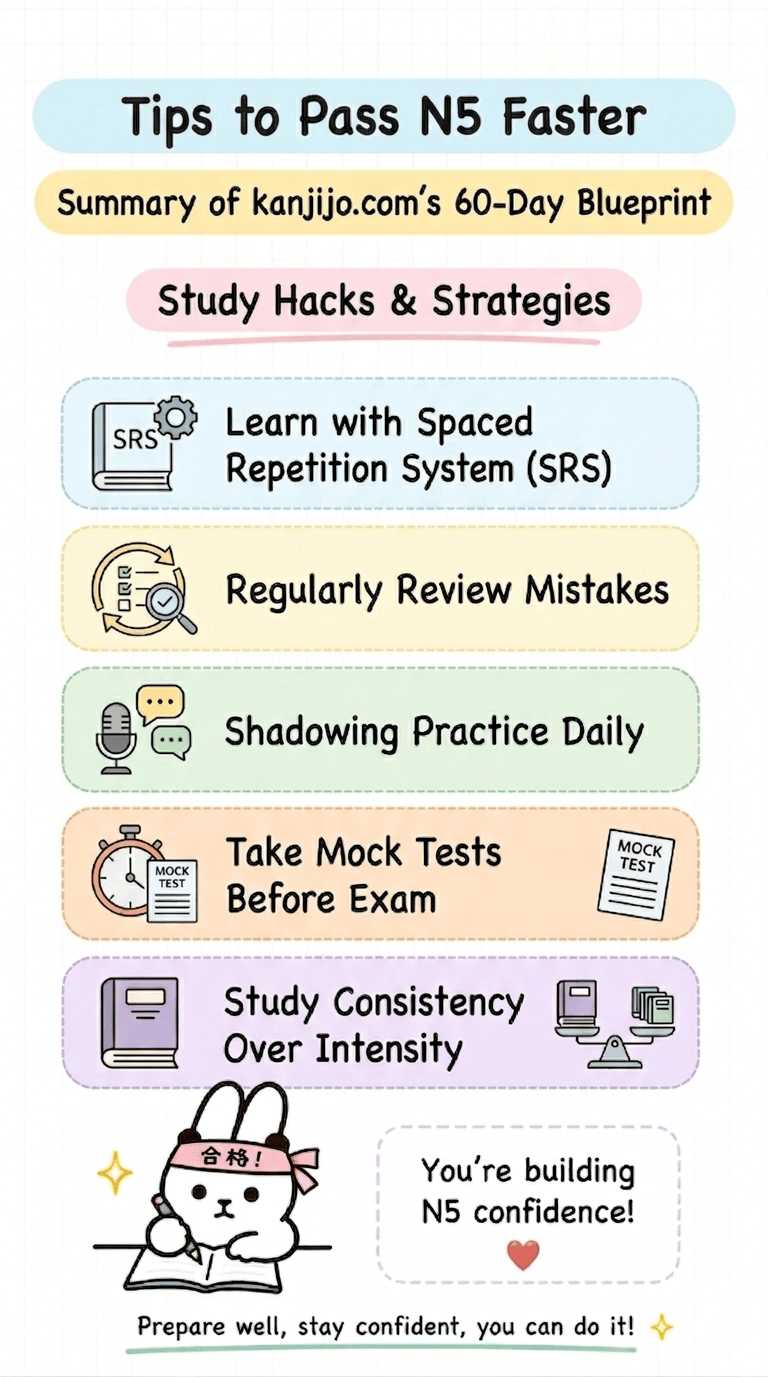
The Widget Layer: Why This Roadmap Works Even When You Miss a Day
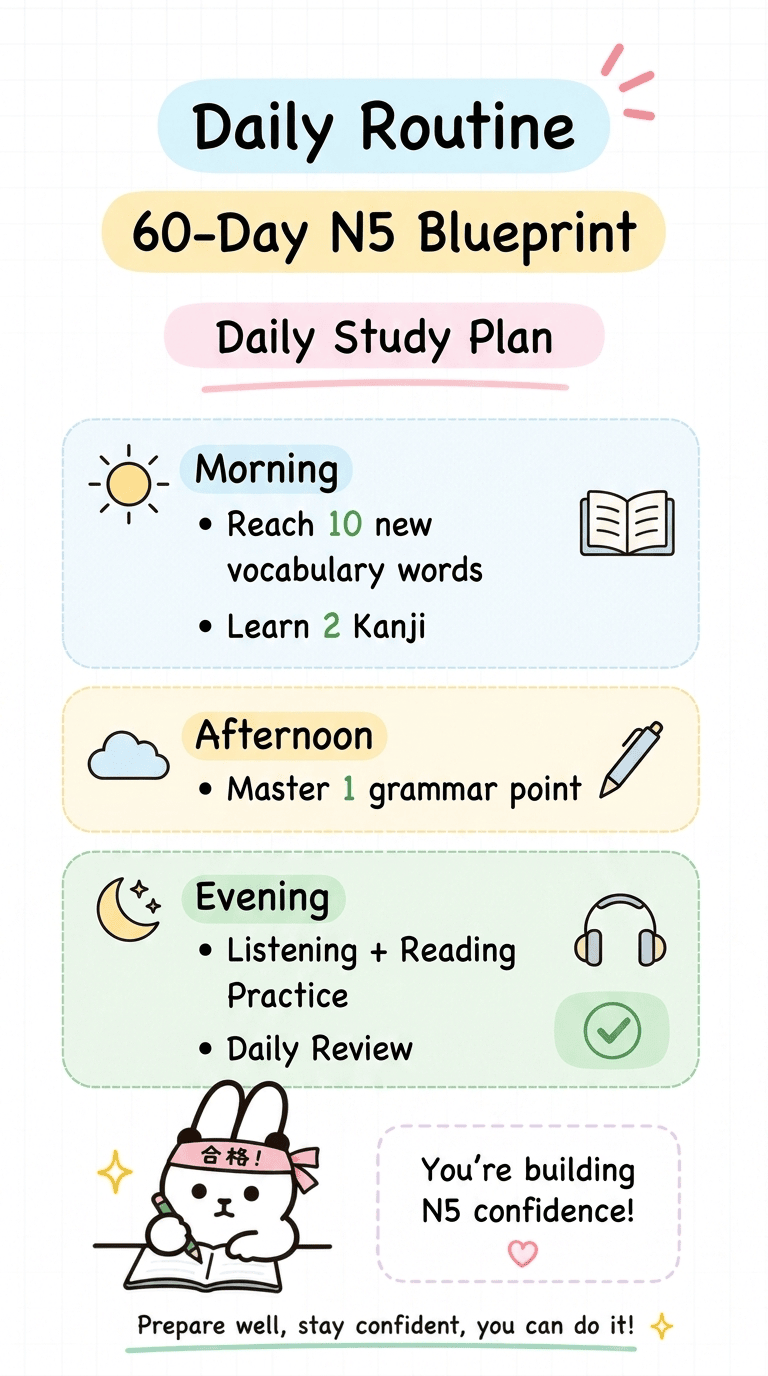
No 60-day plan survives contact with real life without contingency. Meetings overrun. Kids get sick. Motivation collapses on Tuesday. The difference between a plan that survives these interruptions and one that doesn't is ambient exposure - learning that happens without requiring an active session.
Kanjijo's three widget layers work exactly here. Your lock screen widget cycles through SRS-due content every time you check your phone. Your home screen widget shows the kanji or vocabulary you most need to review. The interactive test widget lets you tap a quick answer directly from the home screen without opening the app. On a day when you have zero time to study, 20 passive glances at your lock screen still reinforce 20 SRS items. Those micro-touches are not trivial - they are the emergency review layer that keeps your hard-won memory alive between sessions.
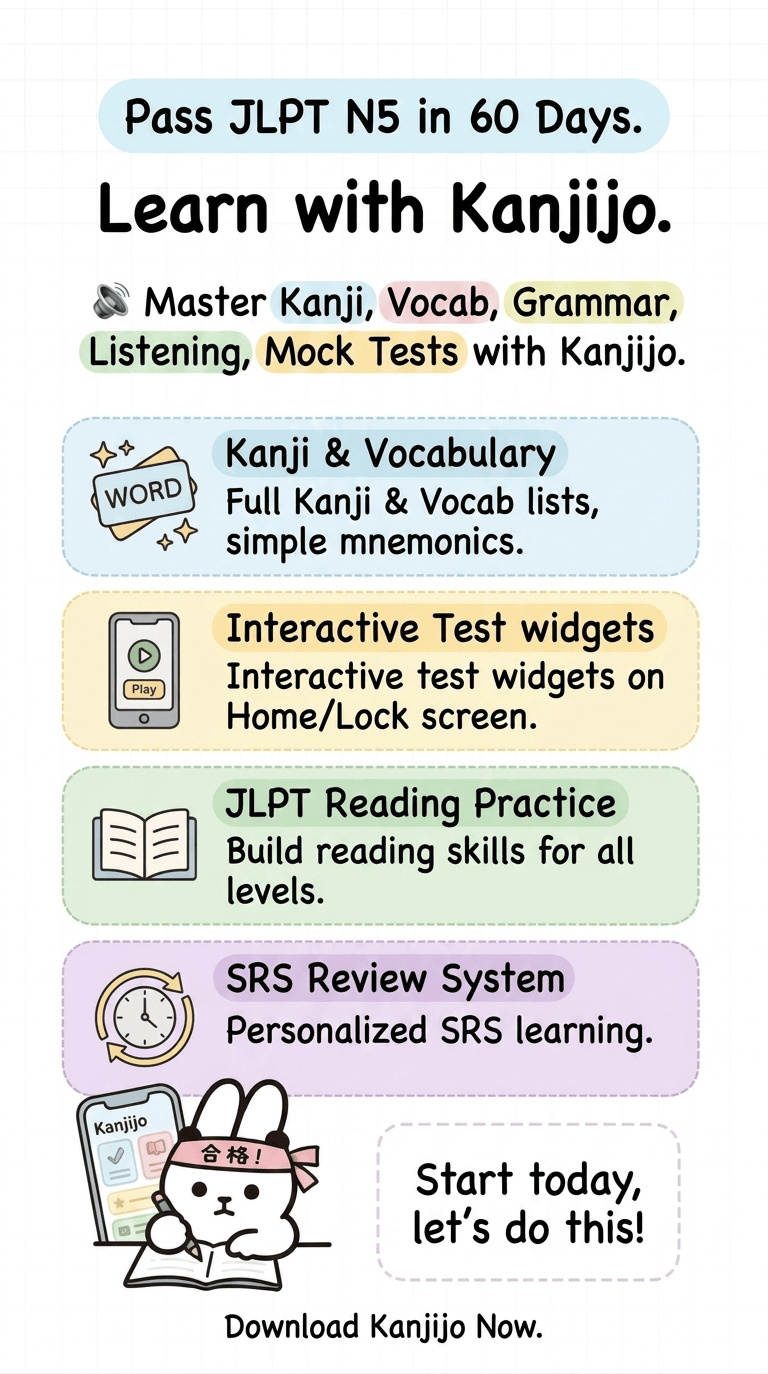
The N5 Mindset Shift: You Are Not Memorizing - You Are Building Infrastructure
The frustrating truth about JLPT N5 is that none of the content is the destination. N5 knowledge is infrastructure for everything above it. Every kanji you learn at N5 reappears in N4 vocabulary. Every grammar pattern you drill at N5 is extended and complicated at N3. The mnemonic you used for 山 at N5 will still be activating whenever you read 登山 (mountain climbing) at N3 or 山岳 (mountain range) at N1.
This is why Kanjijo links kanji, vocabulary, grammar and kana into a single coherent knowledge network - not four disconnected decks. When you learn 食 at N5, Kanjijo surfaces 食べる, 食べ物, 食事, 朝食, and 外食 simultaneously. Your brain builds a cluster, not a point. Clusters survive the forgetting curve. Points do not.
Continue Your Japanese Journey
- JLPT N5 Kanji List: all 80 core characters
- JLPT N5 Tips & Tricks - The Exam-Specific Edge
- The Japanese Forgetting Curve Explained
- What Is Spaced Repetition? The Science Behind SRS
- Complete Guide to Kanji Mnemonics
- The SRS Method for Hiragana Mastery
- 25 N5 verbs, from waking up to bed
- How to say what you want in Japanese (N5)
Frequently Asked Questions
Yes - for a motivated beginner with no prior Japanese exposure, 60 days at 20–30 minutes per day is sufficient to cover the full N5 syllabus. JLPT N5 requires approximately 100 hours of total study. At 25 minutes per day for 60 days you accumulate ~25 hours of focused study plus passive widget and ambient exposure. The key is using SRS so that every minute counts toward long-term retention.
Ideally spend the first 10 days on hiragana and katakana before adding vocabulary. Reading fluency in kana - the ability to parse characters at the speed of thought - dramatically accelerates every subsequent lesson. Kanjijo's JLPT Hiragana and JLPT Katakana tracks teach kana through real N5 vocabulary context, not isolated symbol drilling.
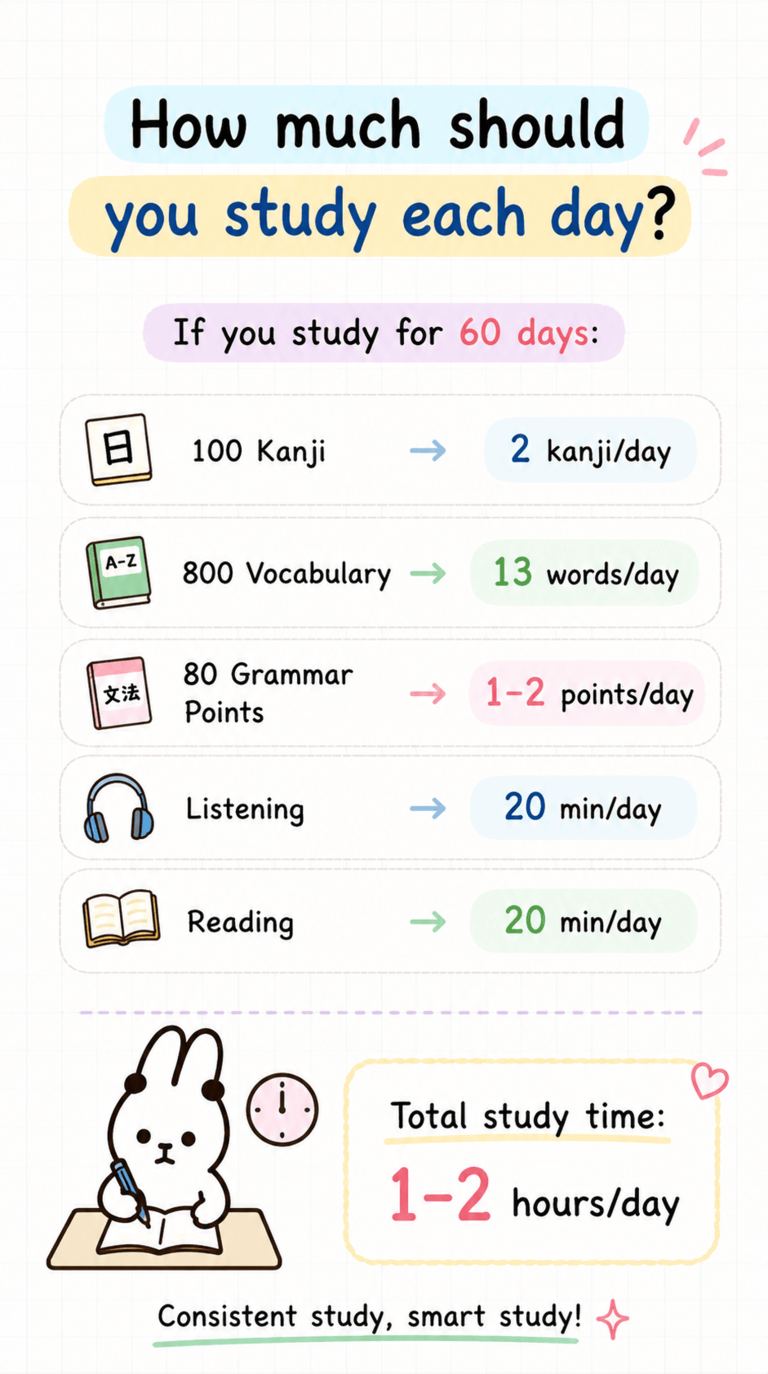
Aim for 1–2 new kanji, 5–8 new vocabulary words, and 1–2 new grammar patterns every other day. Kanjijo's free plan unlocks approximately this pace automatically (1 new lesson per day per content track). Overloading new items without giving SRS time to consolidate leads to review pile-up and burnout.
Kanjijo covers all six N5 content tracks in a single free app: Kanji+Vocab (with exclusive mnemonics for every item), JLPT Hiragana, JLPT Katakana, Grammar (all N5 patterns), JLPT Reading passages, and JLPT Listening exercises. No other free Japanese app provides this breadth of N5 content in one place with SRS spacing, lock screen widgets, and OCR scanning.
Missing one day does not reset your progress. The SRS algorithm simply queues those items for the next session. The lock screen widget continues passively cycling SRS-due content throughout the day. On a day you genuinely cannot study, 20 glances at your lock screen widget still reinforce 20 items - enough to prevent the forgetting cliff for most material.
What You Actually Get Inside Kanjijo
Kanjijo is one app that covers every part of Japanese, so you are not stitching together five tools. Here is the full list, as of 2026:
Everything in one app · free to start
- Complete kanji, vocabulary and grammar for all five JLPT levels — N5 through N1, in a fixed order with no gaps.
- Exclusive mnemonics written by hand for every kanji and every vocabulary word — not auto-generated, not borrowed from a public deck.
- SRS reviews that schedule each item right before you would forget it, so 10–15 minutes a day is enough.
- OCR camera scanner — point your phone at a menu, sign, manga panel or receipt and Kanjijo reads the Japanese and turns the words into cards.
- Lock screen widget — a new kanji or word every time you pick up your phone.
- Home screen widget — today’s review count and study item, visible without opening anything.
- Interactive test widget — answer a real question straight from the home screen, no app launch needed.
- JLPT reading practice — graded passages with the exact question types the real exam uses.
- JLPT listening practice — native audio exercises per level, including the trap-heavy formats.
- Full JLPT mock exams — timed, section-scored, so you know your weak section before test day.
- Conversation lessons — natural dialogues with every grammar point actually used in context, not bolted on.
- Shadowing — speak along with native audio and hear yourself against the model.
- Dictation — listen to real everyday Japanese and rebuild the sentence word by word.
- Learn from a video — paste a link to any Japanese video and Kanjijo turns what is spoken in it into a lesson: every sentence split into separate words, furigana on the kanji, and the grammar patterns named.
Start Your 60-Day N5 Blueprint Today
Download Kanjijo free and follow this exact roadmap. All six content tracks - Kanji, Vocabulary, Hiragana, Katakana, Grammar, Reading, Listening - are included. No credit card. No paywall on the core content.
Download Kanjijo Free