Katakana loanwords look familiar but sound strange because Japanese reshapes foreign words to its own sound system - テレビ is “TV,” マクドナルド is “McDonald’s.” The fix is to learn the recurring sound rules (long vowels, the small ッ, ファ/ティ sounds, and dropped consonants) and the most-misread words, so you can decode any katakana word on sight instead of sounding it out blindly.
Learn kana, then keep going. Kanjijo has hiragana and katakana courses and a Foundation course that takes you from the three scripts to reading a whole sentence. Download Kanjijo free on the App Store
You spent two months drilling katakana flashcards. You can read them character by character. Then a Japanese friend says "テレビ" and you have no idea they mean TV.
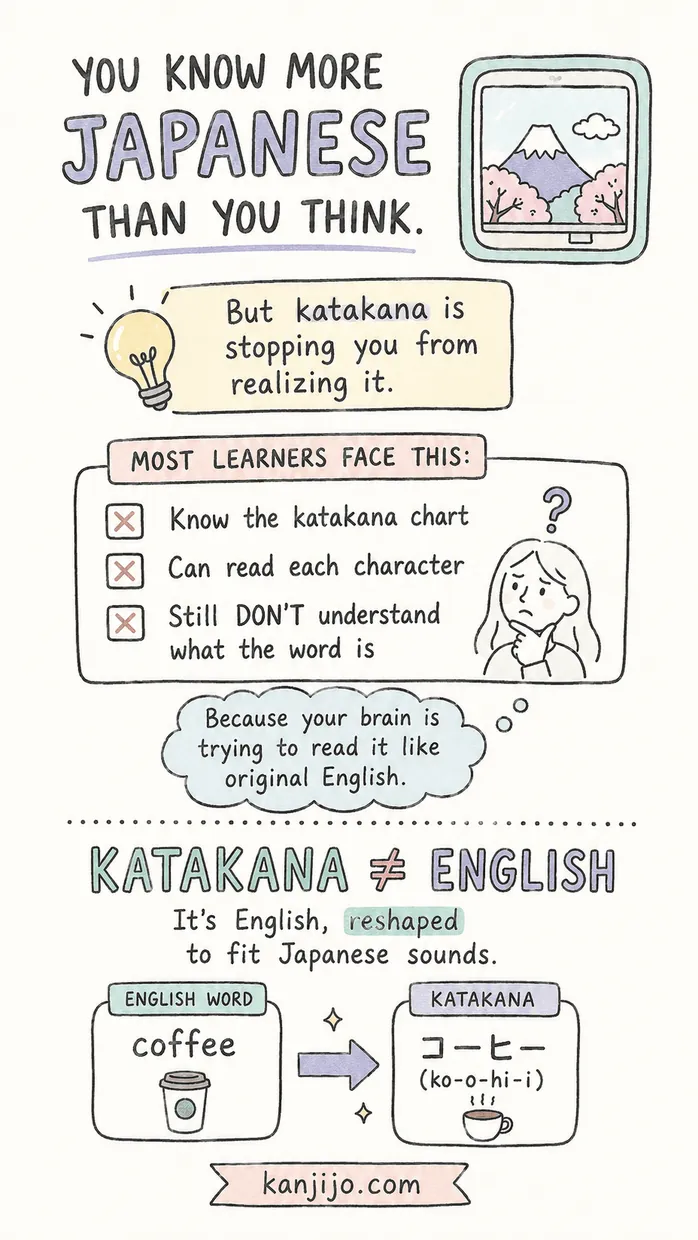
This is the katakana paradox: knowing the alphabet is not the same as understanding the words. Loanwords (gairaigo, 外来語) have been bent through Japanese phonology into shapes their English originals would barely recognize. This guide gives you the sound rules to decode them on the fly - plus a list of the 50 katakana words that trip up almost every learner.
Why Katakana Loanwords Look Wrong
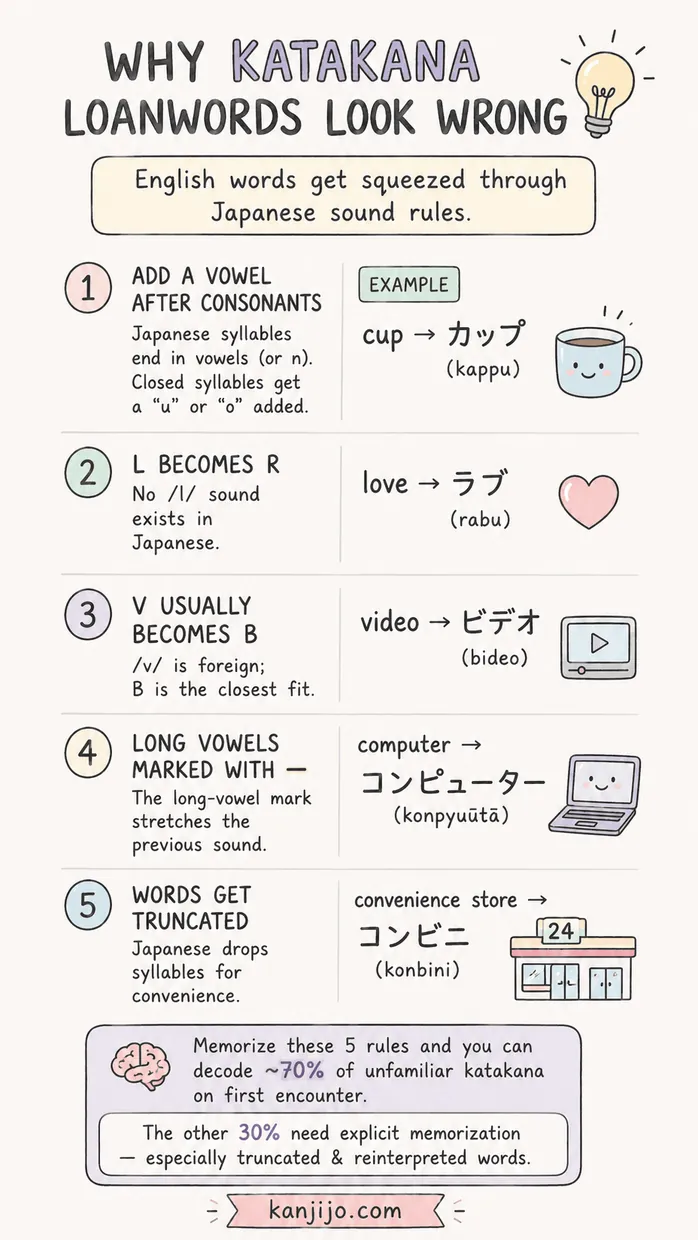
Japanese only allows certain sound combinations. When an English word enters Japanese, it gets squeezed through these rules:
| Rule | What changes | Example |
|---|---|---|
| 1. Add a vowel after consonants | Japanese syllables end in vowels (or n). Closed syllables get a "u" or "o" added. | cup → カップ (kappu) |
| 2. L becomes R | No /l/ sound exists in Japanese. | love → ラブ (rabu) |
| 3. V usually becomes B | /v/ is foreign; B is the closest fit. | video → ビデオ (bideo) |
| 4. Long vowels marked with – (ー) | The long-vowel mark stretches the previous sound. | computer → コンピューター (konpyuūtā) |
| 5. Words get truncated | Japanese drops syllables for convenience. | convenience store → コンビニ (konbini) |
Once you internalize these five rules, you can decode roughly 70% of unfamiliar katakana on first encounter. The other 30% need explicit memorization - especially the truncated and reinterpreted ones.
The 50 Most-Misread Katakana Loanwords
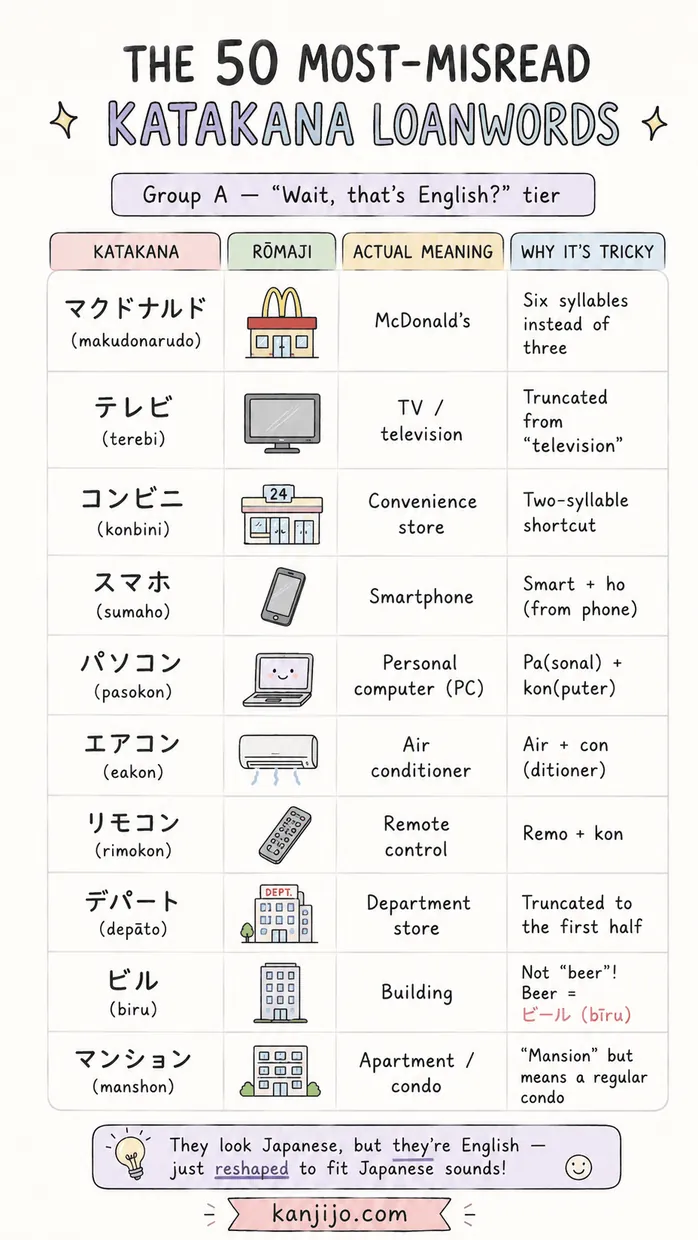
Group A - The "Wait, that's English?" tier:
| Katakana | Rōmaji | Actual meaning | Why it's tricky |
|---|---|---|---|
| マクドナルド | makudonarudo | McDonald's | Six syllables instead of three |
| テレビ | terebi | TV / television | Truncated from "television" |
| コンビニ | konbini | Convenience store | Two-syllable shortcut |
| スマホ | sumaho | Smartphone | Smart + ho (from phone) |
| パソコン | pasokon | Personal computer (PC) | Pa(sonal) + kon(puter) |
| エアコン | eakon | Air conditioner | Air + con(ditioner) |
| リモコン | rimokon | Remote control | Remo + kon |
| デパート | depāto | Department store | Truncated to first half |
| ビル | biru | Building | Not "beer"! Beer = ビール (bīru) |
| マンション | manshon | Apartment / condo | "Mansion" but means a regular condo |
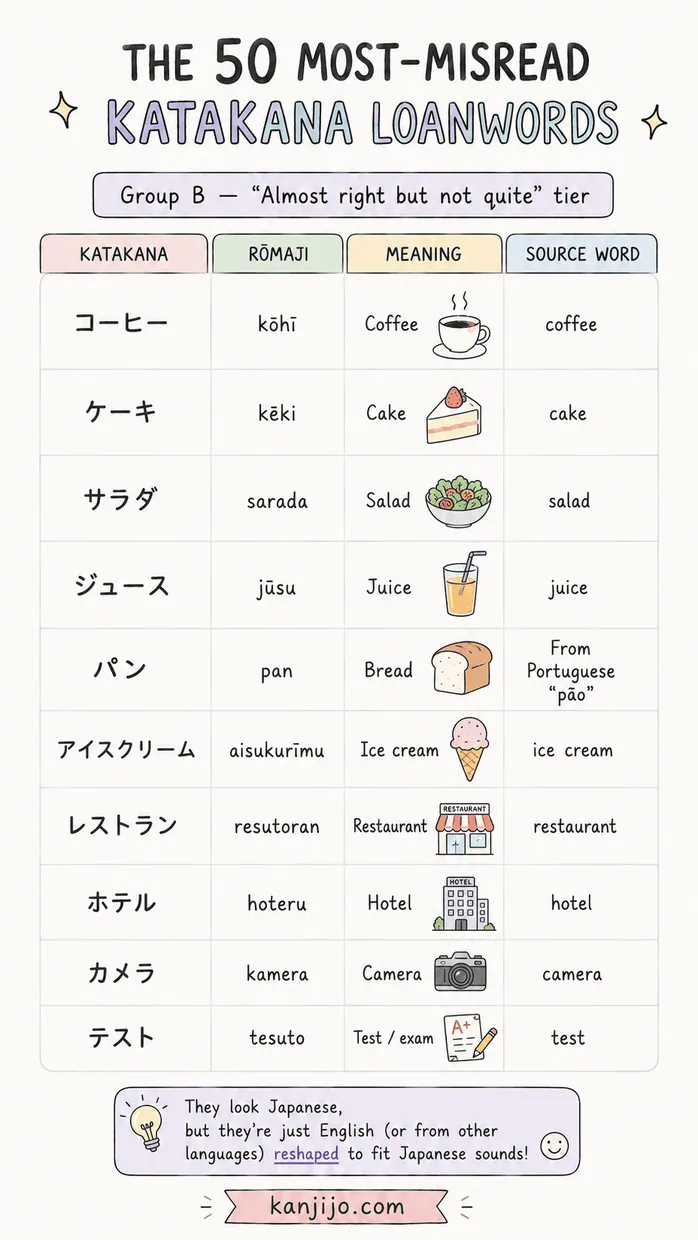
Group B - The "almost right but not quite" tier:
| Katakana | Rōmaji | Meaning | Source word |
|---|---|---|---|
| コーヒー | kōhī | Coffee | coffee |
| ケーキ | kēki | Cake | cake |
| サラダ | sarada | Salad | salad |
| ジュース | jūsu | Juice | juice |
| パン | pan | Bread | From Portuguese "pão" |
| アイスクリーム | aisukurīmu | Ice cream | ice cream |
| レストラン | resutoran | Restaurant | restaurant |
| ホテル | hoteru | Hotel | hotel |
| カメラ | kamera | Camera | camera |
| テスト | tesuto | Test / exam | test |
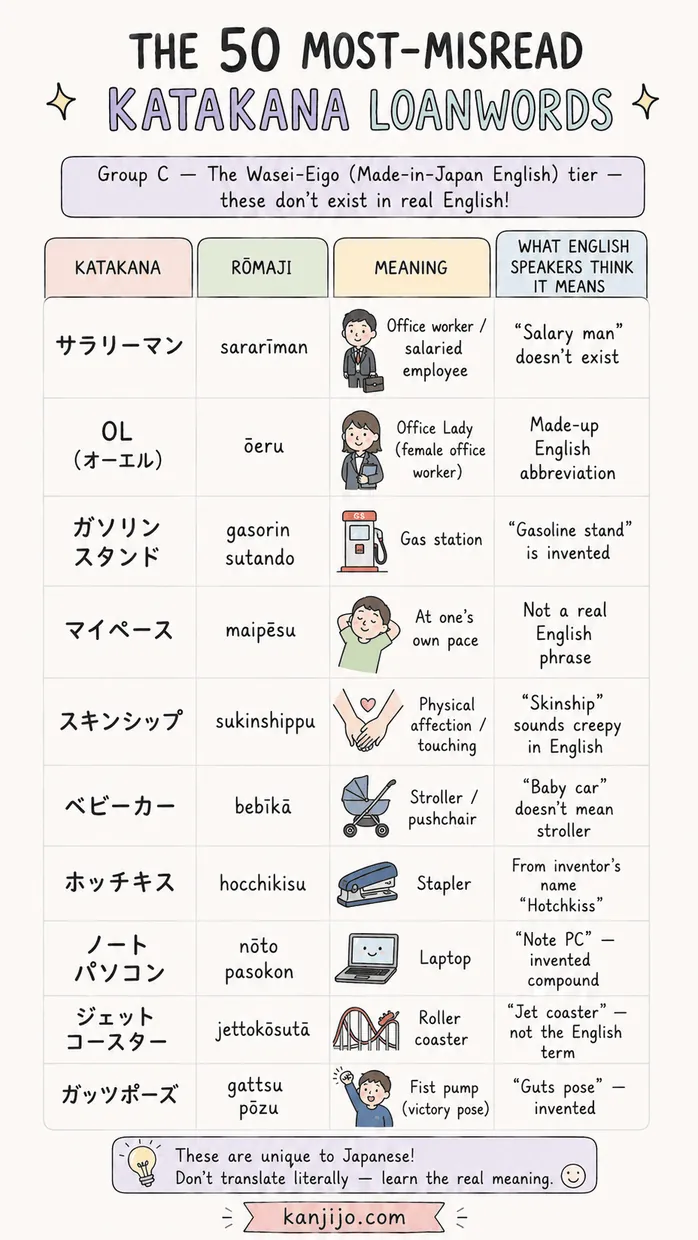
Group C - The Wasei-Eigo (Made-in-Japan English) tier - these don't exist in real English:
| Katakana | Rōmaji | Meaning | What English speakers think it means |
|---|---|---|---|
| サラリーマン | sararīman | Office worker / salaried employee | "Salary man" doesn't exist |
| OL (オーエル) | ōeru | Office Lady (female office worker) | Made-up English abbreviation |
| ガソリンスタンド | gasorin sutando | Gas station | "Gasoline stand" is invented |
| マイペース | maipēsu | At one's own pace | Not a real English phrase |
| スキンシップ | sukinshippu | Physical affection / touching | "Skinship" sounds creepy in English |
| ベビーカー | bebīkā | Stroller / pushchair | "Baby car" doesn't mean stroller |
| ホッチキス | hocchikisu | Stapler | From inventor's name "Hotchkiss" |
| ノートパソコン | nōto pasokon | Laptop | "Note PC" - invented compound |
| ジェットコースター | jettokōsutā | Roller coaster | "Jet coaster" - not the English term |
| ガッツポーズ | gattsu pōzu | Fist pump (victory pose) | "Guts pose" - invented |
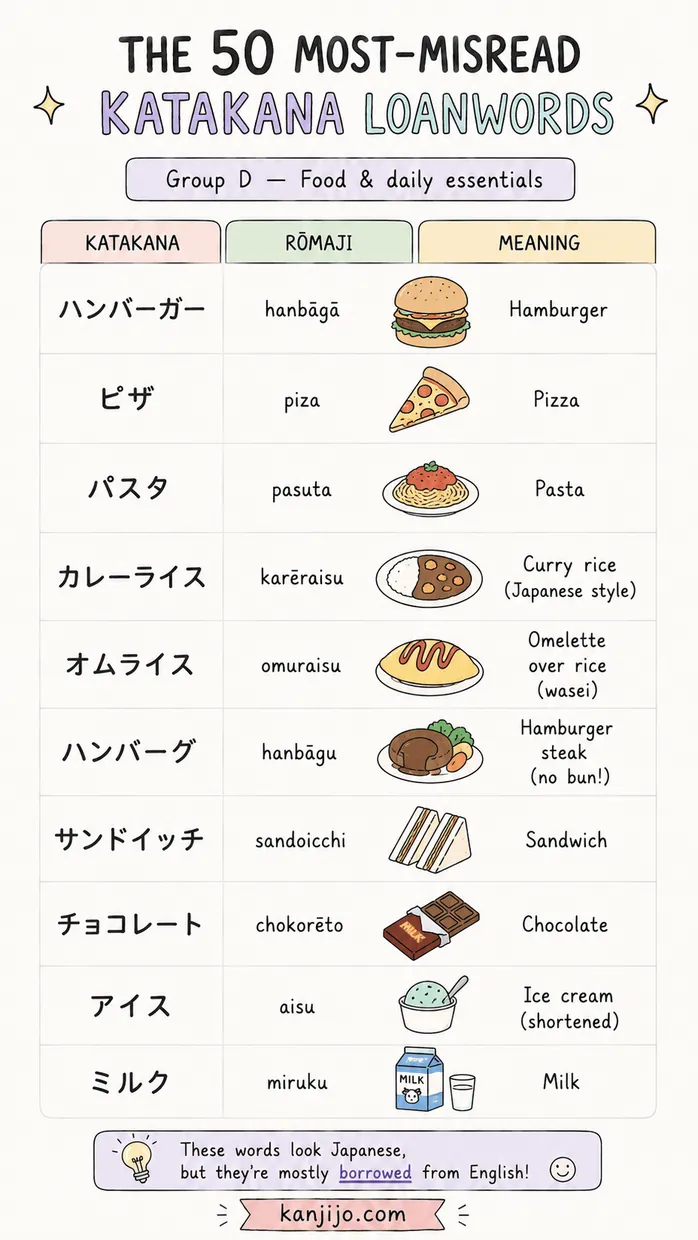
Group D - Food & daily essentials:
| Katakana | Rōmaji | Meaning |
|---|---|---|
| ハンバーガー | hanbāgā | Hamburger |
| ピザ | piza | Pizza |
| パスタ | pasuta | Pasta |
| カレーライス | karēraisu | Curry rice (Japanese style) |
| オムライス | omuraisu | Omelette over rice (wasei) |
| ハンバーグ | hanbāgu | Hamburger steak (no bun!) |
| サンドイッチ | sandoicchi | Sandwich |
| チョコレート | chokorēto | Chocolate |
| アイス | aisu | Ice cream (shortened) |
| ミルク | miruku | Milk |
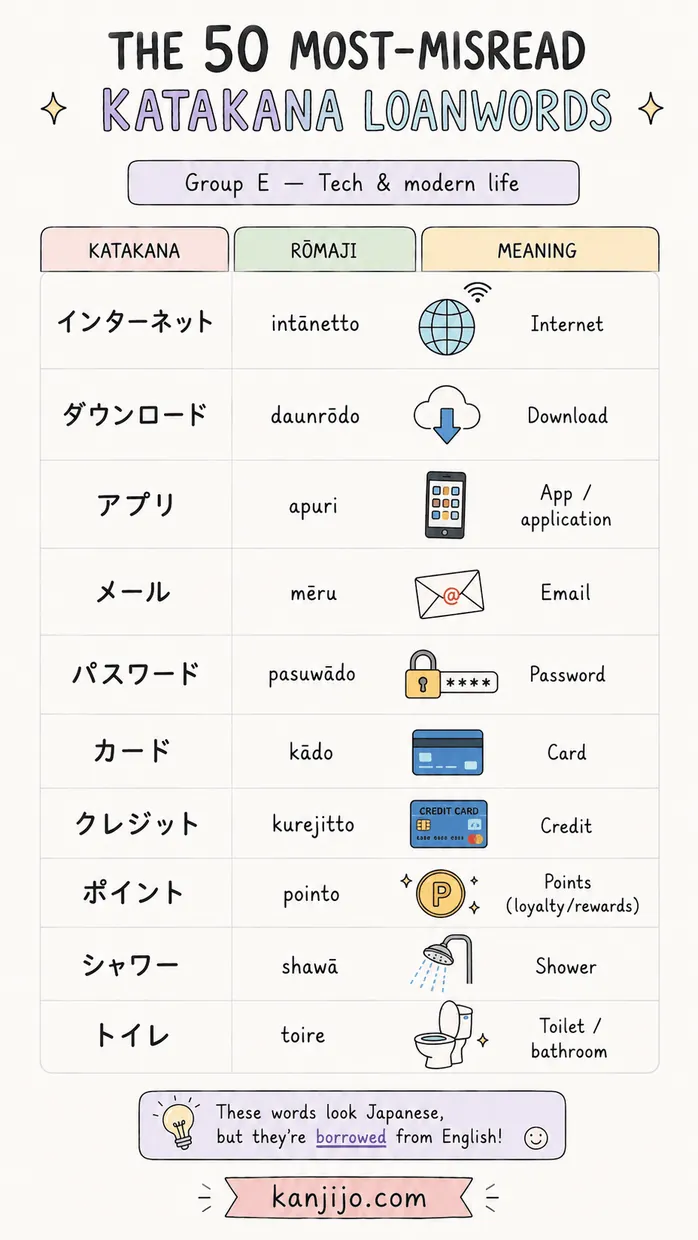
Group E - Tech & modern life:
| Katakana | Rōmaji | Meaning |
|---|---|---|
| インターネット | intānetto | Internet |
| ダウンロード | daunrōdo | Download |
| アプリ | apuri | App / application |
| メール | mēru | |
| パスワード | pasuwādo | Password |
| カード | kādo | Card |
| クレジット | kurejitto | Credit |
| ポイント | pointo | Points (loyalty/rewards) |
| シャワー | shawā | Shower |
| トイレ | toire | Toilet / bathroom |
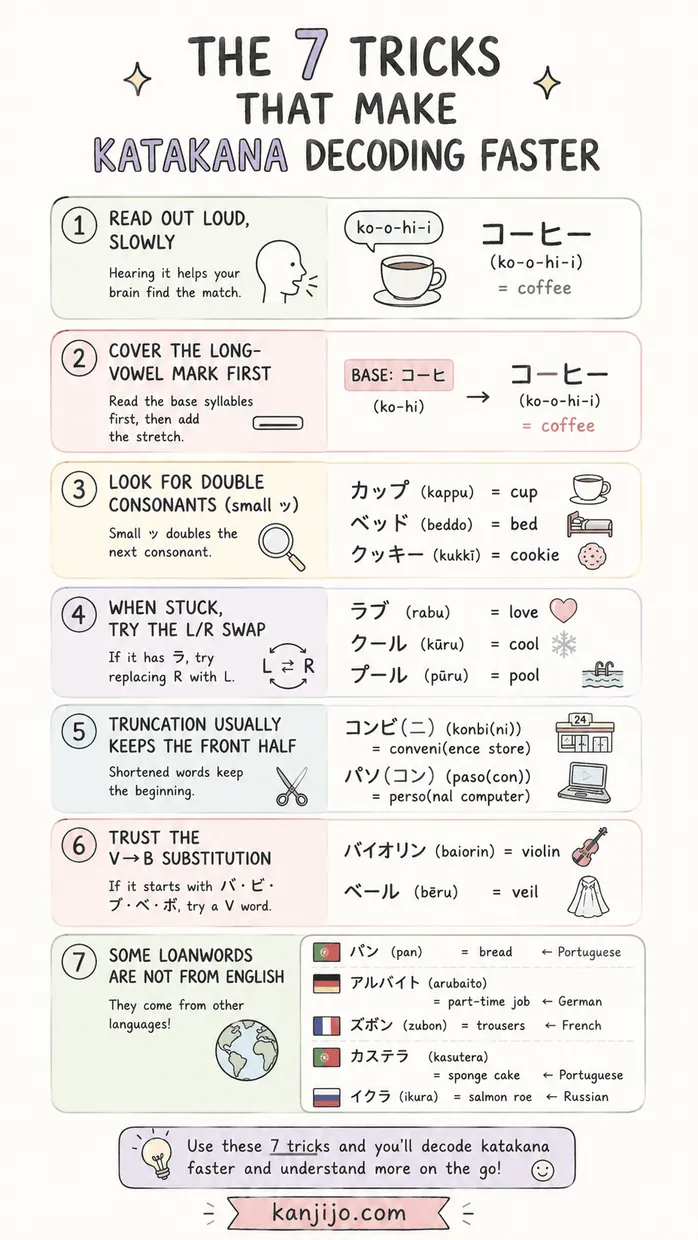
The 7 Tricks That Make Katakana Decoding Faster
Trick 1: Read out loud, slowly
Katakana words click when you hear them. Reading silently in your head won't activate the English match. Whisper if you must - but pronounce it.
Trick 2: Cover the long-vowel mark first
The ー symbol confuses pattern recognition. Read the base syllables first, then add the stretch.
Trick 3: Look for double consonants (small ッ)
The small ッ doubles the next consonant. カップ (kappu) → cup, ベッド (beddo) → bed, クッキー (kukkī) → cookie.
Trick 4: When stuck, try the L/R swap
Saw ラ in a confusing word? Try replacing R with L. ラブ = love. クール = cool. プール = pool.
Trick 5: Truncation usually keeps the front half
Most loanword shortcuts preserve the beginning. コンビ(ニ) = conveni(ence). パソ(コン) = perso(nal computer).
Trick 6: Trust the V→B substitution
If a word starts with バ, ビ, ブ, ベ, ボ, try a V version too. バイオリン = violin. ベール = veil.
Trick 7: Some loanwords are NOT from English
Watch for these non-English origins:
- パン (bread) ← Portuguese pão
- アルバイト (part-time job) ← German Arbeit
- ズボン (trousers) ← French jupon
- カステラ (sponge cake) ← Portuguese castella
- イクラ (salmon roe) ← Russian ikra
Train Katakana the Smart Way
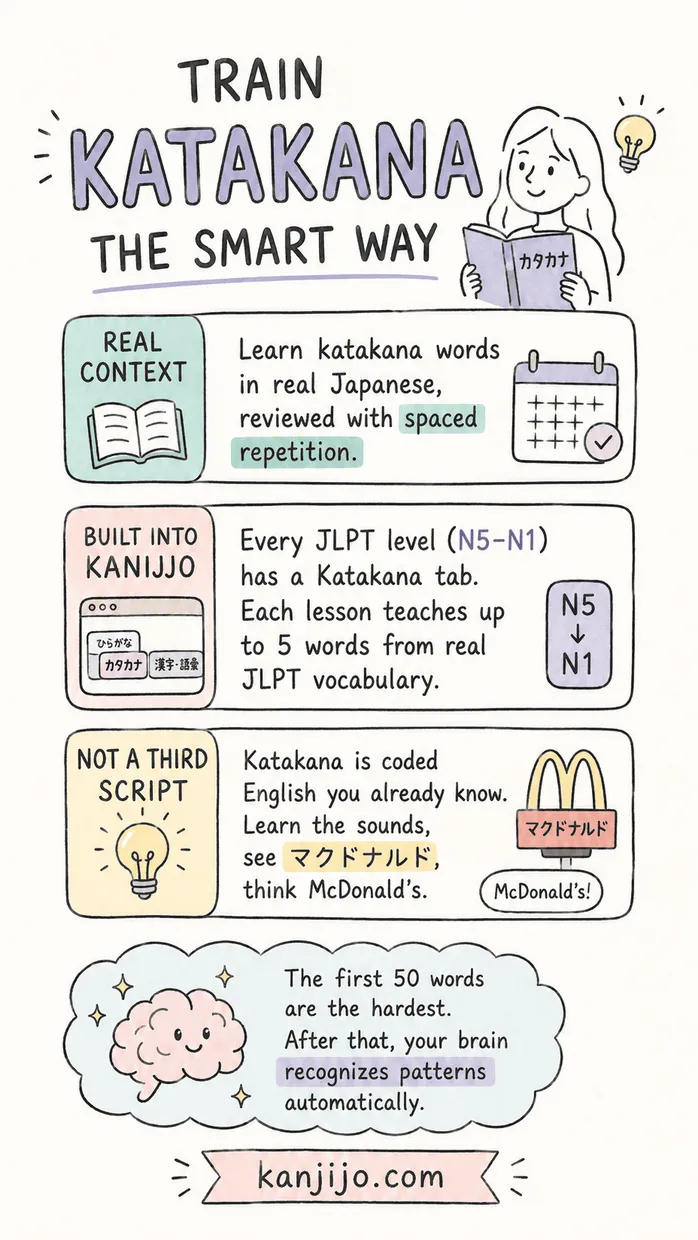
Memorizing isolated character charts won't fix the gap between "I can read it" and "I understand it". You need katakana words inside real Japanese context, reviewed on a spaced repetition schedule.
Inside Kanjijo, every JLPT level (N5 through N1) now has a dedicated Katakana tab alongside the Hiragana and Kanji & Vocab tabs. Each lesson holds up to 5 katakana words mapped from real JLPT vocabulary - so you're learning loanwords in the order you'll actually encounter them, not in alphabetical isolation.
Bonus: Every katakana word you swipe through automatically enters your SRS queue. The lesson test mixes "katakana → meaning" with "meaning → katakana" so both directions get drilled. By N3, the loanwords stop feeling foreign.
Free tool
Drill hiragana and katakana right here in your browser — all 46 base characters plus dakuten and combination kana, in either direction, with the full charts underneath. No signup.
Open the free kana quizDecode Every Katakana Word with Kanjijo
Kanjijo teaches katakana and loanwords in context with audio and exclusive mnemonics, then locks them in with one SRS engine so テレビ and マクドナルド click instantly. Spot a katakana sign in the wild? The OCR scanner turns it into a flashcard, and home & lock screen widgets review it for you - all on a full JLPT N5–N1 path with reading, listening, video dictation drills (where loanwords fly by at natural speed) and mock tests.
Download Kanjijo FreeFinal Word
Katakana isn't a third script you have to fight - it's a coded version of English you already know. Once the sound rules click, you'll see マクドナルド and just hear McDonald's. The first 50 words are the hardest. After that, your brain will start recognizing patterns automatically.
Print the tables above. Photograph them. Quiz yourself on the wasei-eigo list once a week. In a month, the loanwords that used to look impossible will read like text messages from a friend.