I built Kanjijo because I was tired.
Not tired of learning Japanese - tired of the apps that were supposed to help me learn it. The owl that guilt-trips you. The confetti that erupts every time you tap the right answer. The push notification at 11:43pm that says “Don’t lose your streak!” while you’re trying to fall asleep. The XP bar. The leaderboards. The progress bar that fills up dramatically and means absolutely nothing about whether you can actually read a Japanese sentence.
Somewhere along the way, language learning apps stopped trying to teach you a language. They started trying to retain you as a user. And those are not the same thing.
Gamification Is Not Learning. It’s a Treadmill.
The dirty secret of gamified language apps is that the game and the learning are pulling in opposite directions.
Streaks reward attendance, not retention. You can do five seconds of tapping every day for two years, never form a single Japanese sentence on your own, and still have a 730-day streak. The app is delighted with you. Your Japanese is exactly where it started.
XP rewards activity, not understanding. The fastest way to earn XP in any gamified app is to do the easiest exercises repeatedly. So that’s what users do. They optimize for the metric the app shows them - and that metric is not “Can you read manga yet?”
Confetti rewards guessing right, not knowing. The dopamine hit fires whether you carefully recalled the answer or guessed between two options. Over time, your brain learns to chase the hit, not the meaning.
The Moment I Decided to Build Something Different
I had been studying Japanese using one of the most popular apps on the App Store. My streak was over 200 days. My XP was in the top 1%. I felt productive. I felt like a learner.
Then I tried to read the menu at a Japanese restaurant. I couldn’t.
Not some of it. None of it.
Two hundred days. Top 1% XP. Couldn’t read 焼き鳥. Couldn’t read 唐揚げ. Couldn’t even read 牛.
I stared at that menu and realized: the app didn’t fail me. I had been letting the app pretend to teach me. Because the pretending felt good. The pretending had a streak counter and a green owl and a leaderboard.
That night, I started planning Kanjijo.
Three Principles I Built Around
1. No Streaks. No Shame. No Punishment.
Kanjijo has no streak counter. None. The day you skip is just a day you skipped - no broken chain, no angry owl, no public guilt.
Why? Because the goal of language learning isn’t showing up daily. The goal is retaining what you learned. SRS already does this. If a card is due, the app tells you. If life gets in the way, the cards wait. Your relationship with Japanese should not be transactional with an app - it should be patient and personal with the language itself.
2. Calm Visuals. No Confetti. No Sound Effects.
Open Kanjijo and the first thing you notice is what isn’t there. No bouncing characters. No bright reds and greens. No celebratory animations every time you tap a button.
Just a quiet, off-white background. Soft typography. A kanji, sitting in space, the way a kanji deserves to sit.
Calm visuals aren’t a design choice. They’re a cognitive choice. Animations and sound effects compete with the kanji for attention. Every “tada!” you remove gives the brain another second to actually encode what it just saw.
3. Real Progress, Not Fake Progress
Most apps have a progress bar that fills up because you tapped buttons. Kanjijo has a zen garden that grows because you actually learned things.
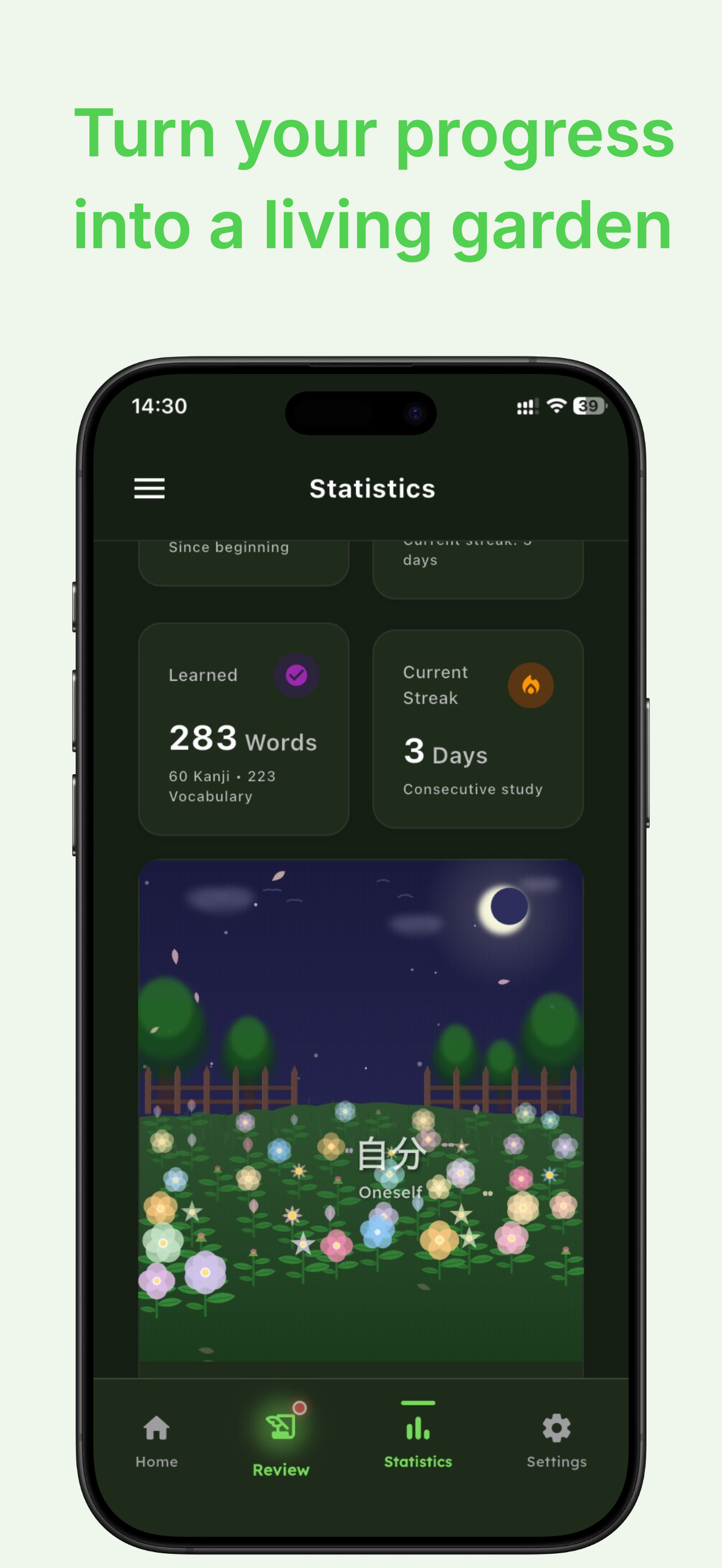
- Every kanji that reaches mastered SRS level plants a tree
- Every grammar point you master blooms a flower
- Every JLPT level you complete unlocks a new pavilion
- Nothing ever resets. Nothing ever shames you for not visiting.
The garden is slow. It’s patient. It only grows when you actually know something. And one day you look up and realize the garden is full - because you’ve quietly become someone who can read Japanese.
The Counter-Argument I Kept Hearing
Every time I told someone “Kanjijo doesn’t have streaks,” they said the same thing: “But I need streaks. I’m not disciplined enough without them.”
I understand the fear. But here’s what I’ve come to believe: streaks don’t make you disciplined. They make you compliant. The day you break the streak, you don’t suddenly recover discipline - you usually quit entirely. The streak was load-bearing, and once it’s gone, the whole structure collapses.
True discipline is the ability to come back on day 11 after missing 10 days, with no shame, no punishment, no rebuilt streak to chase. Kanjijo is built for the comeback, not the chain.
What Kanjijo Has Instead of Gamification
- SRS done right - a spaced-repetition engine that surfaces the exact card your brain is about to forget. No cards you already know. No cards you’re not ready for.
- Mnemonic system - visual memory aids that turn radicals into stories, not just shapes to memorize.
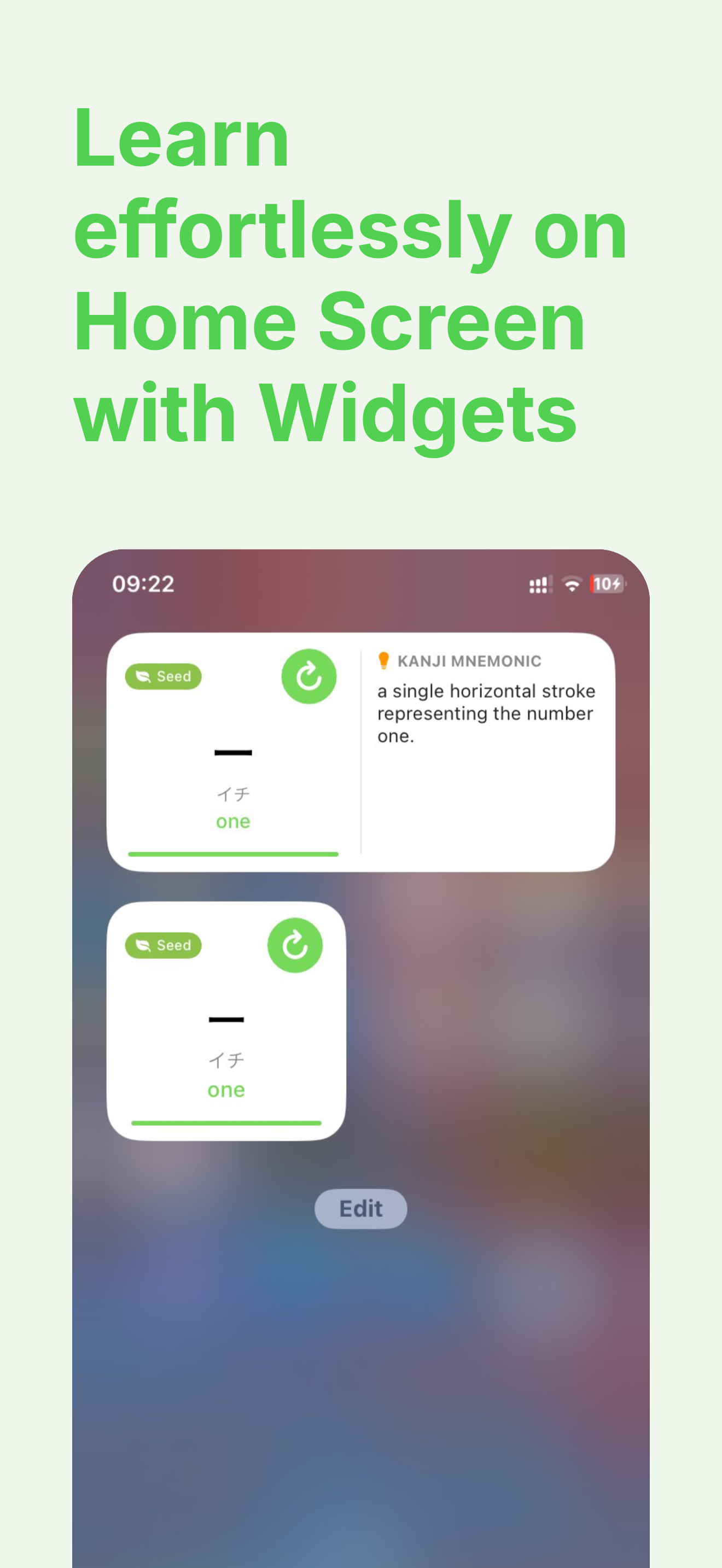
- Lock screen and home screen widgets - passive exposure throughout the day, so your “study time” doesn’t even need to be study time.
- OCR scanner - point your camera at any Japanese text - a sign, a menu, a manga page - and Kanjijo breaks it down word by word. Real-world Japanese, instantly decoded.
- Test widgets and quiz widgets - micro-quizzes on your home screen that count toward real SRS progress.
- Full content - kanji, vocabulary, grammar, hiragana, katakana from JLPT N5 to N1. No artificial gating.
The People Kanjijo Is For
Kanjijo isn’t for everyone. It’s honestly not for the casual learner who just wants a streak to brag about. It’s for the person who:
- Wants to actually read Japanese, not just collect points
- Has been burned by gamified apps that gave them streaks but no fluency
- Prefers calm tools over loud ones
- Trusts SRS science more than dopamine triggers
- Wants the freedom to skip a day without being punished
- Believes a slow garden is more honest than a flashy progress bar
If You’re Tired Too
If you’ve ever uninstalled a Japanese app because the notifications became hostile, this is the app I built for that version of you.
If you’ve ever finished a 365-day streak and realized you still couldn’t read manga, this is the app I built for that version of you.
If you’ve ever wanted Japanese learning to feel less like a video game and more like tending something patient and beautiful - that’s the app I tried to make.
The garden grows quietly. You don’t have to.
Related Reading on Kanjijo
Frequently Asked Questions
Streaks reward attendance, not learning. They turn studying into a transaction with the app rather than a relationship with the language. Kanjijo is intentionally streak-free so that every session is a choice, not a debt.
The opposite. Gamification often distracts from the actual learning loop. Kanjijo replaces dopamine triggers with a clean SRS engine, calm visuals, and a quiet zen garden that grows as you learn - depth instead of noise.
Every kanji you master plants a tree. Every grammar point blooms a flower. Every JLPT level unlocks a new pavilion. It’s a slow, honest reflection of real progress - not arbitrary XP.
Try a Quieter Way to Learn Japanese
Download Kanjijo and find out what learning Japanese feels like without the noise. No streaks. No confetti. Just a garden that grows when you do.
Download Kanjijo Free