Why JLPT Grammar Feels Impossible
Every Japanese learner hits the same wall. You finish N5 grammar feeling decent, then open an N4 list and see ~してしまう, ~ようになる, ~ばよかった, ~ところだった, ~らしい, ~みたい, ~そう (hearsay vs appearance)… and motivation evaporates. Then N3 doubles it. Then N2 doubles it again. Then you discover N1 has structures you've never even seen in a manga.
Practise this pattern in real sentences. Kanjijo explains 476 grammar points from N5 to N1, each with example sentences and a short quiz. Download Kanjijo free on the App Store
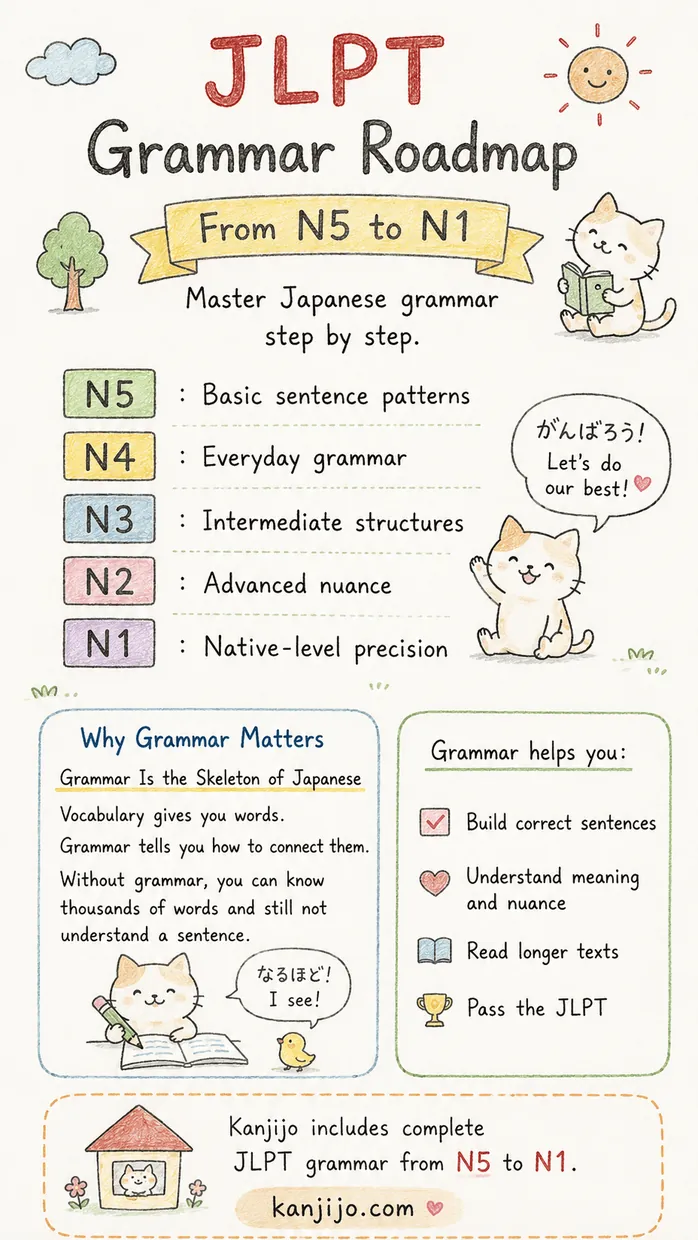
The overwhelm is real, but it isn't because Japanese grammar is infinite. It's because most lists are flat - 600 unrelated entries - when the actual underlying system has only about 12 patterns that get conjugated, nuanced, and recombined.
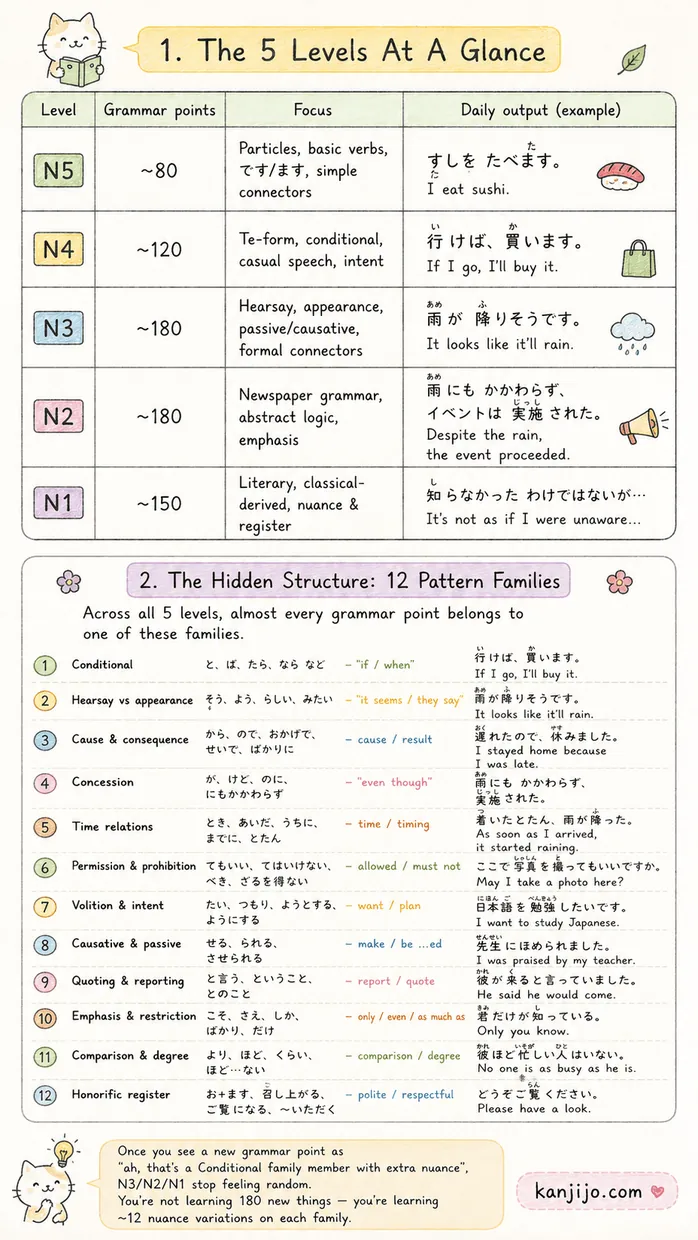
The 5 Levels At A Glance
| Level | Grammar points | Focus | Daily output |
|---|---|---|---|
| N5 | ~80 | Particles, basic verbs, です/ます, simple connectors | "I eat sushi." |
| N4 | ~120 | Te-form, conditional, casual speech, intent | "If I go, I'll buy it." |
| N3 | ~180 | Hearsay, appearance, passive/causative, formal connectors | "It looks like it'll rain." |
| N2 | ~180 | Newspaper grammar, abstract logic, emphasis | "Despite the rain, the event proceeded." |
| N1 | ~150 | Literary, classical-derived, nuance & register | "It's not as if I were unaware…" |
The Hidden Structure: 12 Pattern Families
Across all 5 levels, almost every grammar point belongs to one of these families:
- Conditional (と, ば, たら, なら, the N2 set) - "if / when"
- Hearsay vs appearance (そう, よう, らしい, みたい) - "it seems / they say"
- Cause & consequence (から, ので, おかげで, せいで, ばかりに)
- Concession (が, けど, のに, にもかかわらず) - "even though"
- Time relations (とき, あいだ, うちに, までに, とたん)
- Permission & prohibition (てもいい, てはいけない, べき, ざるを得ない)
- Volition & intent (たい, つもり, ようとする, ようにする)
- Causative & passive (せる, られる, させられる)
- Quoting & reporting (と言う, ということ, とのこと)
- Emphasis & restriction (こそ, さえ, しか, ばかり, だけ)
- Comparison & degree (より, ほど, くらい, ほど…ない)
- Honorific register (お+masu, 召し上がる, ご覧になる, ~いただく)
Once you see a new grammar point as "ah, that's a Conditional family member with extra nuance", N3/N2/N1 stop feeling random. You're not learning 180 new things - you're learning ~12 nuance variations on each family.
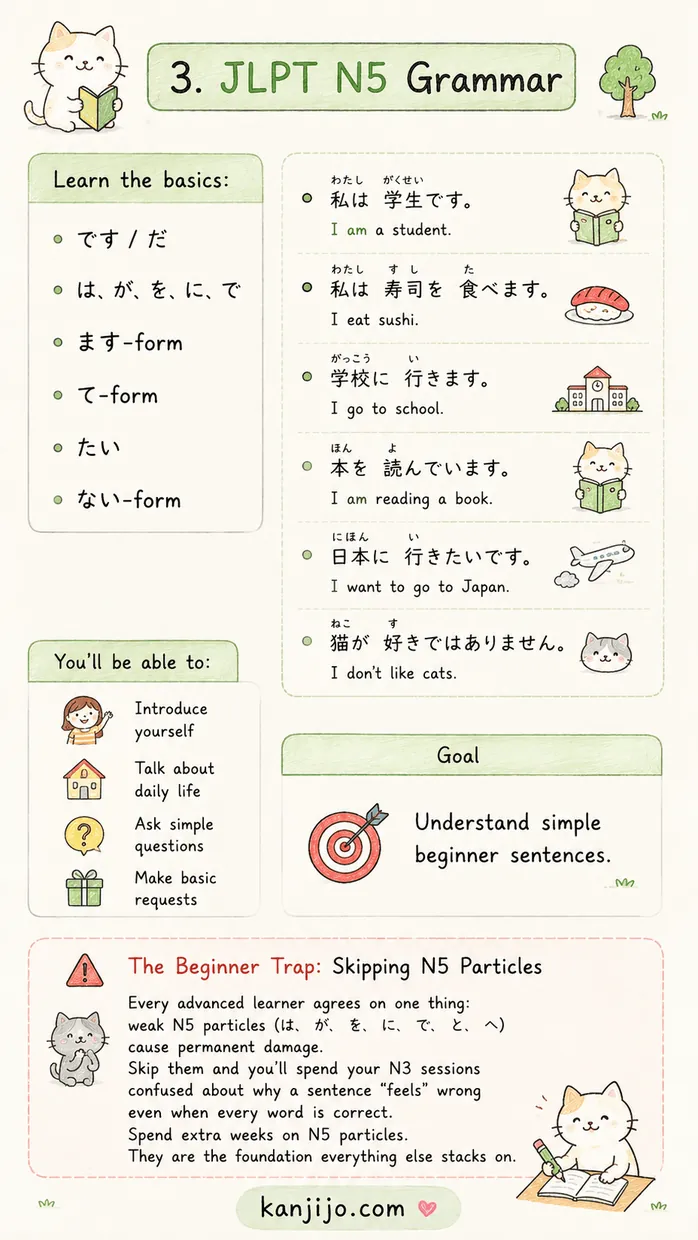
The Beginner Trap: Skipping N5 Particles
Every advanced learner agrees on one thing: weak N5 particles (は, が, を, に, で, と, へ) cause permanent damage. Skip them and you'll spend your N3 sessions confused about why a sentence "feels" wrong even when every word is correct. Spend extra weeks on N5 particles. They are the foundation everything else stacks on.
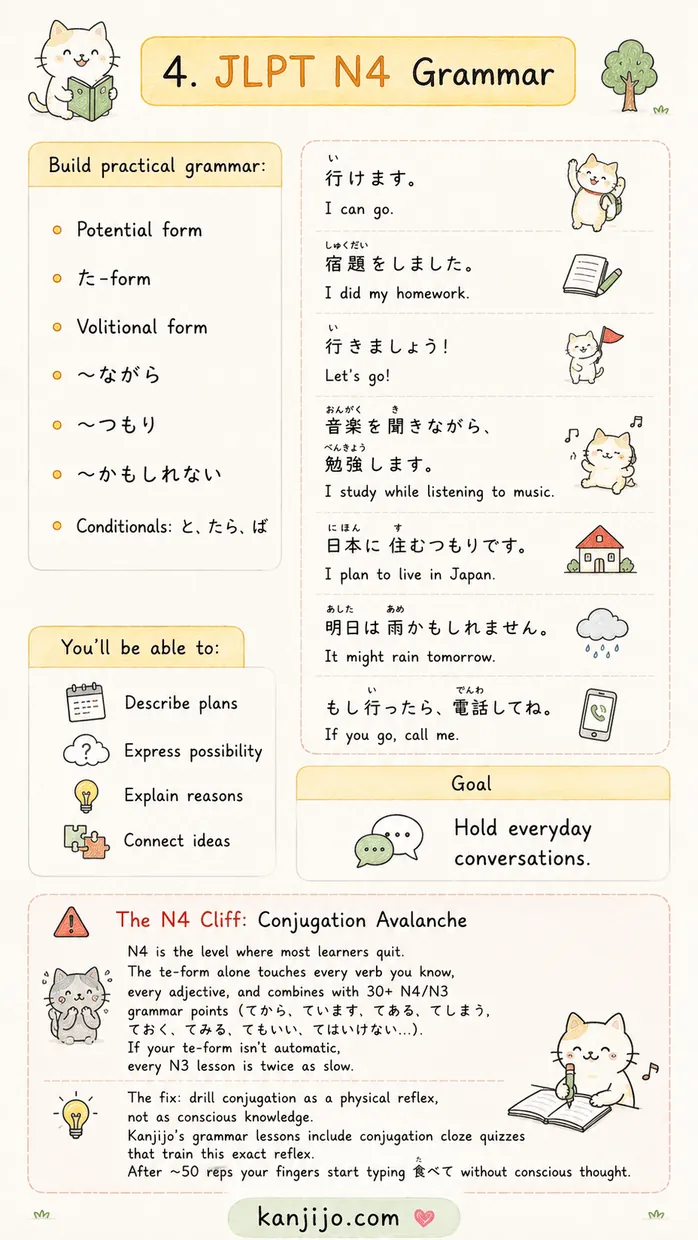
The N4 Cliff: Conjugation Avalanche
N4 is the level where most learners quit. The te-form alone touches every verb you know, every adjective, and combines with 30+ N4/N3 grammar points (てから, ています, てある, てしまう, ておく, てみる, てもいい, てはいけない…). If your te-form isn't automatic, every N3 lesson is twice as slow.
The fix: drill conjugation as a physical reflex, not as conscious knowledge. Kanjijo's grammar lessons include conjugation cloze quizzes that train this exact reflex. After ~50 reps your fingers start typing 食べて without conscious thought.
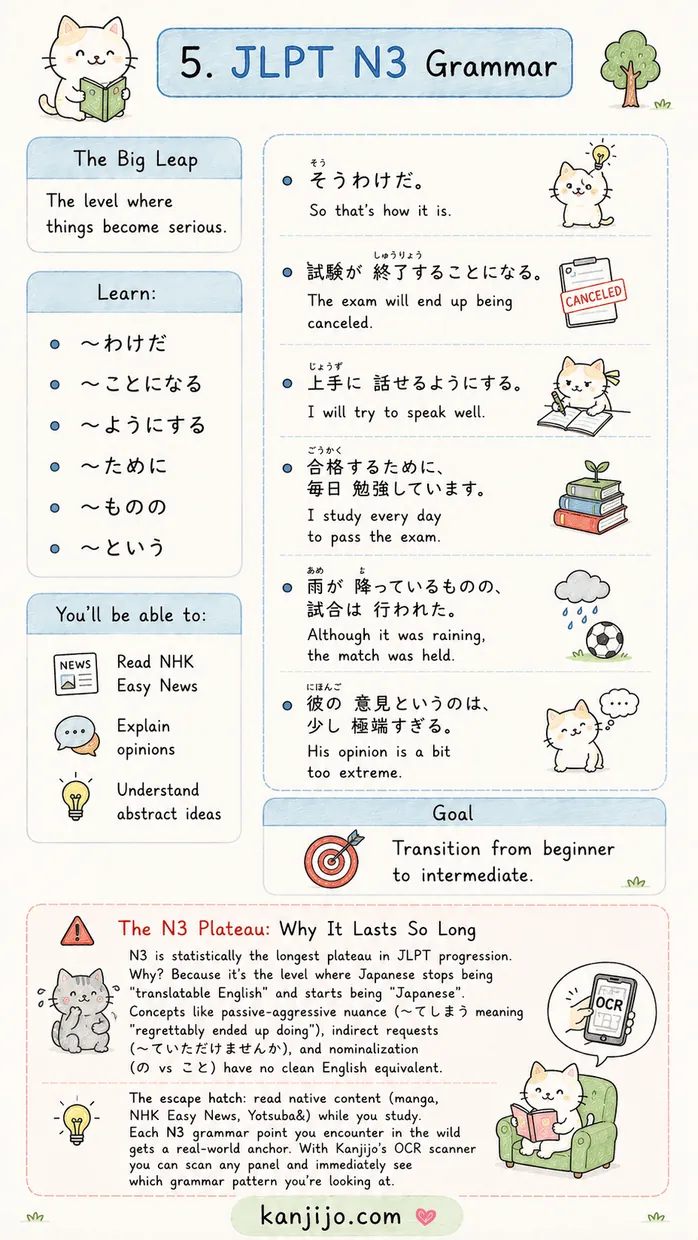
The N3 Plateau: Why It Lasts So Long
N3 is statistically the longest plateau in JLPT progression. Why? Because it's the level where Japanese stops being "translatable English" and starts being "Japanese". Concepts like passive-aggressive nuance (~てしまう meaning "regrettably ended up doing"), indirect requests (~ていただけませんか), and nominalization (の vs こと) have no clean English equivalent.
The escape hatch: read native content (manga, NHK Easy News, Yotsuba&) while you study. Each N3 grammar point you encounter in the wild gets a real-world anchor. With Kanjijo's OCR scanner you can scan any panel and immediately see which grammar pattern you're looking at.
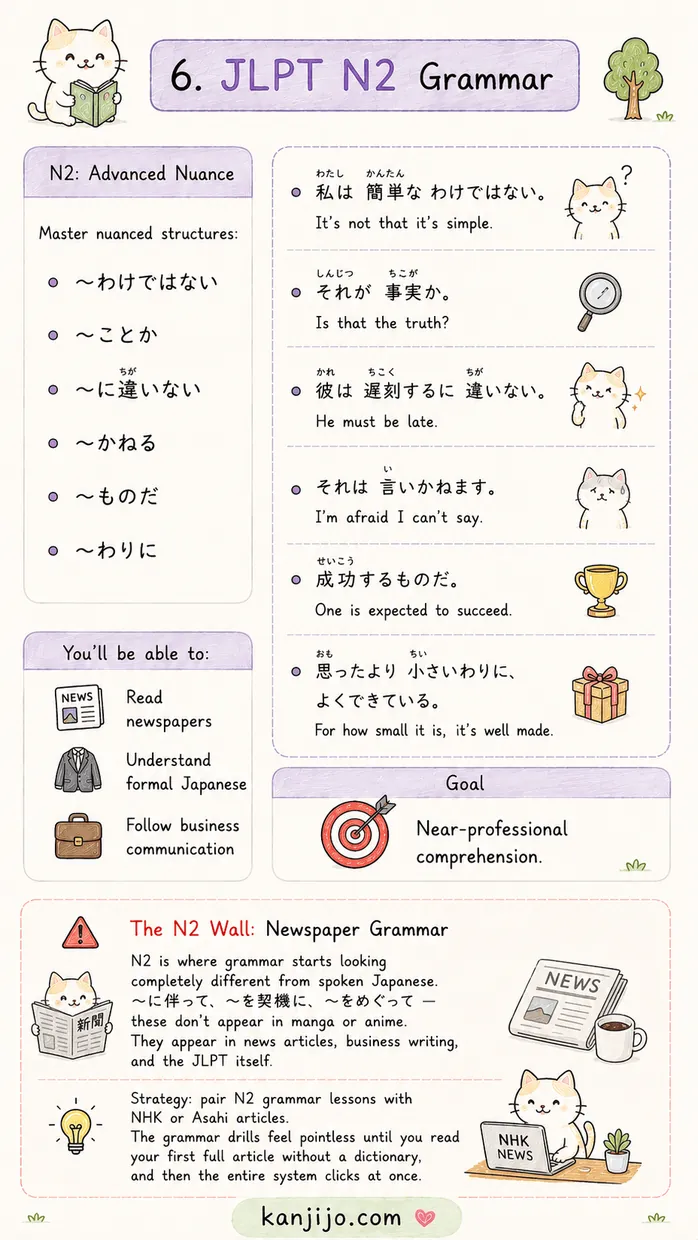
The N2 Wall: Newspaper Grammar
N2 is where grammar starts looking completely different from spoken Japanese. ~に伴って, ~を契機に, ~をめぐって - these don't appear in manga or anime. They appear in news articles, business writing, and the JLPT itself.
Strategy: pair N2 grammar lessons with NHK or Asahi articles. The grammar drills feel pointless until you read your first full article without a dictionary, and then the entire system clicks at once.
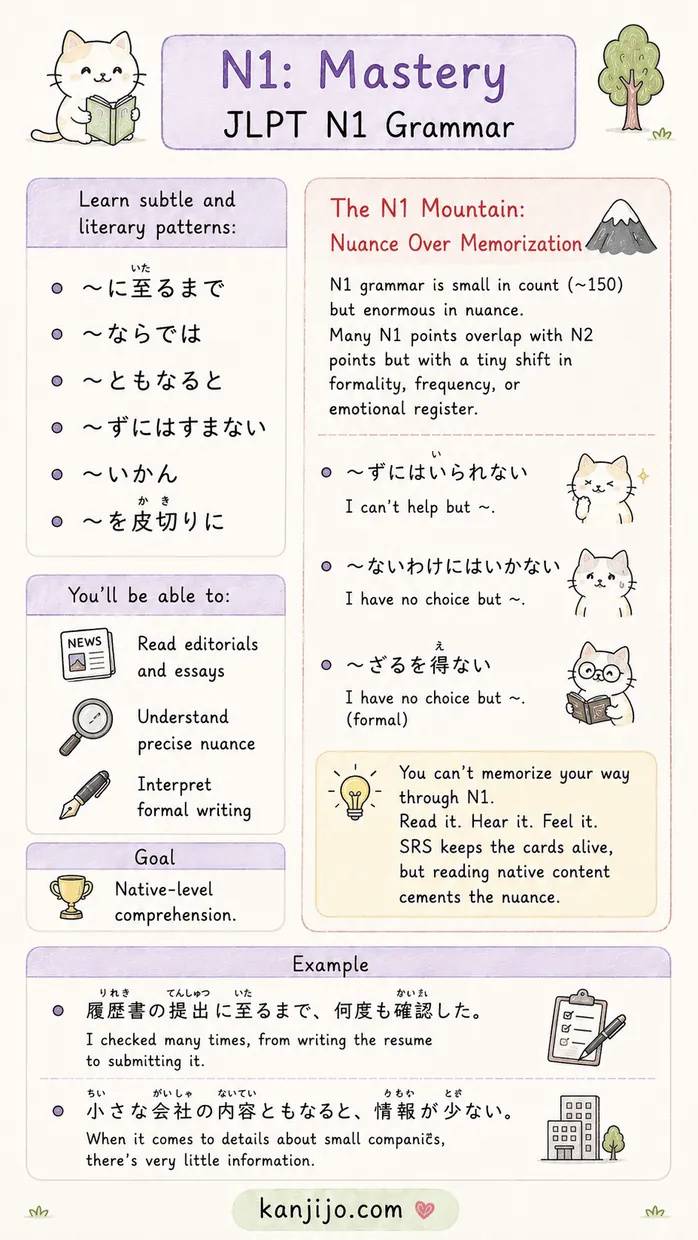
The N1 Mountain: Nuance Over Memorization
N1 grammar is small in count (~150) but enormous in nuance. Many N1 points overlap heavily with N2 points but with a tiny shift in formality, frequency, or emotional register. ~ずにはいられない vs ~ないわけにはいかない vs ~ざるを得ない all roughly mean "have to / can't help but" but differ in formality and the speaker's emotional state.
You can't memorize your way through N1. You have to read it, hear it, and feel it. SRS keeps the cards alive, but reading native content is what cements the nuance.
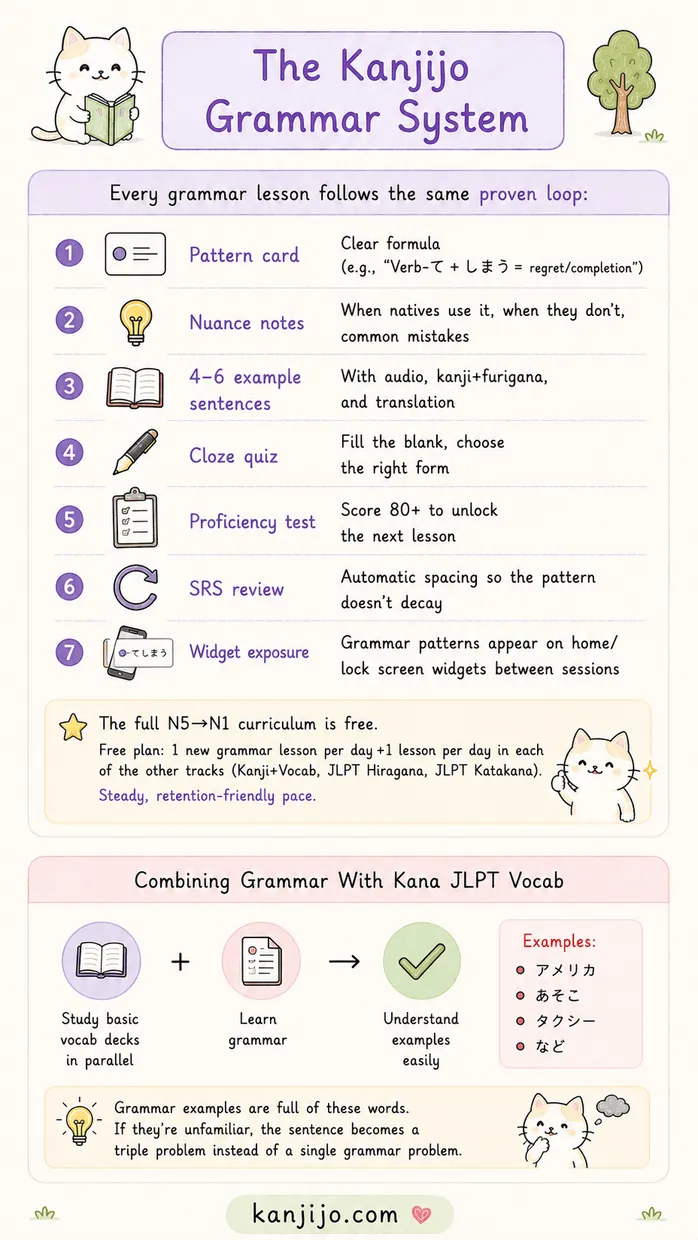
The Kanjijo Grammar System
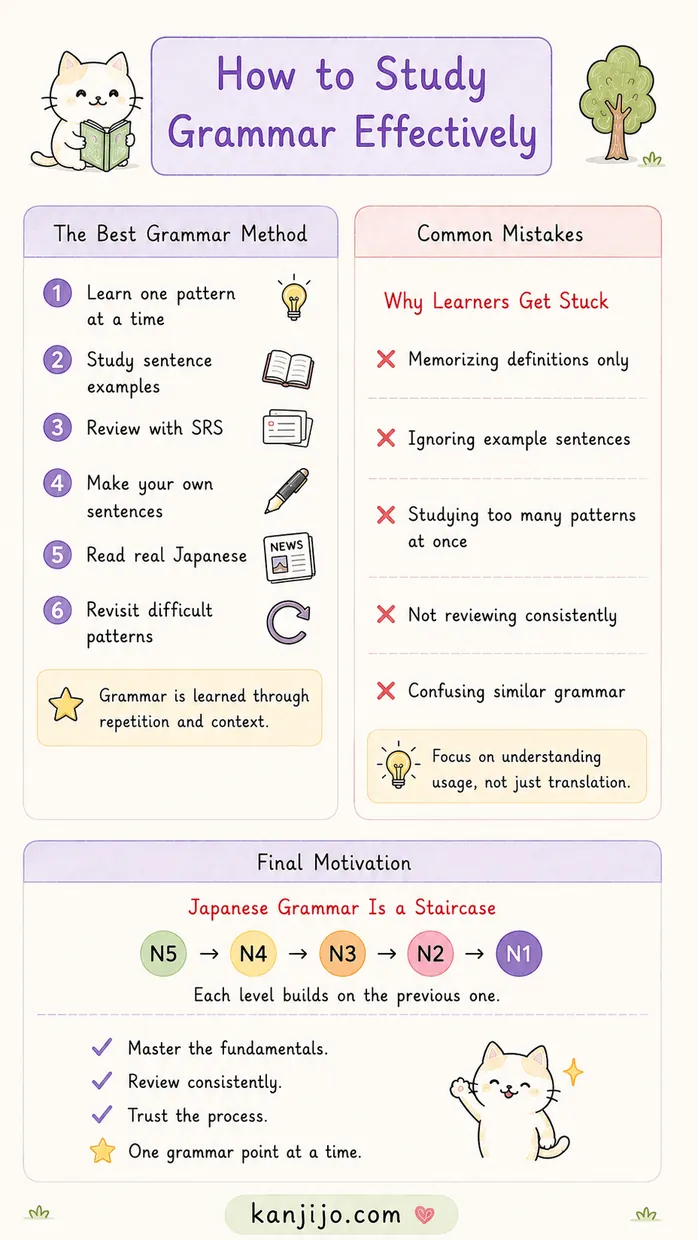
Every grammar lesson in Kanjijo follows the same proven loop:
- Pattern card - clear formula (e.g., "Verb-て + しまう = regret/completion")
- Nuance notes - when natives use it, when they don't, common mistakes
- 4–6 example sentences - with audio, kanji+furigana, and translation
- Cloze quiz - fill the blank, choose the right form
- Proficiency test - score 80+ to unlock the next lesson
- SRS review - automatic spacing so the pattern doesn't decay
- Widget exposure - grammar patterns also appear on home/lock screen widgets between sessions
The full N5→N1 curriculum is free. The free plan unlocks 1 new grammar lesson per day alongside 1 lesson per day in each of the other tracks (Kanji+Vocab, JLPT Hiragana, JLPT Katakana) - a steady, retention-friendly pace.
How To Sequence Your Study
- Weeks 1–4: N5 grammar + N5 kanji+vocab. Particles first.
- Weeks 5–10: N4 grammar + N4 kanji+vocab. Force te-form to reflex.
- Months 3–6: N3 grammar + start native reading (NHK Easy, Yotsuba&).
- Months 6–12: N2 grammar + news article practice. Use OCR to scan articles.
- Year 2: N1 grammar + serious reading (novels, editorials).
This isn't a guarantee - your speed will vary - but it's a structured path with no dead ends.
Combining Grammar With Kana JLPT Vocab
An underrated Kanjijo move: study JLPT Hiragana and Katakana vocabulary decks (アメリカ, あそこ, タクシー, など) in parallel with N5 grammar. Why? Because grammar examples are full of these words. If あそこ and タクシー are unfamiliar, the grammar example sentence becomes a triple problem instead of a single grammar problem.
Related Reading on Kanjijo
Frequently Asked Questions
Roughly 600–700 distinct grammar points across all five levels. Each level mostly extends the previous one rather than introducing entirely new structures.
Both, in this order: structured pattern → example sentence → cloze quiz → SRS review → real reading. That ordered loop is exactly how Kanjijo grammar lessons are built.
Yes. The complete N5→N1 grammar curriculum is free. The free plan unlocks 1 new grammar lesson per day, plus 1 lesson per day in each of the other three tracks (Kanji+Vocab, JLPT Hiragana, JLPT Katakana) - 4 new lessons total per day. SRS reviews of grammar are unlimited.
Ready To Tame JLPT Grammar?
Download Kanjijo and start the structured N5→N1 grammar path today - free, with cloze quizzes, audio examples, SRS reviews, and grammar widgets included.
Download Kanjijo Free