Most JLPT guides are written like a sales pitch. Buy this textbook. Take this course. Subscribe to this YouTube channel. By the time you’ve assembled the toolkit they recommend, you have 14 different apps, 6 textbooks, and 20 hours of weekly content to consume - and you haven’t learned a single kanji yet.
This guide is the opposite. One app. Five JLPT levels. A clear roadmap.
Below is the exact way to use Kanjijo to climb from N5 (absolute beginner) to N1 (near-native reading proficiency), with the features that matter at each stage and the milestones to hit before moving up.
What Kanjijo Covers (And What It Doesn’t)
Honesty first. Here’s what Kanjijo gives you across all 5 JLPT levels:
| Skill | Coverage |
|---|---|
| Hiragana | Full - 46 base + dakuten + combos |
| Katakana | Full - 46 base + dakuten + combos |
| Kanji (N5–N1) | ~2,000 characters - readings, meanings, mnemonics |
| Vocabulary (N5–N1) | ~10,000 words - by JLPT level + theme |
| Grammar (N5–N1) | ~500 patterns - explanations, examples, quizzes |
| Reading practice | Built-in via OCR scanner on real-world Japanese |
| Listening | Word/example audio (TTS) - supplement with native audio |
| Speaking | Not directly - pair with shadowing / iTalki |
For kanji + vocabulary + grammar, Kanjijo is fully self-contained. For listening and speaking, treat Kanjijo as the foundation and add native input on top.
The Kanjijo SRS Engine: Why It Matters at Every Level
Before we get to the level-by-level roadmap, the most important thing to understand: Kanjijo’s spaced repetition system runs across the entire app. Whether you’re studying N5 hiragana or N1 kanji, the same algorithm decides exactly when each item resurfaces - keeping your review load proportional to what you’ve actually learned.
This means at N5 you might review 20 cards a day. At N3 it’s 80–120. At N1 it stabilizes around 150 - never explodes the way Anki decks tend to.
JLPT N5 - The Foundation (3–6 Months)
Volume: ~100 kanji, ~800 vocabulary, ~80 grammar patterns. Plus all hiragana and katakana.
Goal: Read children’s books. Order food. Hold a basic introduction. Recognize all kana instantly.
Week-by-week plan
- Weeks 1–2: Master hiragana. Use Kanjijo’s hiragana lessons + flashcard mode + the lock screen widget set to kana. By end of week 2, you should write any hiragana word from romaji.
- Weeks 3–4: Master katakana. Same approach. Add OCR scanner usage on coffee shop menus and street signs to lock in muscle memory.
- Weeks 5–8: N5 kanji. 5 new kanji per day via Kanjijo’s SRS lessons. Use the mnemonic system on every new card.
- Weeks 9–16: N5 vocabulary, paced at 15–20 new words/day. Grammar: 1 new pattern every 2 days.
- Weeks 17–24: Buffer / consolidation. Take Kanjijo’s N5 lesson tests. Aim for 90%+ before moving up.
Features that matter at N5:
- Mnemonic system - essential for first 100 kanji
- Hiragana / katakana lessons + tests
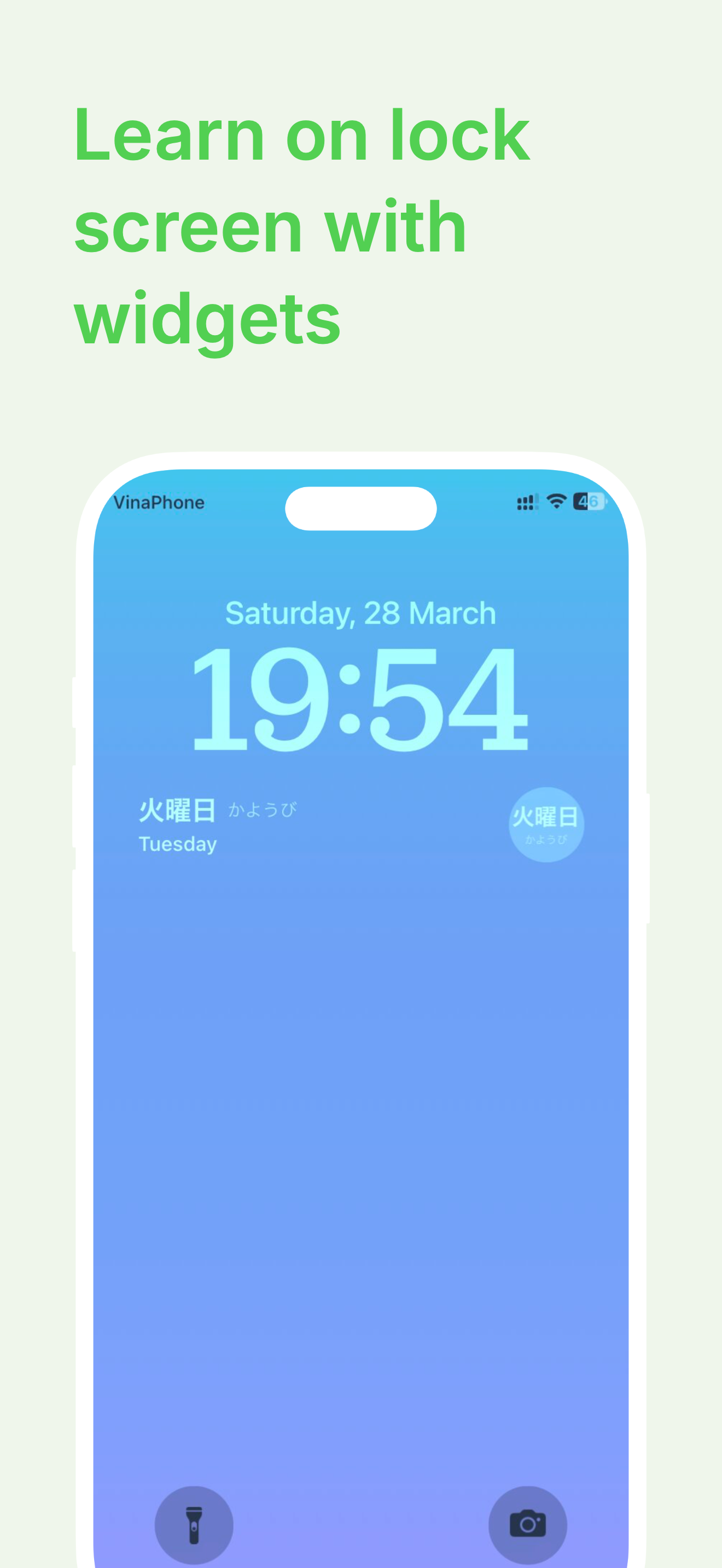
- Lock screen widget - the most efficient kana reinforcement tool
- OCR scanner for confidence-building on real Japanese
JLPT N4 - The Real Beginning (6–9 Months from Zero)
Volume: ~200 additional kanji (300 total), ~1,500 additional vocabulary, ~80 additional grammar patterns.
Goal: Read simple manga with furigana. Understand basic NHK Easy News. Have a real conversation about your day.
The N4 trap (and how Kanjijo solves it)
N4 is where most learners quit - not because it’s hard, but because the volume becomes uncomfortable. The honeymoon of hiragana is over; suddenly there are 200 new kanji and the SRS queue starts climbing.
Kanjijo’s answer: the daily lesson cap and the home screen widget. The cap prevents over-loading. The widget converts dead time into review time, so the SRS queue doesn’t pile up between sessions.
Recommended pace:
- 5 new kanji/day, paired with their primary vocabulary
- 10–15 new vocabulary words/day
- 1 new grammar pattern every 2 days
- 20–30 minutes of focused review per day, plus 100+ widget glances
Features that matter at N4:
- Daily lesson limit - protects against burnout
- Quiz widget on home screen - converts pocket time into active recall
- Grammar lesson screen with examples + mnemonic
- SRS due-only widget mode - focus on what’s actually fading
JLPT N3 - The Plateau Killer (12–18 Months from Zero)
Volume: ~370 additional kanji (~650 total), ~2,000 additional vocabulary, ~150 additional grammar patterns.
Goal: Read most signage and menus unaided. Watch slice-of-life anime with Japanese subtitles. Hold semi-abstract conversations.
N3 is the level where Japanese stops being an academic exercise and starts being a usable language. It’s also where most self-study learners stall for 6–12 months.
Why N3 plateaus happen
- Grammar patterns start overlapping in nuance (〜たら / 〜ば / 〜と / 〜なら)
- Kanji begin sharing readings (混乱, 困難, 困惑) - discrimination matters more than recognition
- Listening fluency hasn’t caught up with reading
How to use Kanjijo to break through
- Switch from kanji-meaning quizzes to kanji-in-context vocabulary. Kanjijo’s vocabulary cards always show the kanji used in real words.
- Activate the grammar quiz widget for pattern discrimination practice - multiple-choice is exactly the format JLPT will use.
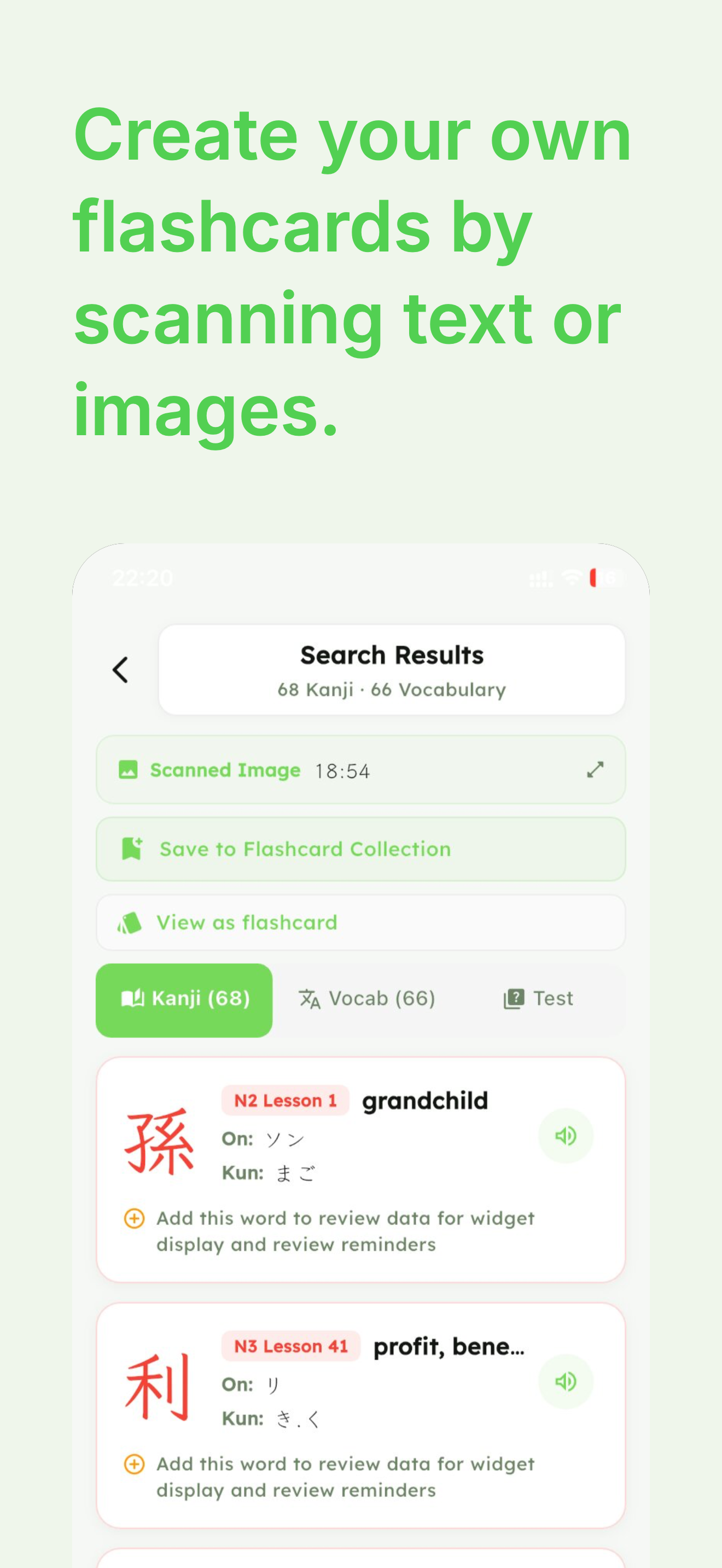
- Use OCR scanner on Japanese Twitter screenshots and online articles. This is where Kanjijo justifies the premium tier - you’ll scan something every day at N3.
- Take the JLPT N3 mock test inside Kanjijo lessons. Your score predicts the real test within ~5%.
JLPT N2 - The Reading Level (24–36 Months from Zero)
Volume: ~370 additional kanji (~1,000 total), ~3,000 additional vocabulary, ~120 additional grammar patterns.
Goal: Read most newspapers and novels with minor lookups. Understand business Japanese. Watch news without subtitles.
The N2 mindset shift
Up through N3, you were learning Japanese. From N2 onward, you’re using Japanese to learn more Japanese. The most efficient sources of new vocabulary are now native materials, with Kanjijo as the SRS backbone.
Recommended workflow:
- Daily Kanjijo lesson on N2 grammar (15 min)
- Read native content (news article, manga chapter, novel page) - 20–30 min
- Scan unknown words with Kanjijo OCR → add to favorites → SRS handles the rest
- Run through SRS due cards (15–25 min)
- Quiz widget glances throughout the day for cross-grammar discrimination
Features that matter at N2:
- OCR scanner - your primary vocabulary acquisition tool now
- Favorites system - promote scanned words into your study deck
- Grammar test mode - N2 grammar nuance is brutal; spaced testing > passive review
- Custom widget content - show only N2 cards on lock screen for level focus
JLPT N1 - The Long Road (36–60 Months from Zero)
Volume: ~1,000 additional kanji (~2,000 total - but only ~200 are common in modern usage), ~3,500 additional vocabulary, ~200 advanced grammar patterns.
Goal: Read native literature, academic papers, and legal/business documents. Understand fast natural speech. Pass JLPT N1.
N1 is qualitatively different from every level below it. The kanji are no longer about radicals - they’re about cultural literacy. The grammar patterns are often archaic or formal-only. Vocabulary is dominated by 四字熟語 (yojijukugo), 慣用句 (idioms), and obscure compound verbs.
Kanjijo at N1 is your maintenance engine
By N1, you don’t learn from one source anymore. You learn from everything - books, NHK, work, friends. Kanjijo’s job changes from teacher to memory engine:
- OCR everything you encounter - Kanjijo becomes your “personal Anki deck of life”
- Run daily SRS reviews to keep N3–N1 vocabulary fresh against atrophy
- Use Kanjijo’s N1 grammar lessons specifically for JLPT prep - 200 patterns, drilled to mastery
- Test widget for daily yojijukugo / idiom rotation
The Universal Daily Workflow (Works at Every Level)
- Morning (5 min): Quick SRS review of due cards. Quiz widget glance.
- Commute / break (10 min): Today’s lesson - kanji, vocab, or grammar.
- Throughout the day: 100+ widget glances. Tap quiz widget when you have 10 seconds.
- Evening (10 min): Finish remaining SRS due cards. Scan one piece of real Japanese with OCR.
- Before bed (2 min): Glance at lock screen one last time.
Total: 25–30 minutes of structured time + ambient passive exposure. Sustainable for years, which is exactly the timescale that matters.
How to Know You’re Ready to Move Up a Level
Don’t move to the next JLPT level just because you finished the last one’s lessons. Use these markers:
- Kanjijo level test score: 85%+ on the level’s mock test
- SRS retention: Mature card retention >90% on the current level
- Real-world signal: You can read and understand 80%+ of a randomly chosen news article at that level’s difficulty
- Speed: You can recognize current-level kanji at glance speed (under 1 second per character)
The Mistake That Wastes Years
Almost every JLPT failure comes from the same cause: skipping ahead before mastery. A learner half-finishes N4 and jumps to N3 because “the new content is more interesting”. Six months later they fail N3 and don’t understand why.
The reason is always the same: their N4 base wasn’t solid. N3 grammar patterns assume N4 patterns are automatic. N3 kanji compounds assume N4 kanji are instant. Skipping creates invisible gaps that haunt every level above.
Kanjijo’s SRS is designed to prevent this. Don’t fight it - let the app pace you.
Related Reading on Kanjijo
Frequently Asked Questions
For kanji, vocabulary, and grammar - yes. Kanjijo includes the full N5 to N1 curriculum: ~2,000 kanji, ~10,000 vocabulary words, and ~500 grammar patterns. For listening practice, you’ll want to supplement with native audio (podcasts, anime, JLPT mock tests).
With consistent daily Kanjijo use (15–30 minutes), most learners take 6–9 months for N5, 6–9 months for N4, ~12 months for N3, ~12–18 months for N2, and 18–24 months for N1. Total: 4–5 years for hobbyists, faster with immersion.
Don’t skip the lessons - but use Kanjijo’s test feature to fast-track. Pass each lesson’s test (80%+) and Kanjijo marks it complete and only adds the cards you missed to your SRS queue. This is the fastest legitimate way to skip ahead.
Free tool
Not sure which level you are? Take the free JLPT level test: 25 questions, five per level from N5 to N1, with an instant result and an explanation after every answer.
Take the free JLPT level testStart Your JLPT Journey Today
Download Kanjijo and pick your starting level. The roadmap from N5 to N1 is one app away.
Download Kanjijo Free