OCR helps Japanese learners when it is used as the first step of a study loop: scan real text, identify unknown words, save high-frequency items, review them with SRS, and re-encounter them through widgets, reading, listening, and mock JLPT practice. Scanning alone is lookup. Scanning plus review is learning.
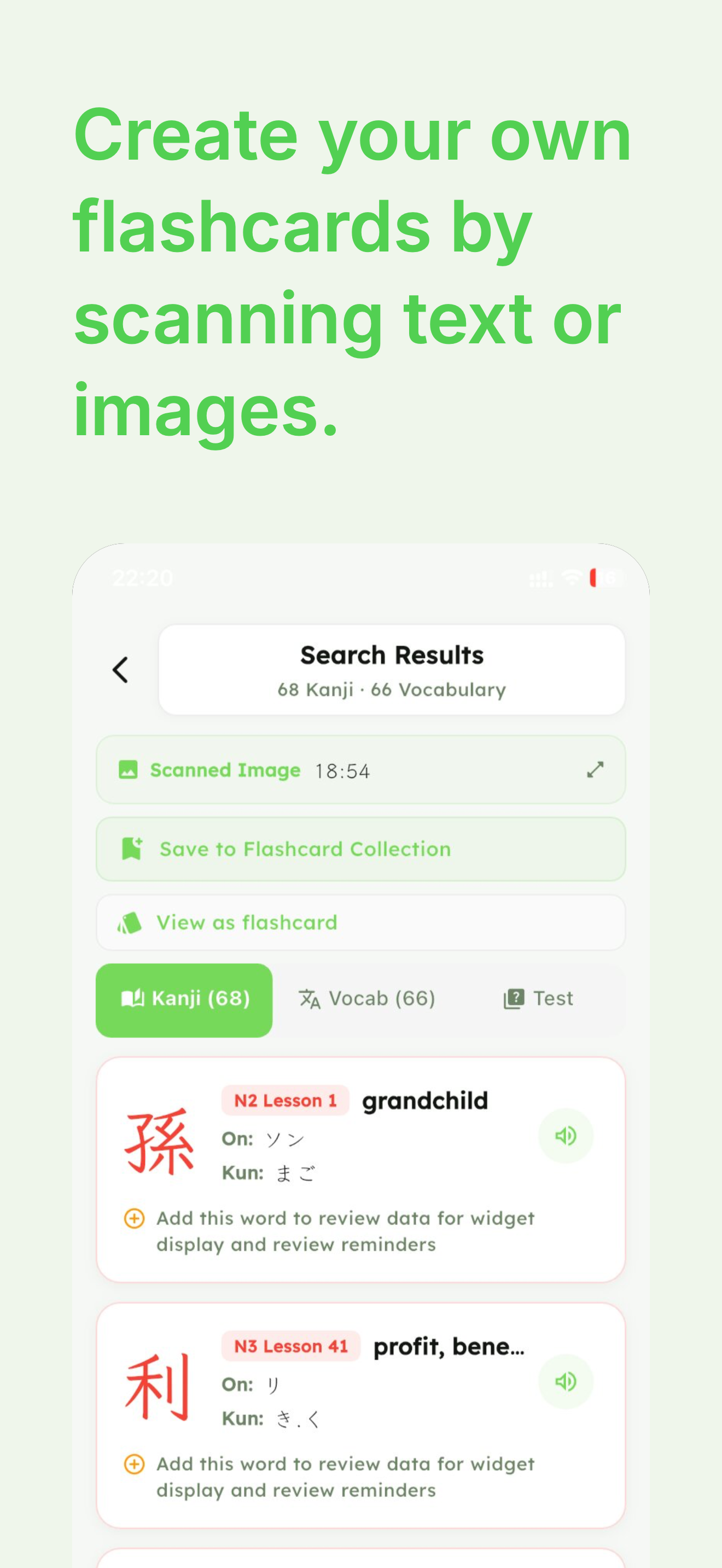
Menus, train signs, receipts, manga panels, labels, hotel notices, delivery slips: real Japanese is full of useful repetition. The problem is that learners often look up a word once, feel a small victory, then forget it by dinner. OCR solves the lookup friction. SRS solves the forgetting.
The 5-Step Real-World Study Loop
- Scan: Use OCR on one small text block, not an entire wall.
- Filter: Choose only words you are likely to see again.
- Understand: Check reading, meaning, and sentence role.
- Save: Put the item into review with context.
- Re-encounter: Review through SRS and widgets until it becomes familiar.
Start With Menus
Menus repeat a small set of extremely useful kanji:
| Kanji | Reading | Meaning | Example |
|---|---|---|---|
| 焼 | やき | grilled | 焼き鳥 (やきとり) grilled chicken skewers |
| 揚 | あげ | fried | 唐揚げ (からあげ) fried chicken |
| 定食 | ていしょく | set meal | 魚定食 (さかなていしょく) |
| 大盛り | おおもり | large serving | ご飯大盛り (ごはんおおもり) |
| 税込 | ぜいこみ | tax included | 税込価格 (ぜいこみかかく) |
Once these are in SRS, restaurants become easier every week. You stop scanning the same word as if it were new.
Then Scan Signs
Signs teach verbs and warning language that textbooks delay:
- 立入禁止 (たちいりきんし) = no entry
- 使用中 (しようちゅう) = in use
- 工事中 (こうじちゅう) = under construction
- 非常口 (ひじょうぐち) = emergency exit
- 受付 (うけつけ) = reception
Notice the pattern 中 (ちゅう) meaning in the middle of. One sign teaches a kanji pattern you can reuse across dozens of words.
Receipts Are Vocabulary Gold
Receipts look boring, but they repeat commerce words constantly:
合計 ごうけい = total
小計 しょうけい = subtotal
割引 わりびき = discount
お預り おあずかり = amount received
お釣り おつり = change
These words appear in shops, apps, ticket machines, forms, and customer-service interactions. Real-world frequency makes them perfect SRS candidates.
What Not to Save
Do not save everything. Save useful repetition.
- Save words you saw twice in one week.
- Save kanji that appear across multiple signs.
- Save practical phrases you can use.
- Skip brand names, one-off product codes, and rare proper nouns.
How Kanjijo Makes OCR Stick
Kanjijo is designed for the loop after the scan. The OCR scanner helps you inspect Japanese text quickly. Kanji and vocabulary mnemonics make the first memory hook. SRS schedules review before forgetting. Home screen and lock screen widgets create passive re-encounter. Reading and listening tracks show the same words in controlled context. Mock JLPT practice checks whether recognition survives pressure.
Frequently Asked Questions
No. OCR is a lookup tool. It becomes learning when you review the scanned words and try to recognize them later without help.
Beginners can scan manga, but menus, signs, and labels usually give faster practical returns because vocabulary repeats more predictably.
Five to ten useful words is enough. Too many new cards can overload your SRS queue.