Key facts
- Dictation: 100 lessons, 20 per level from N5 to N1, with 914 sentences from 55 YouTube channels. Free users get the first three lessons of each level and can start one new dictation lesson a day.
- What it is: Kanjijo: Learn Japanese JLPT on the App Store, a Japanese learning app for the JLPT from N5 to N1.
- Devices: iPhone and iPad with iOS 16 or later; the widgets need iOS 17 or later. There is no Android version at the moment.
- Price: Free to download. Premium is $5.99 a month, $39.99 a year or $149.99 once on the US App Store (prices vary by country), and one Premium account also unlocks Hanzijo and Hanguljo.
- Free plan: Free users get one new lesson a day in each lesson track, daily reviews, the widgets, the first two mock tests of each level and the first three reading and listening lessons of each level.
- Content: 2,480 kanji, 9,020 words, 476 grammar points, 324 lessons, 95 reading and 95 listening lessons, 264 conversations, 100 dictation lessons and 40 mock tests, JLPT N5 to N1.
Facts checked on (app version 4.0.10).
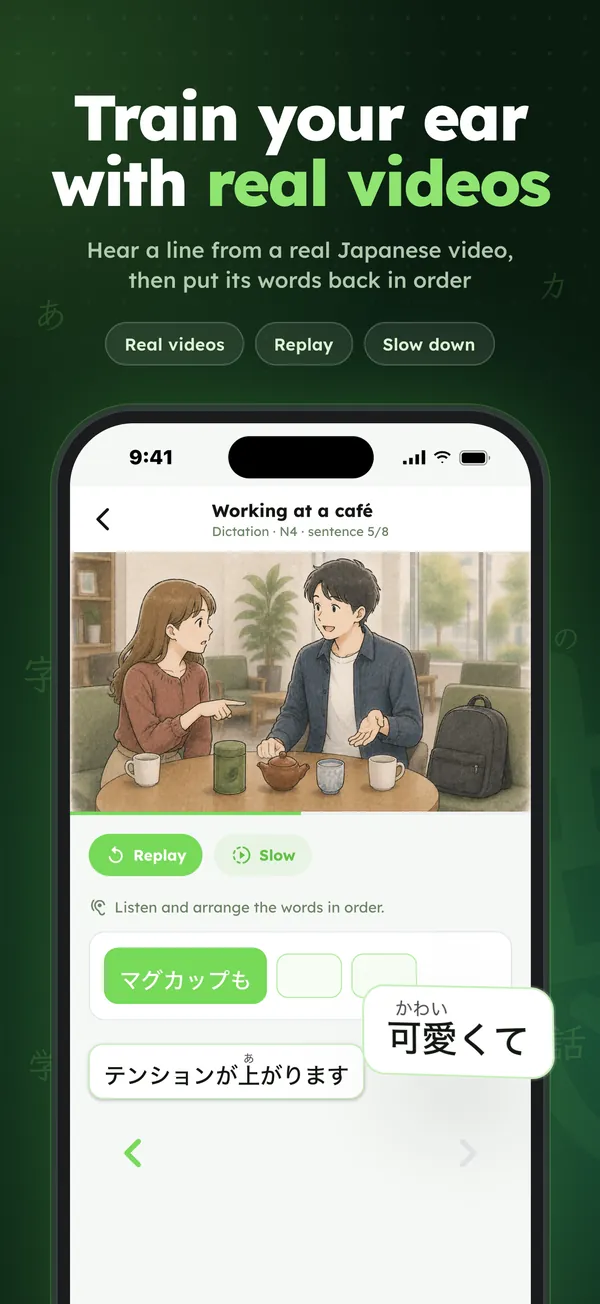
How one sentence works
Open a lesson and Kanjijo plays a single sentence cut from the video, about 6 seconds on average. Below the player, the words of that sentence wait in a shuffled bank. Tap them into the empty slots in the order you heard them, then check. If the order is wrong, the app asks you to rearrange the words and try again; if it is right, the whole sentence appears with furigana you can show or hide, its romaji and an English translation, and the next sentence is ready.
Replay and slow down as often as you need
Two buttons sit under the video. Replay starts the same sentence again from its first word. Slow drops the speed to 0.75x, which keeps the voice natural but leaves a little more space between words. Neither button costs you anything, so the useful habit is to listen at full speed first and to slow down only for the part you still cannot hear.
Real videos, not studio recordings
The sound is the original audio of each video: everyday clips, podcasts, folk tales told aloud, documentaries, talks, interviews and readings of literature. The clips play through YouTube’s own embedded player inside the app, so the videos stay on their channels; Kanjijo adds the sentence timing, the word cards and the translations. If a video is taken down, its lesson says that the video is unavailable.
Twenty lessons for every level
Each JLPT level has twenty lessons. At N5 and N4 the sentences are short and a lesson holds 8 to 12 of them; from N3 up the sentences grow longer and denser, and a lesson holds 5 to 8. The table below gives the number of lessons and sentences for each level, the sentences per lesson and the average length of a sentence.
Is it really dictation?
In a classic dictation you write down every word you hear. Kanjijo’s version is listen and rebuild: the words are given as cards, and your task is to hear the order and the boundaries between them. That keeps the practice on listening rather than on typing kana or recalling how each kanji is written, and it fits into a few minutes on a phone.
The trade-off should be said plainly. Rebuilding with cards does not test spelling, and now and then the grammar alone gives the order away. To make the exercise harder, play the sentence and say it back aloud before you touch the cards, or write it on paper first and use the app to check what you wrote.
How it connects to the JLPT listening section
The JLPT tests listening as a section of its own, from 30 minutes at N5 to 55 minutes at N1. Every level has task-based questions, questions on key points and quick-response questions; N3 and above add questions on the general outline of a talk, and N2 and N1 add integrated comprehension. None of these is a dictation task, but all of them depend on the same skill: cutting a stream of speech into words quickly enough to follow its meaning.
Dictation trains that skill directly. For the exam formats themselves, Kanjijo has 95 listening lessons written in the JLPT question styles and 40 mock tests, eight per level, each with the time limit of the real exam and a pass mark for each section, so you can see whether the work shows up under test conditions.
Choosing a lesson
Pick lessons at the level you are studying, not the level you hope to reach. A lesson where you understand most words but miss how they run together is the right difficulty; a lesson where every second word is new turns into vocabulary study. The lower levels lean on daily life, picture-book stories and simple podcasts, while N2 and N1 move to talks, interviews, documentaries and classic literature read aloud, which is close to the range of voices the higher JLPT levels expect.
What each level contains
Counted from the lesson data of the current app version. The average sentence is the mean length of the audio clip for one sentence.
| Level | Lessons | Sentences | Per lesson | Average sentence | Channels |
|---|---|---|---|---|---|
| N5 | 20 | 225 | 8–12 | 5.5 s | 11 |
| N4 | 20 | 222 | 8–12 | 5.4 s | 14 |
| N3 | 20 | 150 | 5–8 | 6.6 s | 15 |
| N2 | 20 | 158 | 7–8 | 6.3 s | 15 |
| N1 | 20 | 159 | 7–8 | 7.2 s | 15 |
| All | 100 | 914 | 5–12 | 6.1 s | 55 |
A dictation session, step by step
- Open the level you are studying and choose a lesson whose topic interests you.
- Play each sentence once at full speed and build it from the word cards.
- If it is wrong, replay first; use Slow only for the part you still cannot hear.
- When a sentence is solved, hide the furigana and read it aloud once.
Good to know
- Kanjijo runs on iPhone and iPad with iOS 16 or later; there is no Android version at the moment.
- Free users get the first three dictation lessons of each level and can start one new dictation lesson a day; Premium opens all 100.
- The videos stream from YouTube, so the lessons need an internet connection.
- You rebuild sentences from word cards rather than typing them, so spelling and kanji writing are not tested.
Frequently asked questions
Is there an app for Japanese dictation practice?
Yes. Kanjijo has 100 dictation lessons with 914 sentences from real Japanese videos, 20 lessons for each JLPT level from N5 to N1, with replay and 0.75x slow playback.
Where do the dictation videos come from?
From 55 Japanese YouTube channels: everyday videos, podcasts, folk tales, documentaries, talks and readings. They play through YouTube’s embedded player inside the app, with their original audio.
Can I slow the audio down?
Yes. The Slow button plays the sentence at 0.75x speed, and Replay repeats it as often as you need.
Is the dictation free?
The first three lessons of each level are free, and free users can start one new dictation lesson a day. Kanjijo Premium opens all 100 lessons.
Does dictation help with the JLPT?
It trains the skill every listening question depends on: hearing where words start and end at natural speed. For the exam format itself, Kanjijo also has 95 listening lessons and 40 mock tests.
Sources
- Composition of Test Sections and Items, JLPT official site: listening times and question types by level
- N1-N5: Summary of Linguistic Competence Required for Each Level, JLPT official site
- YouTube IFrame Player API reference, Google for Developers: the embedded player the lessons play in
Try Kanjijo free
Free to download on iPhone. One Premium account unlocks Kanjijo, Hanzijo and Hanguljo.
Download on theApp Store On a computer?Scan with your iPhone